
präsentiert von

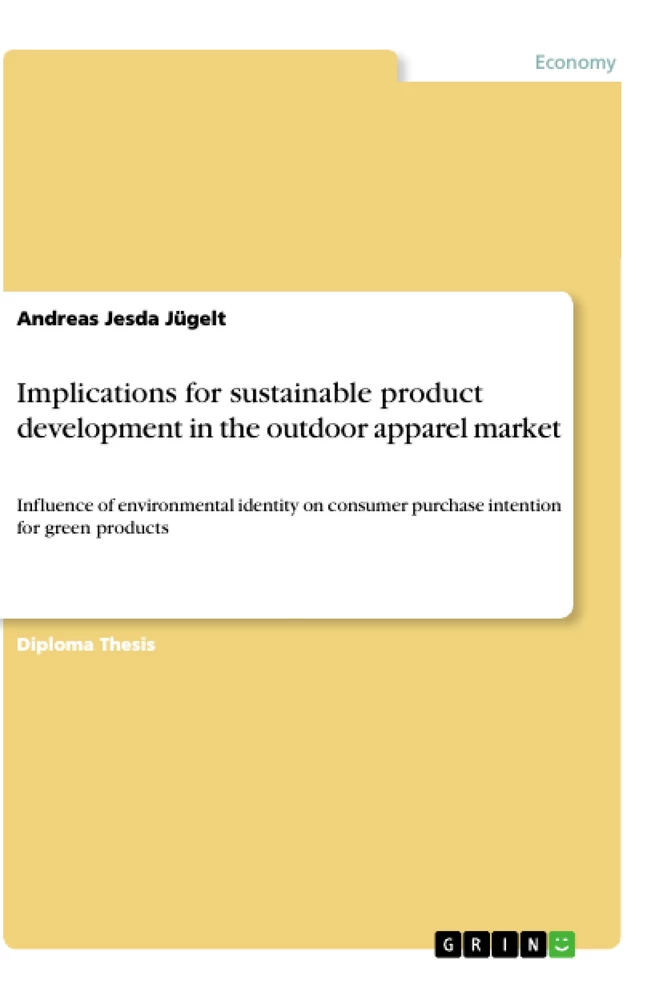
Table of Contents
1 Introduction
1.1 Motivation of the thesis
1.2 Objectives of the thesis
2 Theoretical background and definitions
2.1 Approaches to profile and understand environmentally friendly consumers
2.1.1 Rational and sociological explanations for sustainable consumer behavior
2.1.2 Environmental attitudes and ethical obligation as psychological explanations for sustainable purchase intentions
2.1.3 Motivational complexity of sustainable consumer behavior
2.1.4 Issues with identifying the green consumer by demographic criteria
2.2 Environmental identity as motivational basis for sustainable consumer behavior
2.2.1 The Biophilia Hypothesis
2.2.2 Environmental identity as source of green consumerism
2.3 Sustainability marketing and product development options for eco-friendly clothing
2.3.1 Definition and goals of sustainability marketing
2.3.2 Market Situation and characteristic consumer behavior in the green apparel business
2.3.3 Prospects and challenges for product development of sustainable clothing
3 Research framework for the purchasing behavior of environmentally friendly clothing
3.1 The modified Theory of Planned Behavior
3.1.1 The original TPB framework by Ajzen and Fishbein
3.1.2 Modification of the TPB model: the addition of self-identity and ethical obligation
3.2 Hypothesis development for the modified TPB framework
3.2.1 Adding a new self-identity measure: the Environmental Identity Scale
3.2.2 Conjoint analysis as indirect measure of purchase intention for green product attributes
3.2.3 Developing a psychographic profile of consumer groups preferring specific green product attributes
3.2.4 Classification of environmental identity within the framework
4 Empirical Research
4.1 Methodology of quantitative research
4.1.1 Structure of the questionnaire and operationalization of the variables
4.1.2 Composition of the sample
4.2 Results of quantitative research
4.2.1 Preliminary analyses
4.2.2 Psychological influences on specific green product attribute preferences
4.2.3 Classification of environmental identity within the model
4.3 Discussion of the results
4.3.1 Critical reflection of quantitative research
4.3.2 Analytical review on the effects of adding environmental identity
4.3.3 Psychographic profile of consumers favoring green products
5 Conclusion
Objectives & Research Topics
The primary goal of this research is to develop a comprehensive psychographic profile of green consumers within the functional outdoor apparel market to inform sustainable product development and marketing strategies. By integrating Environmental Identity (EID) into the Theory of Planned Behavior (TPB), the study addresses the gap in understanding how psychological nature-relatedness influences purchasing intentions, testing whether such identity acts as a direct predictor or as a mediator through established cognitive variables.
- The influence of environmental identity on purchase intentions for green products.
- The identification of psychographic clusters preferring specific unique sustainable selling propositions.
- The effectiveness of applying adaptive conjoint analysis to measure consumer preferences in realistic trade-off scenarios.
- The role of intrinsic versus extrinsic motivation factors in shaping sustainable consumption.
- The limitations of demographic criteria in predicting environmentally conscious behavior.
Auszug aus dem Buch
2.3.3 Prospects and challenges for product development of sustainable clothing
In 2007, the international market for sustainable apparel represented about $3 billion in international retail sales. This is still just a fraction of less than one percent in the $450 billion global apparel market, but green clothing is on the rise and expected to reach up to $11 billion by 2012 (Lipson 2008). Dominating the market, organic fiber products resemble over two-thirds of the overall market share while recycled fibers (polyester fleeces) represented 6.6% only. But how can companies successfully tap into this emerging market? Which is the better product development strategy and which communication efforts make the most sense regarding the immense complexity of green consumer decision-making processes?
“A truly green product does not exist” and for the natural environment the best consumer decision it not to consume at all to cause less harm (Charter 1992, p. 169). But obviously this viewpoint is not very compatible with classical marketing strategies for the mass market and green products struggle to “move beyond the niche” (Peattie 2001, p. 143). And the creation of added value is usually closely linked to higher production costs that limit the margin for suppliers, producers, and retailers and ultimately result in higher prices for the consumer (Meyer 2001). A polarization effect has been emerging in several markets over the past decades because the middle segment eroded, while the lower price points and the high performance segment were becoming increasingly important (Ertel et al. 2008, p. 125).
Summary of Chapters
1 Introduction: Provides the context of environmental issues in business, establishes the research focus on green consumerism in the outdoor apparel industry, and defines the primary objectives.
2 Theoretical background and definitions: Explores rational, sociological, and psychological explanations for sustainable behavior, introducing Environmental Identity (EID) as a key motivational factor.
3 Research framework for the purchasing behavior of environmentally friendly clothing: Details the modified Theory of Planned Behavior (TPB) and develops specific hypotheses concerning EID and consumer preferences.
4 Empirical Research: Describes the quantitative survey methodology, presents findings regarding cluster membership, and discusses the psychographic profile of green consumers.
5 Conclusion: Synthesizes the results, highlights the theoretical contribution of EID to the TPB model, and provides managerial implications for marketing sustainable apparel.
Keywords
Green Consumerism, Environmental Identity, Sustainability Marketing, Theory of Planned Behavior, Outdoor Apparel, Psychographic Profile, Recycled Material, Eco-label, Sustainable Product Development, Consumer Purchase Intention, Nature-relatedness, Market Segmentation, Conjoint Analysis, Ethical Obligation, Consumer Sophistication
Frequently Asked Questions
What is the core focus of this thesis?
The research examines the influence of "environmental identity"—a person's emotional relatedness to nature—on the consumer purchase intention for environmentally friendly products, specifically in the outdoor apparel market.
What are the primary themes investigated?
Key themes include the motivational complexity of sustainable consumption, the role of self-identity in decision-making, the efficacy of different sustainable selling propositions (like recycled materials vs. third-party eco-labels), and the psychological drivers behind green purchasing behavior.
What is the main research question?
The research asks: What influence does environmental identity (EID) have on consumer purchase intentions for green products, and how can this be modeled within a psychological framework?
Which scientific methodology is utilized?
The study utilizes a mixed-methods approach: qualitative elicitation interviews to identify salient beliefs, and a quantitative online survey analyzed via multinomial logistic regression and adaptive conjoint analysis to test hypotheses.
What topics are covered in the main section?
The main sections cover the theoretical background (rational and psychological theories), the modification of the Theory of Planned Behavior (TPB) to include self-identity variables, and an empirical analysis involving consumer clustering based on conjoint utility values.
Which keywords characterize this research?
The research is characterized by terms such as Environmental Identity, Sustainability Marketing, Green Consumerism, Theory of Planned Behavior, and Psychographic Profiling.
How does the use of "environmental identity" improve upon previous research?
Unlike simpler green consumer identity scales, the EID scale provides a multi-dimensional view of nature-relatedness. The study shows it has higher predictive power for specific green product preferences than standard single-item self-identity measures.
What is the managerial significance of the findings?
The findings suggest that marketers should focus on the female segment for initial green product adoption, use labels as "demonstrative" branding to provide social recognition, and that communication efforts must prioritize consumer education to improve "consumer sophistication."
Ende der Leseprobe aus 170 Seiten
- nach oben
- Arbeit zitieren
- Andreas Jesda Jügelt (Autor:in), 2010, Implications for sustainable product development in the outdoor apparel market, München, Page::Imprint:: GRINVerlagOHG, https://www.diplomarbeiten24.de/document/1006259

neugierig - aktuell - relevant
Entdecken Sie hilfreiche Tipps und Tricks rund ums Studium!

Entdecken Sie hilfreiche Tipps und Tricks rund ums Studium!
Ihre Hausarbeit / Abschlussarbeit:

- - Publikation als E-Book und Buch
- - Hohes Honorar auf die Verkäufe
- - Für Sie komplett kostenlos - mit ISBN
- - Es dauert nur 5 Minuten
- - Jede Arbeit findet Leser

- © GRIN Publishing GmbH.
- Alle Inhalte urheberrechtlich geschützt. Kopieren und verbreiten untersagt.
- info@grin.com
- AGB
- Open Publishing
Der GRIN Verlag hat sich seit 1998 auf die Veröffentlichung akademischer eBooks und Bücher spezialisiert. Der GRIN Verlag steht damit als erstes Unternehmen für User Generated Quality Content. Die Verlagsseiten GRIN.com, Hausarbeiten.de und Diplomarbeiten24 bieten für Hochschullehrer, Absolventen und Studenten die ideale Plattform, wissenschaftliche Texte wie Hausarbeiten, Referate, Bachelorarbeiten, Masterarbeiten, Diplomarbeiten, Dissertationen und wissenschaftliche Aufsätze einem breiten Publikum zu präsentieren.
Kostenfreie Veröffentlichung: Hausarbeit, Bachelorarbeit, Diplomarbeit, Dissertation, Masterarbeit, Interpretation oder Referat jetzt veröffentlichen!
Folgen Sie GRIN auf


- GRIN Verlag GmbH
-
- Nymphenburger Str. 86
- 80636
- Munich, Deutschland
- +49 89-550559-0
- +49 89-550559-10
- info@grin.com
-
