
präsentiert von

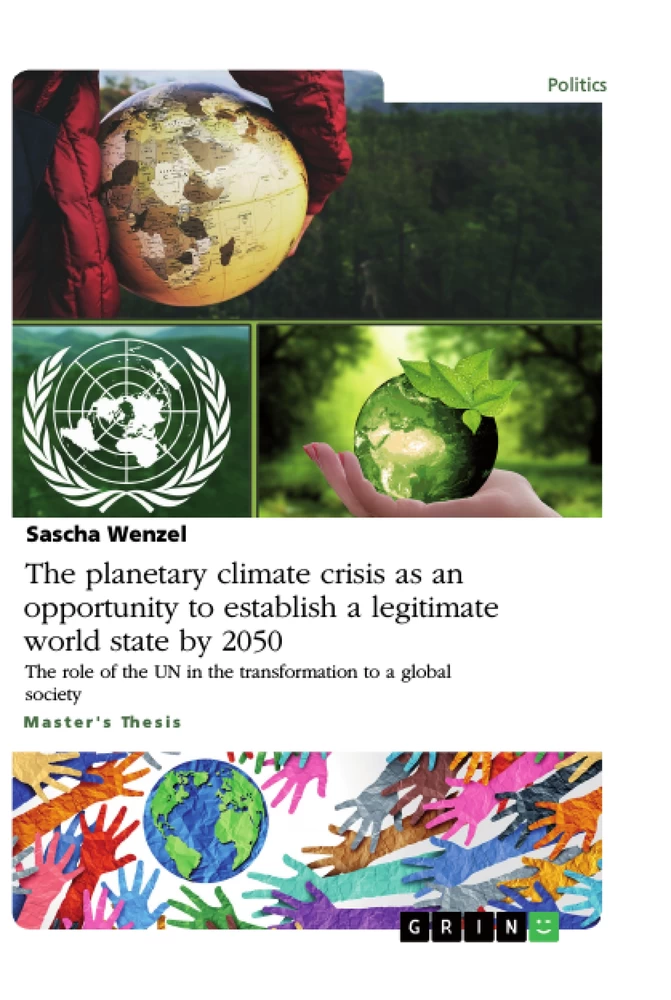
Table of Contents
1. introduction
2. The climate crisis and the importance of actors
2.1 Considerations for saving biodiversity
2.2 Proposed solutions for the preservation of humanity
2.3 National actors as supporters to mitigate the global climate crisis
3. The role of civil society in transformation
3.1 Influence of civil society in the international structure
3.2 The leading role of civil society in the policy-making process
4. The future of the UN
4.1 Projects for the reform of the UN
4.2 The sustainability goals and their implementation problems
4.3 The IMF in its function as a potential guardian of a global currency
4.4 World domestic policy as a framework for global action
4.5 The transformation to a global society
4.5 Democracy and the difficulties of further development
4.6 Visions for a World Parliament and a World State
5. A new solidarity community
5.1 Global ethics as a common framework for the global community
5.2 The role of world religions with regard to transformation
5.3 Considerations for the design of a new policy
6. Global governance in focus
6.1 Aspirations of appropriate governance
6.2 Leadership of a global society in the 21st century
6.3 Global governance as a solution to world politics
7. Four strategic scenarios for the future of a world state by 2050
7.1 Scenario 1: The retreat into individual statehood
7.2 Scenario 2: An alternative to the world state
7.3 Scenario 3: Between the worlds
7.4 Scenario 4: The future has begun
8. Conclusion and outlook until 2050
Research Objective and Core Themes
This thesis examines the possibility of transforming the United Nations into a representative and effective global governing body to address the planetary climate crisis and establish a legitimate world state by 2050, focusing on the essential roles of civil society, global ethics, and reformed international cooperation.
- The intersection of the climate crisis and the necessity for global governance.
- The transformative potential and influence of civil society and NGOs.
- Proposals and structural obstacles regarding the reform of the United Nations.
- The development of a global ethic as a foundation for a unified world society.
- Strategic futurological scenarios for the transition toward a world state.
Excerpt from the Book
1. introduction
The future of biodiversity and humanity is uncertain. On the one hand, humans need the world to live, on the other hand, they attack it until soon there will be nothing left to ensure their survival. The human species has become its own danger. Although it is aware that without a joint global effort it will no longer be able to control the problems of the climate crisis and the pollution of public goods such as water and air in the coming years, governments continue to persist in their own hermetically sealed spheres. For centuries, there have been discussions about whether it would not be better to act as a world community with a world state at its head in order to unite societies with their many differences.
Thomas Hobbes (1588-1679), an english mathematician and philosopher, took the archaic state of man as the basis for discussion for achieving a permanent absence of war. This state must be managed in an interstate model to contain the negative aspects of human behavior. Hobbes conceived of a state of nature in which man's animal nature, based on competitive behavior, distrust, selfishness, and the absence of a general force through law, must be restrained (cf. Leinen/Bummel 2017: 15).
The legal philosopher Immanuel Kant (1724-1804) pointed out that it would be better to leave the state of nature behind and create an order of public justice. He thus placed all his hopes in a valid legal peace and declared this to be the highest political good for all peoples. At the same time, the state of nature is for him a state of makeshift and unsecured law in which peace has no validity. Thus, his vision of the human state included the utopian dimension of secure membership in a world republic. But he was aware of national sovereignty and combined the concept of a world republic with the idea of federalism, since, in his view, no state has the right to enter into a world state with other states and to establish coercive world laws. Eternal peace is to be achieved through a world-public state of law in order to restrain man in his semi-archaic activity (cf. Werkner/Ebeling 2017: 485-490).
Summary of Chapters
1. introduction: Defines the existential threats to humanity and the environment and introduces the necessity of moving toward a world state to address global crises.
2. The climate crisis and the importance of actors: Analyzes the failures of nation-states to protect public goods and explores proposed solutions for a social-ecological transformation.
3. The role of civil society in transformation: Explains the essential, growing influence of NGOs and civil society in international negotiation processes and global governance.
4. The future of the UN: Evaluates the possibilities for UN reform, the implementation of sustainable development goals, and visions for a world parliament and world state.
5. A new solidarity community: Explores the role of global ethics and world religions in forming a unified, peaceful global society.
6. Global governance in focus: Discusses the necessity of evolving global governance models to move beyond intergovernmental limitations toward effective leadership.
7. Four strategic scenarios for the future of a world state by 2050: Presents four distinct, researched scenarios ranging from a retreat into isolationism to an AI-managed future.
8. Conclusion and outlook until 2050: Summarizes the necessity of proactive political action and civil society pressure to secure a sustainable future for the world community.
Keywords
United Nations, Climate Crisis, World State, Civil Society, Global Governance, Sustainability, Biodiversity, World Parliament, Global Ethics, Multilateralism, Futurology, Social Transformation, International Relations, Global Identity, 2050 Agenda.
Frequently Asked Questions
What is the core issue addressed in this work?
The thesis addresses the inability of current nation-state structures to combat the planetary climate crisis and suggests that a transformation toward a legitimate world state is necessary for the survival of humanity.
What are the central themes discussed?
The core themes include the effectiveness of the United Nations, the role of civil society in policy-making, the necessity of a global ethic, and the vision of a world parliament.
What is the primary research question?
The research asks if the UN needs fundamental constitutional change and if states must cede power to create an effective world state capable of addressing global challenges by 2050.
Which scientific methodology is applied?
The research uses a literature review of political and sociological theories and applies the scenario technique from the field of futurology to model possible future outcomes.
What is the focus of the main section?
The main section explores the current state of the UN, the influence of NGOs, the role of the IMF, and the theoretical and practical visions for achieving a global society through new governance structures.
How would you characterize this work with keywords?
Key terms include UN reform, World State, Global Governance, Climate Crisis, Civil Society, and Global Ethics.
Why does the author argue that the UN is currently incapable of reform?
The author argues that the permanent members of the Security Council use their veto power to block structural changes to protect their national interests and maintain the status quo.
What is the significance of the four scenarios presented?
The scenarios serve as a futurological tool to map out the potential consequences of current political trajectories, demonstrating what is possible or desirable by the year 2050.
Ende der Leseprobe aus 67 Seiten
- nach oben
- Arbeit zitieren
- Sascha Wenzel (Autor:in), 2020, The planetary climate crisis as an opportunity to establish a legitimate world state by 2050, München, Page::Imprint:: GRINVerlagOHG, https://www.diplomarbeiten24.de/document/1014866

neugierig - aktuell - relevant
Entdecken Sie hilfreiche Tipps und Tricks rund ums Studium!

Entdecken Sie hilfreiche Tipps und Tricks rund ums Studium!
Ihre Hausarbeit / Abschlussarbeit:

- - Publikation als E-Book und Buch
- - Hohes Honorar auf die Verkäufe
- - Für Sie komplett kostenlos - mit ISBN
- - Es dauert nur 5 Minuten
- - Jede Arbeit findet Leser

- © GRIN Publishing GmbH.
- Alle Inhalte urheberrechtlich geschützt. Kopieren und verbreiten untersagt.
- info@grin.com
- AGB
- Open Publishing
Der GRIN Verlag hat sich seit 1998 auf die Veröffentlichung akademischer eBooks und Bücher spezialisiert. Der GRIN Verlag steht damit als erstes Unternehmen für User Generated Quality Content. Die Verlagsseiten GRIN.com, Hausarbeiten.de und Diplomarbeiten24 bieten für Hochschullehrer, Absolventen und Studenten die ideale Plattform, wissenschaftliche Texte wie Hausarbeiten, Referate, Bachelorarbeiten, Masterarbeiten, Diplomarbeiten, Dissertationen und wissenschaftliche Aufsätze einem breiten Publikum zu präsentieren.
Kostenfreie Veröffentlichung: Hausarbeit, Bachelorarbeit, Diplomarbeit, Dissertation, Masterarbeit, Interpretation oder Referat jetzt veröffentlichen!
Folgen Sie GRIN auf


- GRIN Verlag GmbH
-
- Nymphenburger Str. 86
- 80636
- Munich, Deutschland
- +49 89-550559-0
- +49 89-550559-10
- info@grin.com
-
