
präsentiert von

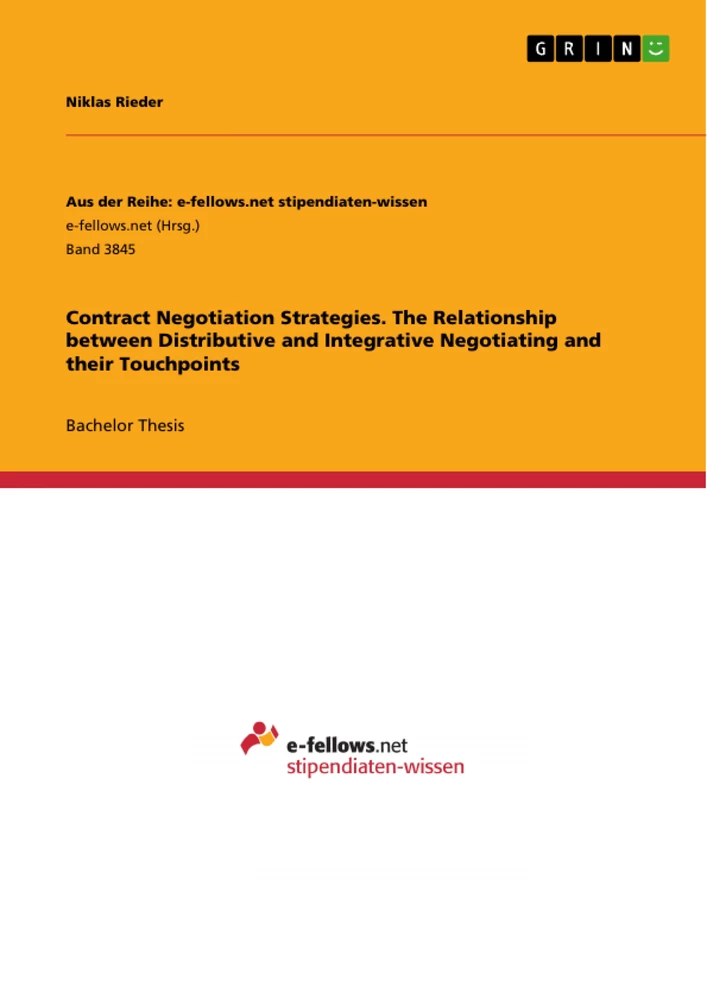
Table of Contents
1 INTRODUCTION
2 LITERATURE SEARCH
3 CONCEPTUAL FRAMEWORK
3.1 Theoretical Foundations
3.2 Distributive Negotiation Strategy
3.3 Integrative Negotiation Strategy
3.4 Relationship between Integrative and Distributive Negotiating
3.5 Theoretical Touchpoints
4 RESEARCH’S EMPIRICAL FINDINGS AND THEORETICAL WORK
4.1 Experience
4.2 Goals
4.3 Fit with Sourcing Strategy, Mobility, and Type of Sacrifice
4.4 Relationships
4.5 Orientations
5 CONCLUSION
Research Objectives & Key Themes
This thesis aims to investigate the current state of research regarding contract negotiation strategies within business-to-business relationships. By synthesizing existing academic literature, the work seeks to identify how different determinants, such as negotiator experience, goal orientation, and relationship quality, influence the choice between distributive and integrative negotiation strategies.
- Theoretical foundations of distributive versus integrative negotiation strategies.
- The role of relational experience and negotiator characteristics in strategy selection.
- The impact of goal orientations and goal incongruence on negotiation outcomes.
- Analysis of structural factors like team composition and relationship strength.
- Practical implications for organizations in selecting appropriate negotiation approaches.
Excerpt from the Book
3.2 Distributive Negotiation Strategy
Distributive negotiation refers to situations where two or more parties negotiate over a fixed sum of any resources (e.g., economic, power, or status symbols). Negotiators are in conflict over allocating those resources and one party's gain is the other party's loss. (Walton & McKersie, 1965, pp. 4–5)
Employing a distributive strategy, a negotiator‘s typical approach is „[...] to stand firm and employ pressure tactics (e.g., persuasive arguments, threats, positional commitments) in an effort to persuade the other party to concede and thus also to reduce the distance between demands.“ (Pruitt, 1981, p. 15)
A simplistic example for distributive negotiating can be a car deal, where the buyer tries to pay as little money as possible for a specific car. On the other hand, the seller has opposing interests, trying to convince the buyer to pay a higher price for that vehicle. The buyer can only improve his negotiation outcome (paying less) at the expense of the seller (receiving less money) and vice versa.
However, some researchers argue that most conflicts are of integrative nature, where more than one issue is usually involved, and different problems are valued differently by the negotiating parties. Instead of a fixed-pie of resources to be divided between the parties, an integrative solution can be found to satisfy all parties. (Katz-Navon & Goldschmidt, 2009, p. 62)
This leads us to Pruitt’s integrative strategy of negotiating, which will now be explained in more detail.
Summary of Chapters
1 INTRODUCTION: This chapter establishes the relevance of buyer-supplier relationships in a globalized market and introduces the central research question regarding strategic approaches to contract negotiations.
2 LITERATURE SEARCH: This section details the methodology used for the literature review, including the specific databases, keyword selection, and filtering criteria applied to ensure high-quality, peer-reviewed sources.
3 CONCEPTUAL FRAMEWORK: This chapter defines the theoretical foundations, specifically distinguishing between distributive and integrative negotiation strategies while discussing their interrelation and application.
4 RESEARCH’S EMPIRICAL FINDINGS AND THEORETICAL WORK: This comprehensive chapter examines empirical studies on variables influencing negotiation strategies, including experience, goal settings, team dynamics, and negotiator orientations.
5 CONCLUSION: The final chapter summarizes the key insights derived from the literature and provides recommendations for companies regarding the conscious selection of negotiation styles based on negotiator characteristics.
Keywords
Contract Negotiation, Negotiation Strategies, Distributive Negotiation, Integrative Negotiation, Buyer-Supplier Relationship, Strategic Sourcing, Goal Orientation, Relationship Strength, Negotiation Tactics, Relational Experience, Business Negotiations, Negotiation Simulation, Organizational Behavior, Social Exchange Theory, Fixed-Pie Bias
Frequently Asked Questions
What is the primary focus of this work?
The thesis explores the current state of academic research concerning contract negotiation strategies, specifically within the context of buyer-supplier relationships.
What are the core themes analyzed in the document?
The study focuses on the determinants of negotiation strategies, including negotiator experience, goal alignment, team structure, relationship strength, and personal identity orientations.
What is the main research objective?
The objective is to synthesize existing theoretical and empirical findings to understand how different factors lead negotiators to choose between distributive ("win-lose") and integrative ("win-win") strategies.
Which scientific methodology is employed?
The research is based on an extensive, systematic literature search and the qualitative analysis of thirteen selected high-relevance papers to build a coherent conceptual framework.
What is covered in the main body of the text?
The main body examines empirical findings regarding how experience over time, process versus outcome goals, and the presence of teams versus solo negotiators influence strategic choices.
Which keywords best describe this research?
Key terms include contract negotiation, integrative/distributive strategies, buyer-supplier relationships, goal orientation, and negotiator characteristics.
How do "distributive" and "integrative" strategies differ according to the text?
Distributive strategies are characterized by a "fixed-pie" perception where one party's gain is the other's loss, whereas integrative strategies aim to increase the "joint gain" through cooperation and information sharing.
What role does "relationship strength" play in negotiations?
The research suggests that stronger relationship cohesion often reduces the use of coercive tactics and increases the willingness to share information, supporting a more integrative approach.
What is the "fixed-pie bias"?
It is a cognitive bias where a negotiator mistakenly assumes that the other party's interests are diametrically opposed to their own, precluding the discovery of mutually beneficial trade-offs.
What implication does the thesis have for business managers?
Managers are encouraged to assess the personal characteristics and goals of their negotiators rather than relying solely on departmental responsibilities to ensure the chosen negotiation strategy fits the situation.
Ende der Leseprobe aus 39 Seiten
- nach oben
- Arbeit zitieren
- Niklas Rieder (Autor:in), 2021, Contract Negotiation Strategies. The Relationship between Distributive and Integrative Negotiating and their Touchpoints, München, Page::Imprint:: GRINVerlagOHG, https://www.diplomarbeiten24.de/document/1022432

neugierig - aktuell - relevant
Entdecken Sie hilfreiche Tipps und Tricks rund ums Studium!

Entdecken Sie hilfreiche Tipps und Tricks rund ums Studium!
Ihre Hausarbeit / Abschlussarbeit:

- - Publikation als E-Book und Buch
- - Hohes Honorar auf die Verkäufe
- - Für Sie komplett kostenlos - mit ISBN
- - Es dauert nur 5 Minuten
- - Jede Arbeit findet Leser

- © GRIN Publishing GmbH.
- Alle Inhalte urheberrechtlich geschützt. Kopieren und verbreiten untersagt.
- info@grin.com
- AGB
- Open Publishing
Der GRIN Verlag hat sich seit 1998 auf die Veröffentlichung akademischer eBooks und Bücher spezialisiert. Der GRIN Verlag steht damit als erstes Unternehmen für User Generated Quality Content. Die Verlagsseiten GRIN.com, Hausarbeiten.de und Diplomarbeiten24 bieten für Hochschullehrer, Absolventen und Studenten die ideale Plattform, wissenschaftliche Texte wie Hausarbeiten, Referate, Bachelorarbeiten, Masterarbeiten, Diplomarbeiten, Dissertationen und wissenschaftliche Aufsätze einem breiten Publikum zu präsentieren.
Kostenfreie Veröffentlichung: Hausarbeit, Bachelorarbeit, Diplomarbeit, Dissertation, Masterarbeit, Interpretation oder Referat jetzt veröffentlichen!
Folgen Sie GRIN auf


- GRIN Verlag GmbH
-
- Nymphenburger Str. 86
- 80636
- Munich, Deutschland
- +49 89-550559-0
- +49 89-550559-10
- info@grin.com
-
