
präsentiert von

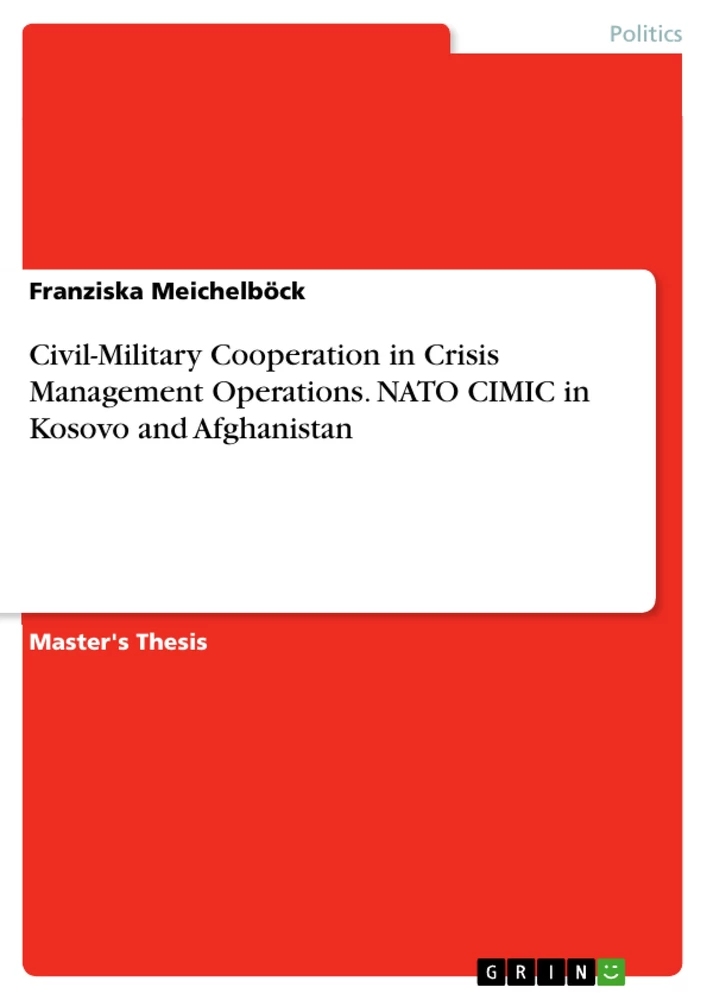
Table of Contents
Introduction
Chapter 1: Background
Chapter 2: Literature Review
2.1 Civil-Military Relations
2.2 Civil-Military Cooperation in Inter-Organizational Relations
2.3 Mixed Theoretical Approaches to Civil-Military Cooperation
Chapter 3: Theoretical Framework and Methodology
3.1 Civil-Military Cooperation in Institutional Theory
3.2 Methodology
3.3 Case Selection
Chapter 4: Analysis of the NATO CIMIC Framework
4.1 The Development of the NATO CIMIC Framework
4.2 NATO CIMIC in Kosovo
4.3 NATO CIMIC in Afghanistan
4.4 Evaluation of NATO CIMIC
Conclusion
Research Objectives and Themes
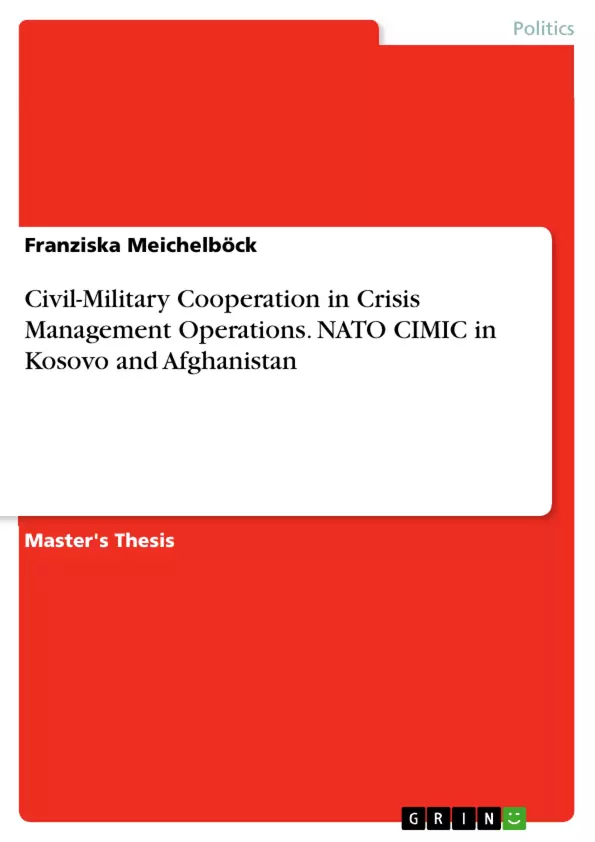
The thesis examines how international organizations, specifically NATO, formulate and implement civil-military cooperation (CIMIC) as part of their institutional framework to legitimize external interventions and manage crises. The research questions focus on the origins of CIMIC policies, their integration into military structures, and their practical impact on mission legitimacy through comparative case studies.
- The institutionalization of CIMIC within NATO's strategic framework.
- The divergence between formal policy rhetoric and practical field implementation.
- The role of civil-military activities in legitimizing international interventions.
- A comparative analysis of NATO CIMIC implementation in Kosovo and Afghanistan.
- The application of the policy cycle model to evaluate CIMIC effectiveness.
Excerpt from the Book
NATO CIMIC Policy in the Agenda-Setting Stage
The agenda-setting process of the NATO CIMIC policy will be analysed by looking at the origins of the policy. Some researchers as well as NATO itself highlighted the importance of the NATO missions in Bosnia – IFOR (1995-1996) and SFOR (1996-2004) – as well as the changed conditions of crisis management after the breakdown of the Soviet Union, as reasons for the development of civil-military cooperation (Frantzen 2004; e.g. Kasselmann 2012). One document in which these developments were highlighted was the Strategic Concept approved by the head of states and government at the Washington Summit 1999.
‘The interaction between Alliance forces and the civil environment (both governmental and non governmental) in which they operate is crucial to the success of operations. Civil-military cooperation is interdependent: military means are increasingly requested to assist civil authorities; at the same time, civil support to military operations is important for logistics, communications, medical support, and public affairs. Cooperation between the Alliance’s military and civil bodies will accordingly remain essential’ (NATO 1999:para. 60).
Summary of Chapters
Introduction: Provides the context of rising humanitarian crises post-Cold War and introduces the significance of Civil-Military Cooperation (CIMIC) as a management tool for military organizations.
Chapter 1: Background: Discusses the rationale behind civil-military cooperation, highlighting both the potential advantages for division of labor and the challenges arising from mistrust and the 'militarization of aid'.
Chapter 2: Literature Review: Surveys theoretical approaches including civil-military relations, inter-organizational relations, and institutional theory to establish a foundation for analyzing CIMIC.
Chapter 3: Theoretical Framework and Methodology: Details the use of institutional theory and the policy cycle model (agenda-setting, formulation, decision-making, implementation, evaluation) to study NATO's approach.
Chapter 4: Analysis of the NATO CIMIC Framework: Investigates the development of NATO's CIMIC policies and evaluates their implementation in the specific operational contexts of Kosovo and Afghanistan.
Conclusion: Summarizes findings, noting that while CIMIC helps legitimize interventions, its practical implementation is often decoupled from formal rhetoric and adapted to mission-specific needs.
Keywords
Civil-Military Cooperation, CIMIC, NATO, Kosovo, Afghanistan, Crisis Management, Institutional Theory, Policy Cycle, Legitimacy, Humanitarian Aid, Inter-Organizational Relations, Peacebuilding, Security, Conflict Resolution, Military Intervention.
Frequently Asked Questions
What is the core subject of this thesis?
The work explores how organizations, particularly NATO, integrate Civil-Military Cooperation (CIMIC) into their institutional frameworks to support crisis management and legitimize their external military interventions.
What are the primary thematic areas?
Key themes include the institutionalization of CIMIC, the politics of legitimization in international missions, the gap between policy and practice, and the comparative operational environments of Kosovo and Afghanistan.
What is the primary research goal?
The goal is to analyze the origins, development, and implementation of NATO's CIMIC policy to understand why organizations adopt these frameworks and how they function during complex emergencies.
Which scientific methodology is employed?
The thesis utilizes institutional theory combined with a policy cycle model—encompassing agenda-setting, policy formulation, decision-making, implementation, and evaluation—to provide a structured analysis.
What does the main body cover?
The main body reviews existing literature, defines the theoretical framework, and conducts an in-depth analysis of NATO's CIMIC development, followed by specific implementation case studies in Kosovo and Afghanistan.
What are the characterizing keywords?
The research is characterized by terms such as CIMIC, NATO, Institutional Theory, Legitimacy, Peacebuilding, Crisis Management, and the Policy Cycle.
How does the author define the 'militarization of aid'?
It refers to concerns where humanitarian actors are embedded into peacekeeping operations or manipulated as tools for diplomacy and force multiplication, potentially endangering humanitarian neutrality.
What is the role of decoupling in the context of NATO CIMIC?
Decoupling explains the gap between the formal institutional rhetoric of CIMIC and the actual field operations, allowing military commanders to adapt tasks to the specific local needs of their mission.
Why are Kosovo and Afghanistan selected as case studies?
They are chosen because they represent the full range of NATO's CIMIC activities, offering a unique comparative perspective on how different security environments impact the legitimacy and success of military cooperation.
Ende der Leseprobe aus 36 Seiten
- nach oben
- Arbeit zitieren
- Franziska Meichelböck (Autor:in), 2019, Civil-Military Cooperation in Crisis Management Operations. NATO CIMIC in Kosovo and Afghanistan, München, Page::Imprint:: GRINVerlagOHG, https://www.diplomarbeiten24.de/document/1024530

neugierig - aktuell - relevant
Entdecken Sie hilfreiche Tipps und Tricks rund ums Studium!

Entdecken Sie hilfreiche Tipps und Tricks rund ums Studium!
Ihre Hausarbeit / Abschlussarbeit:

- - Publikation als E-Book und Buch
- - Hohes Honorar auf die Verkäufe
- - Für Sie komplett kostenlos - mit ISBN
- - Es dauert nur 5 Minuten
- - Jede Arbeit findet Leser

- © GRIN Publishing GmbH.
- Alle Inhalte urheberrechtlich geschützt. Kopieren und verbreiten untersagt.
- info@grin.com
- AGB
- Open Publishing
Der GRIN Verlag hat sich seit 1998 auf die Veröffentlichung akademischer eBooks und Bücher spezialisiert. Der GRIN Verlag steht damit als erstes Unternehmen für User Generated Quality Content. Die Verlagsseiten GRIN.com, Hausarbeiten.de und Diplomarbeiten24 bieten für Hochschullehrer, Absolventen und Studenten die ideale Plattform, wissenschaftliche Texte wie Hausarbeiten, Referate, Bachelorarbeiten, Masterarbeiten, Diplomarbeiten, Dissertationen und wissenschaftliche Aufsätze einem breiten Publikum zu präsentieren.
Kostenfreie Veröffentlichung: Hausarbeit, Bachelorarbeit, Diplomarbeit, Dissertation, Masterarbeit, Interpretation oder Referat jetzt veröffentlichen!
Folgen Sie GRIN auf


- GRIN Verlag GmbH
-
- Nymphenburger Str. 86
- 80636
- Munich, Deutschland
- +49 89-550559-0
- +49 89-550559-10
- info@grin.com
-
