
präsentiert von

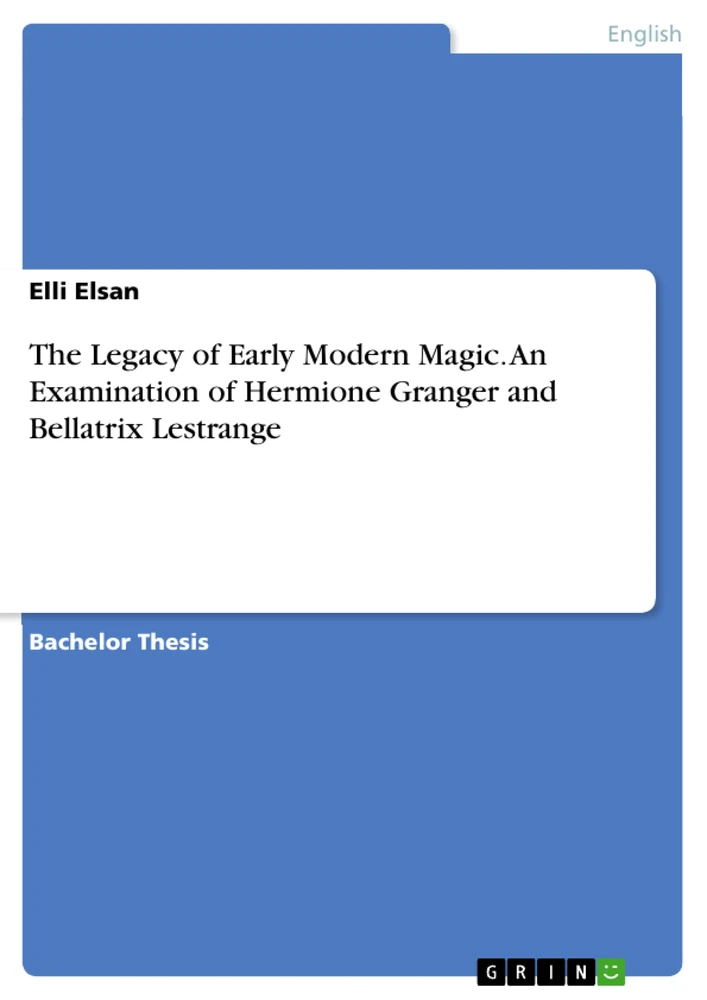
Table of Contents
1. Introduction
2. Religion, Magic and the Idea of Witchcraft
3. Magic in the Early Modern Period
3.1 White Magic
3.2 Black Magic
3.2.1 Witch-Hunts
4. Concepts of Witchcraft
4.1 The Demonic Witch
4.2 The Village Witch
5. The Magical Word of Harry Potter
6. Analysis of Hermione Granger in the Harry Potter Series
6.1 Appearance and Background
6.2 Hermione Granger’s Personality
6.3 Magical Skills
6.4 Hermione Granger – A Wise and Brave Witch
7. Analysis of Bellatrix Lestrange in the Harry Potter Series
7.1 Appearance and Background
7.2 Bellatrix Lestrange’s Personality
7.3 Magical Skills
7.4 Bellatrix Lestrange – The Perfectly Evil Witch
8. Hermione Granger versus Bellatrix Lestrange – Looking at the Results
9. Conclusion
Research Objectives and Themes
This paper examines how early modern perceptions of magic, witchcraft, and the dichotomy between white and black magic are reflected in J.K. Rowling's Harry Potter series. The central research question investigates how these historical concepts are utilized to humanize or demonize key characters, specifically focusing on the comparative analysis of Hermione Granger and Bellatrix Lestrange.
- Comparison between early modern historical concepts of magic and the magical world of Harry Potter.
- Analysis of the character development and representation of Hermione Granger as a modernized counterpart to the "cunning folk."
- Examination of Bellatrix Lestrange as an embodiment of the "demonic" or "evil" witch archetype.
- Exploration of how J.K. Rowling recontextualizes historical ideas of magic to suit contemporary narratives of good versus evil.
- Investigation into the mechanisms of demonization and humanization through magical abilities, personality traits, and physical appearance.
Excerpt from the Book
6.1 Appearance and Background
On the one hand, Hermione Granger resembles the classic image of an historical witch. Her appearance at first can be considered unattractive. Stereotypically, historical witches were described as rather “unattractive” (Barstow 16). Hermione inhibits some physical traits that she herself and others might find bothersome, or at least not attractive. She has “lots of bushy brown hair, and rather large front teeth” (Rowling, Sorcerer’s 83). She is not described as an attractive person, at least not until her appearance changes. Her hair becomes “sleek and shiny” (Rowling, Goblet 360) and “her teeth are all straight […] and normal-sized" (352). Hermione herself is responsible for her teeth looking normal-sized, that indicates that she was not satisfied with the way she looked. She is only described as attractive after looking different, in fact in a way that her friends were not able to recognize her at first. After changing her looks, she is described as a “pretty girl” (359).
However, Hermione is being discriminated against. “Just as elite men targeted mostly women, Slytherin`s hatred began the prejudice against the Muggle and Muggle born […] race among the Pure-blood witches and wizards” (De la Torre 53). Hermione faces difficulties and is often insulted as a mudblood. “Mudblood's a really foul name for someone who is Muggle-born – [someone with] non-magic parents” (Rowling, Chamber 127). It was a common idea that historical witches had old and thick blood (cf. Purkiss 132). Their blood was therefore not considered pure, but rather impure, similar to how muggle born wizards and witches are considered as having “[d]irty blood” (Rowling, Chamber 127). One difference between the Harry Potter series and the early modern period is that, while in the early modern period the elites targeted the people based on gender, in the Harry Potter series a whole race is targeted (De La Torre 53). Nevertheless, it is still an analogy to make.
Summary of Chapters
1. Introduction: Presents the fascination with magic in the early modern period and introduces the Harry Potter series as the basis for analyzing how historical concepts of magic are used to humanize or demonize characters.
2. Religion, Magic and the Idea of Witchcraft: Explores the definitions of magic, religion, and witchcraft in Europe from 1500 to 1800, emphasizing their practical role in everyday life.
3. Magic in the Early Modern Period: Details the historical distinction between white magic (beneficial, associated with cunning folk) and black magic (maleficent, associated with witchcraft).
3.1 White Magic: Examines the role of "cunning folk" or "wise women and men" as healers and mediators, noting their accepted position in early modern society.
3.2 Black Magic: Discusses the historical perception of black magic and witchcraft as harmful, often linked to the devil and perceived threats to society.
3.2.1 Witch-Hunts: Analyzes the social and legal factors that led to the persecution and execution of individuals accused of practicing witchcraft.
4. Concepts of Witchcraft: Outlines the theoretical divide between elite (theological) and popular (practical) fears surrounding witchcraft.
4.1 The Demonic Witch: Describes the archetype of the female witch who makes a pact with the devil and is associated with chaos and harm.
4.2 The Village Witch: Focuses on the neighbor-figure who is accused of bewitching neighbors due to social friction, illness, or antisocial behavior.
5. The Magical Word of Harry Potter: Compares the Harry Potter magic system with early modern concepts, noting Rowling's focus on a "good vs. evil" struggle without traditional religion.
6. Analysis of Hermione Granger in the Harry Potter Series: Analyzes Hermione's character as a modern practitioner of "white magic" who is humanized through relatable flaws and positive traits.
6.1 Appearance and Background: Discusses Hermione's physical transformation and her social status as a "Mudblood" in the context of historical witch-hunting analogies.
6.2 Hermione Granger’s Personality: Explores Hermione's ambition, bravery, loyalty, and intellectual dedication as parallels to early modern "wise" practitioners.
6.3 Magical Skills: Examines Hermione's proficiency in healing, herbology, and defensive magic compared to the traditional skills of the cunning folk.
6.4 Hermione Granger – A Wise and Brave Witch: Summarizes Hermione's character as a relatable, modern figure who reconciles "legal" magic with positive, humanizing attributes.
7. Analysis of Bellatrix Lestrange in the Harry Potter Series: Analyzes Bellatrix as an embodiment of the evil witch archetype, characterized by her sadism and loyalty to Voldemort.
7.1 Appearance and Background: Interprets Bellatrix’s dark aesthetic and her pure-blood status as indicators of her alignment with the dark side.
7.2 Bellatrix Lestrange’s Personality: Highlights her violence, sadistic tendencies, and lack of motherly traits as markers of the classic "demonic witch" stereotype.
7.3 Magical Skills: Examines her power in Dark Arts and dueling, contrasting her intentional evil with historical perceptions of witches' pacts with the devil.
7.4 Bellatrix Lestrange – The Perfectly Evil Witch: Concludes that Bellatrix is a demonized figure, devoid of redemptive qualities, serving as the ultimate antagonist.
8. Hermione Granger versus Bellatrix Lestrange – Looking at the Results: Compares the two characters, reflecting on their roles as protagonist and antagonist and noting which historical aspects were excluded by Rowling.
9. Conclusion: Summarizes how J.K. Rowling utilizes and adapts early modern magical concepts to categorize characters into clear "good" and "dark" sides.
Keywords
Early modern period, magic, witchcraft, Harry Potter, Hermione Granger, Bellatrix Lestrange, white magic, black magic, demonization, humanization, witch-hunt, cunning folk, Dark Arts, good versus evil, historical archetypes.
Frequently Asked Questions
What is the primary focus of this work?
The work investigates the parallels between early modern European concepts of magic and witchcraft and the depiction of magic in the Harry Potter series.
What are the central themes discussed in the paper?
The central themes include the categorization of magic into good and evil, the historical archetypes of witches, and the literary techniques used to humanize or demonize characters.
What is the main goal or research question of the study?
The goal is to analyze how J.K. Rowling uses historical "white" and "black" magic concepts to construct the moral frameworks of Hermione Granger and Bellatrix Lestrange.
Which scientific methodology is applied?
The paper uses a qualitative, comparative literary analysis approach, drawing upon historical sources on witchcraft alongside close readings of the Harry Potter books.
What topics are covered in the main body of the work?
The body covers historical background on white and black magic, witch-hunts, archetypes of the demonic and village witch, and a detailed character analysis of the two selected protagonists/antagonists.
Which keywords best characterize this study?
Key terms include Early modern magic, witchcraft, Harry Potter, Hermione Granger, Bellatrix Lestrange, and character demonization.
How does the author interpret the role of "Dark Arts" in Harry Potter?
The author interprets Dark Arts as a narrative replacement for historical black magic, noting that while the series presents them as dangerous and corrupting, it moves away from religious connotations to secular morality.
Why does the author classify Hermione Granger as a modern "wise woman"?
Hermione is classified this way because she shares key traits with historical "cunning folk," such as extensive knowledge, a dedication to healing, and a role as a provider of advice and practical help to her community.
What makes Bellatrix Lestrange an embodiment of the "demonic witch"?
She fulfills this archetype through her antisocial behavior, violent nature, lack of maternal empathy, and her intense, absolute devotion to a dark master, mirroring historical beliefs about witches serving the devil.
Ende der Leseprobe aus 44 Seiten
- nach oben
- Arbeit zitieren
- Elli Elsan (Autor:in), 2020, The Legacy of Early Modern Magic. An Examination of Hermione Granger and Bellatrix Lestrange, München, Page::Imprint:: GRINVerlagOHG, https://www.diplomarbeiten24.de/document/1030369

neugierig - aktuell - relevant
Entdecken Sie hilfreiche Tipps und Tricks rund ums Studium!

Entdecken Sie hilfreiche Tipps und Tricks rund ums Studium!
Ihre Hausarbeit / Abschlussarbeit:

- - Publikation als E-Book und Buch
- - Hohes Honorar auf die Verkäufe
- - Für Sie komplett kostenlos - mit ISBN
- - Es dauert nur 5 Minuten
- - Jede Arbeit findet Leser

- © GRIN Publishing GmbH.
- Alle Inhalte urheberrechtlich geschützt. Kopieren und verbreiten untersagt.
- info@grin.com
- AGB
- Open Publishing
Der GRIN Verlag hat sich seit 1998 auf die Veröffentlichung akademischer eBooks und Bücher spezialisiert. Der GRIN Verlag steht damit als erstes Unternehmen für User Generated Quality Content. Die Verlagsseiten GRIN.com, Hausarbeiten.de und Diplomarbeiten24 bieten für Hochschullehrer, Absolventen und Studenten die ideale Plattform, wissenschaftliche Texte wie Hausarbeiten, Referate, Bachelorarbeiten, Masterarbeiten, Diplomarbeiten, Dissertationen und wissenschaftliche Aufsätze einem breiten Publikum zu präsentieren.
Kostenfreie Veröffentlichung: Hausarbeit, Bachelorarbeit, Diplomarbeit, Dissertation, Masterarbeit, Interpretation oder Referat jetzt veröffentlichen!
Folgen Sie GRIN auf


- GRIN Verlag GmbH
-
- Nymphenburger Str. 86
- 80636
- Munich, Deutschland
- +49 89-550559-0
- +49 89-550559-10
- info@grin.com
-
