
präsentiert von

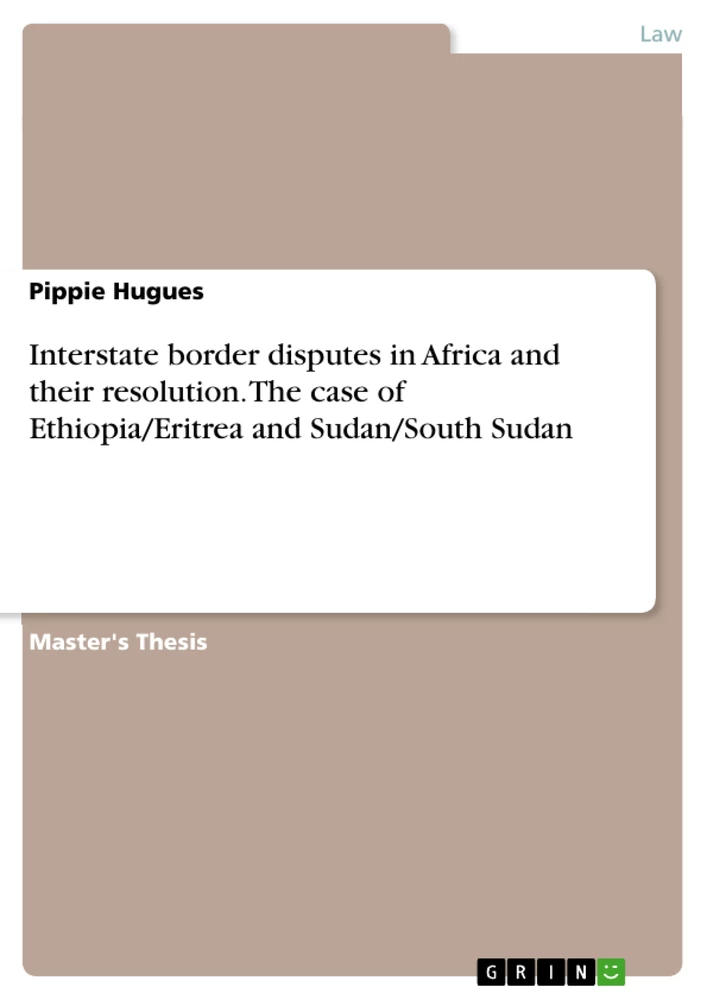
Table of Contents
CHAPTER ONE
GENERAL INTRODUCTION
1.1 Background to the study.
1.2 STATEMENT OF THE PROBLEM.
1.3 RESEARCH QUESTIONS.
1.4 OBJECTIVES
1.4.1 GENERAL OBJECTIVE.
1.5 RESEARCH METHODOLOGY
1.6 REVIEW OF LITERATURE.
1.7 SCOPE OF THE STUDY.
1.8 JUSTIFICATION OF STUDY.
1.9 SIGNIFICANCE OF STUDY.
1.10 THEORETICAL FRAMEWORK.
1.11 DEFINITION OF KEY TERMS.
1.12 SYNOPSIS OF CHAPTER.
CHAPTER TWO
CAUSES AND EFFECTS OF THE RESOLUTION OF INTERSTATE BORDER DISPUTES IN AFRICA.
2.1 OVERVIEW OF INTERSTATE BORDER DISPUTES IN AFRICA.
2.2 ETHIOPIA AND ERITREA BORDER DISPUTE OVER BADME.
2.2.1 MAJOR CAUSES OF THE DISPUTE.
2.2.2 EFFECTS OF THE DISPUTE OVER BADME ON BOTH COUNTRIES.
2.3 SUDAN AND SOUTH SUDAN BORDER DISPUTE OVER ABYEI AND HEGLIG.
2.3.1 MAJOR CAUSE OF THE ABYEI AND HEGLIG DISPUTES
2.3.2 EFFECTS OF THE BORDER DISPUTES IN ABYEI AND HEGLIG ON THE BOTH COUNTRIES.
2.4 GENERAL CAUSES OF INTERSTATE BORDER DISPUTES IN AFRICA.
CHAPTER THREE
LEGAL INSTRUMENTS AND INSTITUTIONS USED IN THE RESOLUTION OF INTERSTATE BORDER DISPUTES IN AFRICA.
3.1 LEGAL INSTRUMENTS USED IN THE RESOLUTION OF INTERSTATE BORDER DISPUTES IN AFRICA.
3.1.1 CHARTER OF THE UNITED NATIONS.
3.1.2 THE STATUTE OF THE INTERNATIONAL COURT OF JUSTICE.
3.1.3 THE UNIVERSAL DECLARATION OF HUMAN RIGHTS (UDHR)
3.1.4 THE AFRICAN CHARTER ON HUMAN AND PEOPLES’ RIGHTS.
3.2 INSTITUTIONS USED IN THE RESOLUTIONS OF INTERSTATE BORDER DISPUTES IN AFRICA.
3.2.1 THE INTERNATIONAL COURT OF JUSTICE (ICJ).
3.2.2 PERMANENT COURT OF INTERNATIONAL JUSTICE (PCIJ).
3.2.3 PERMANENT COURT OF ARBITRATION. (PCA)
3.2.4 THE UN SECURITY COUNCIL.
3.2.5 THE AFRICAN COMMISSION ON HUMAN AND PEOPLES’ RIGHTS.
3.2.6 THE AFRICAN COURT ON HUMAN AND PEOPLES’ RIGHTS.
3.2.7 AFRICAN COURT OF JUSTICE AND HUMAN RIGHTS.
CHAPTER FOUR
MECHANISMS USE IN THE RESOLUTION OF INTERSTATE BORDER DISPUTES IN AFRICA AND THEIR EFFECTIVENESS.
4.1 MECHANISMS USED TO RESOLVE INTERSTATE BORDER DISPUTES IN AFRICA.
4.1.1 ADMINISTRATIVE MECHANISMS.
4.1.2 ARBITRATION.
4.1.3 LEGAL MECHANISM (ADJUDICATION)
4.2 MECHANISM USED TO RESOLVE THE BADME BORDER DISPUTE.
4.3 MECHANISM USED TO RESOLVE THE ABYEI AND HEGLIG BORDER DISPUTES.
4.4 THE EFFECTIVENESS OF THE MECHANISMS ADOPTED IN THE BADME DISPUTE.
4.5 THE EFFECTIVENESS OF THE MECHANISM ADOPTED IN THE ABYEI AND HEGLIG DISPUTES.
4.6 THE ROLE AND EFFECTIVENESS OF THE ICJ IN THE RESOLUTION OF INTERSTATE BORDER DISPUTES IN AFRICA.
CHAPTER FIVE
SUMMARY OF FINDINGS, CONCLUSION AND RECOMMENDATIONS.
5.1 SUMMARY OF FINDINGS.
5.2 CONCLUSION.
5.3 RECOMMENDATIONS.
Research Objectives and Themes
This research critically examines the resolution of interstate border disputes in Africa, specifically focusing on the mechanisms utilized and their effectiveness in maintaining peace. The study evaluates the root causes of these conflicts, the legal instruments governing them, and the role of international and regional institutions in dispute management, using the border conflicts of Ethiopia/Eritrea and Sudan/South Sudan as primary case studies.
- Analysis of root causes and consequences of interstate border disputes in Africa.
- Evaluation of legal instruments and institutional frameworks for dispute resolution.
- Assessment of mediation, arbitration, and judicial mechanisms in settling border conflicts.
- Critique of international enforcement challenges regarding border dispute rulings.
- Development of policy recommendations to foster long-term peace and stability.
Auszug aus dem Buch
2.2 ETHIOPIA AND ERITREA BORDER DISPUTE OVER BADME.
Ethiopia and Eritrea are both situated at the horn of Africa. Interstate disputes, compared to the rampant intra state disputes are very rare in the horn of Africa. When they do take place, however, they give rise to devastating effects to human life, property and environment. A major interstate border dispute that took place at the horn of Africa after the Ethiopia and Somalia war of 1964 and 1977-78, took place between Ethiopia and Eritrea over Badme from 1998 to 2000.
The area of what is now Eritrea came into existence in 1890, when the Italians made their first colonial conquest in the horn of Africa and occupied the territory north of Ethiopia. The Ethiopians evaded colonial occupation by defeating the Italians in the 1896 Battle of Adowa. After Italy’s defeat, Ethiopia and Italy negotiated and signed a series of agreements in 1900, 1902, and 1908 with regards to the Ethiopian border with Eritrea. However, in 1935, Italy again invaded Ethiopia and occupied it for four years before the British freed both Ethiopia and Eritrea from Italian occupation at the end of World War II.
In 1952, the United Nation (UN) gave Eritrea to Ethiopia as a protectorate, and Ethiopia added Eritrea as a province in 1962. This annexation set off a bloody war that finally ended after a group of insurgent forces in Ethiopia united with Eritrean insurgency factions and overcame the government of Ethiopian dictator MengistuHailemarian in 1991. The Ethiopian government allowed Eritreans to determine whether to remain part of Ethiopia through a referendum in 1993. The two countries separated amicably when 99.8% of Eritreans voted instead for independence.
Summary of Chapters
GENERAL INTRODUCTION: This chapter outlines the problem statement, research questions, and theoretical framework, emphasizing the prevalence of border disputes in Africa and the need for effective resolution mechanisms.
CAUSES AND EFFECTS OF THE RESOLUTION OF INTERSTATE BORDER DISPUTES IN AFRICA: This chapter analyzes the historical and economic roots of territorial conflicts, specifically detailing the disputes over Badme (Ethiopia/Eritrea) and Abyei/Heglig (Sudan/South Sudan).
LEGAL INSTRUMENTS AND INSTITUTIONS USED IN THE RESOLUTION OF INTERSTATE BORDER DISPUTES IN AFRICA: This chapter examines the international legal texts and judicial bodies, such as the UN Charter and the ICJ, that facilitate the resolution of border issues.
MECHANISMS USE IN THE RESOLUTION OF INTERSTATE BORDER DISPUTES IN AFRICA AND THEIR EFFECTIVENESS: This chapter evaluates the practical success of administrative, arbitration, and adjudicative methods in resolving specific border conflicts.
SUMMARY OF FINDINGS, CONCLUSION AND RECOMMENDATIONS: This chapter provides a synthesis of the study's findings and offers policy recommendations to improve conflict resolution and regional stability in Africa.
Keywords
Interstate border disputes, Africa, dispute resolution, international law, ICJ, arbitration, mediation, Badme, Abyei, Heglig, perpetual peace, colonial boundaries, human rights, territorial sovereignty, conflict management.
Frequently Asked Questions
What is the primary focus of this research?
The research focuses on the resolution of interstate border disputes in Africa, evaluating the laws and mechanisms used to settle them.
What are the central themes of the work?
The central themes include the historical impact of colonial boundaries, the role of natural resources in fueling conflicts, and the effectiveness of international legal institutions.
What is the core research question?
The main question is how effective the existing legal and diplomatic mechanisms are in resolving interstate border disputes in Africa.
What research methodology is applied?
The work employs a doctrinal, qualitative research method, involving in-depth analysis of primary and secondary legal data.
What does the main body address?
The main body covers the identification of conflict causes, an overview of relevant legal instruments, and an evaluation of mechanisms like arbitration and adjudication in specific case studies.
Which keywords characterize this thesis?
Key terms include interstate border disputes, conflict resolution, ICJ, arbitration, and perpetual peace.
Why are the Badme and Abyei disputes used as case studies?
These cases are selected because they represent significant, ongoing or high-profile border tensions in Africa that illustrate the complexities of international dispute resolution.
What role does the ICJ play in these disputes according to the author?
The author discusses the ICJ as a principal judicial organ but notes significant challenges regarding jurisdiction and the enforcement of its rulings by the UN Security Council.
What are the author's primary recommendations?
The author recommends sincere and committed leadership, the eradication of poverty, a shift toward arbitration courts for contentious disputes, and increased utilization of African regional bodies.
Ende der Leseprobe aus 111 Seiten
- nach oben
- Arbeit zitieren
- Pippie Hugues (Autor:in), 2018, Interstate border disputes in Africa and their resolution. The case of Ethiopia/Eritrea and Sudan/South Sudan, München, Page::Imprint:: GRINVerlagOHG, https://www.diplomarbeiten24.de/document/1033455

neugierig - aktuell - relevant
Entdecken Sie hilfreiche Tipps und Tricks rund ums Studium!

Entdecken Sie hilfreiche Tipps und Tricks rund ums Studium!
Ihre Hausarbeit / Abschlussarbeit:

- - Publikation als E-Book und Buch
- - Hohes Honorar auf die Verkäufe
- - Für Sie komplett kostenlos - mit ISBN
- - Es dauert nur 5 Minuten
- - Jede Arbeit findet Leser

- © GRIN Publishing GmbH.
- Alle Inhalte urheberrechtlich geschützt. Kopieren und verbreiten untersagt.
- info@grin.com
- AGB
- Open Publishing
Der GRIN Verlag hat sich seit 1998 auf die Veröffentlichung akademischer eBooks und Bücher spezialisiert. Der GRIN Verlag steht damit als erstes Unternehmen für User Generated Quality Content. Die Verlagsseiten GRIN.com, Hausarbeiten.de und Diplomarbeiten24 bieten für Hochschullehrer, Absolventen und Studenten die ideale Plattform, wissenschaftliche Texte wie Hausarbeiten, Referate, Bachelorarbeiten, Masterarbeiten, Diplomarbeiten, Dissertationen und wissenschaftliche Aufsätze einem breiten Publikum zu präsentieren.
Kostenfreie Veröffentlichung: Hausarbeit, Bachelorarbeit, Diplomarbeit, Dissertation, Masterarbeit, Interpretation oder Referat jetzt veröffentlichen!
Folgen Sie GRIN auf


- GRIN Verlag GmbH
-
- Nymphenburger Str. 86
- 80636
- Munich, Deutschland
- +49 89-550559-0
- +49 89-550559-10
- info@grin.com
-
