
präsentiert von

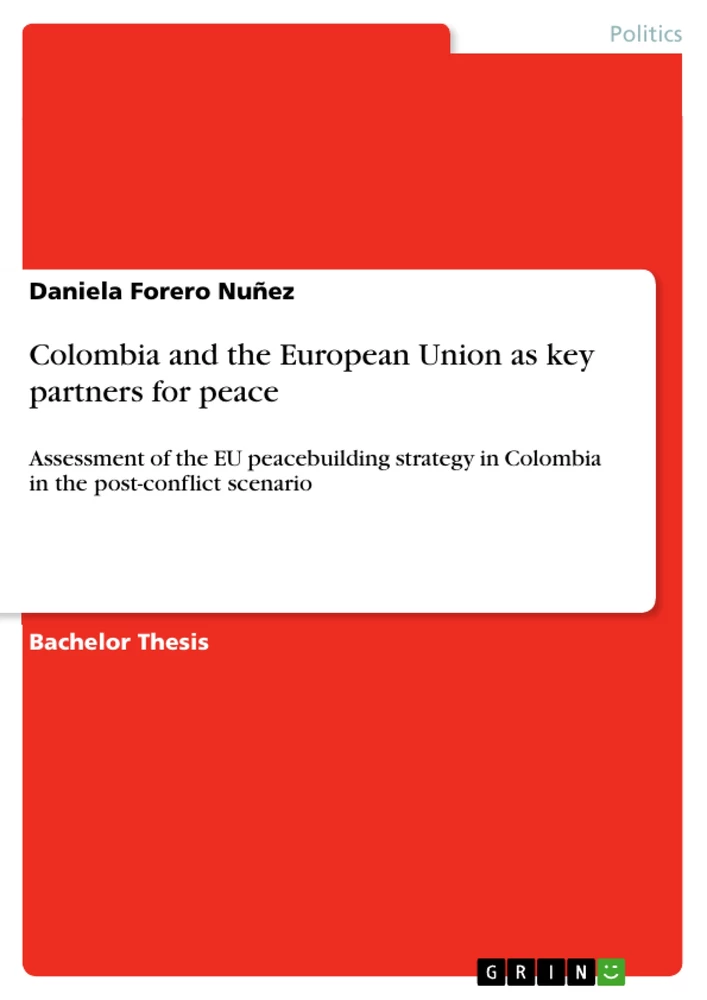
Table of Contents
1. Introduction
1.1 Introduction to the topic and research question
1.2 State of research
1.3 Methodology and structure of the study
2. Theoretical framework
2.1 John Lederach: Peacebuilding as conflict transformation and social reconciliation
2.2 Research hypotheses
3. The EU Development Policy’s role in conflict resolution and post-conflict stabilization worldwide
3.1 Key objectives and fundamental principles of the EU Development policy
3.2 The EU Development Policy’s legal and institutional framework
3.3 The Development Cooperation Instrument (DCI) and the EU Trust Funds as financial instruments of peacebuilding
4. Colombia’s long path towards peace: from the roots causes to the current panorama
4.1 Historical background and course of the Colombian internal armed conflict
4.2 Retrospective review of the European engagement in Colombia
4.3 Signing of the peace agreements of 2016: The end of the internal armed conflict?
4.4 The post-conflict scenario: Implementation of the peace agreements of 2016
5. General assessment of the EU peacebuilding strategy in Colombia during the post-conflict era
5.1 The EU’s grassroots approach to peacebuilding in Colombia
5.2 Sustainable peace vs. security and defense
5.3 Poor accountability and shared responsibility: A threat for lasting peace?
6. Conclusion
6.1 Empirical findings
6.2 Theoretical implications
6.3 Prospects for further research
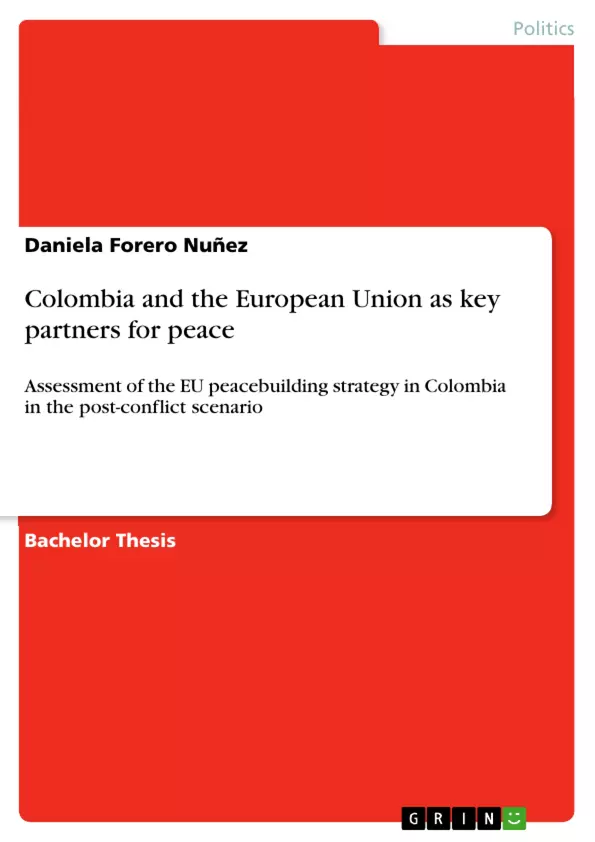
Research Objectives and Core Themes
This thesis examines the effectiveness of the European Union's (EU) peacebuilding strategy in Colombia following the 2016 peace agreement. It evaluates how the EU, through the EU Trust Fund for Colombia (EUTF), has contributed to sustainable peace by fostering grassroots participation, while addressing the challenges posed by conflicting approaches between the Union and the Colombian national government regarding security and social reconciliation.
- The role of the EU Development Policy in post-conflict stabilization.
- The application of John Lederach's conflict transformation theory in the Colombian context.
- Evaluation of the EUTF projects and their impact on grassroots empowerment and social reincorporation.
- The clash between civilian-oriented EU peacebuilding and the Colombian government's security-centric approach.
- Analysis of implementation gaps and accountability mechanisms in the post-conflict scenario.
Excerpt from the Book
2.1 John Lederach: Peacebuilding as conflict transformation and social reconciliation
The definition of peace itself is crucial for understanding the different peacebuilding approaches within the peace studies field. John Lederach defines peace as a dynamic social construct, rather than a stage or condition (cf. Lederach 1997: 20). Hence, the major objective of peacebuilding goes hand in hand with sustainability itself, linking the concept of sustainable development with peacebuilding. Sustainable peace is thus the result of a long-term “proactive process that is capable of regenerating itself over time” (Lederach 1997: 75; 84) and that fully integrates all levels of the society. Especially when an armed conflict had endured for more than two decades, fueled by perceptions dating back generations, it results vital to develop a longer-term vision that overcomes the wounds caused by the conflict and rebuilds the fractured social fabric. This, however, might be fulfilled in years or decades, rather than only months (cf. Lederach 1997:78), as crisis issues are directly linked to systemic roots that have to be fought comprehensively in order to achieve a truly sustainable peace (cf. ibid.: 81).
Summary of Chapters
1. Introduction: Outlines the scope of the Colombian conflict, the emergence of the 2016 peace accords, and the research objectives regarding the EUTF's effectiveness.
2. Theoretical framework: Establishes John Lederach’s theory of conflict transformation and social reconciliation as the primary analytical lens for the study.
3. The EU Development Policy’s role in conflict resolution and post-conflict stabilization worldwide: Discusses the evolution of EU development policy, its legal framework, and its institutional mechanisms for fostering global stability.
4. Colombia’s long path towards peace: from the roots causes to the current panorama: Provides historical context on the Colombian conflict and assesses the implementation status and challenges of the 2016 peace agreements.
5. General assessment of the EU peacebuilding strategy in Colombia during the post-conflict era: Empirically evaluates the EUTF’s impact, focusing on grassroots inclusion, security-oriented versus civilian-led peace models, and accountability.
6. Conclusion: Synthesizes the empirical findings and theoretical implications, suggesting that while the EU has contributed locally, structural and political challenges remain significant.
Keywords
Peacebuilding, Colombia, European Union, EUTF, Conflict Transformation, Grassroots Approach, Social Reconciliation, Post-Conflict, Sustainable Development, FARC-EP, Peace Agreement, Security, Accountability, Civil Society, Human Rights.
Frequently Asked Questions
What is the core focus of this research?
The research focuses on assessing the effectiveness of the European Union's peacebuilding strategy in Colombia, specifically through the implementation of the EUTF since the 2016 peace agreement.
What are the primary themes analyzed in this work?
The primary themes include the role of the EU in post-conflict stabilization, the importance of grassroots participation, the conflict between security-centric and civilian-oriented peace models, and the challenges of sustainable reconciliation.
What is the central research question?
The central question is: To what extent has the EUTF for Colombia contributed to the building of a just and sustainable peace in the country during the post-conflict era?
Which scientific methodology is employed?
The study follows a qualitative, deductive research approach, analyzing primary documents, official reports, and academic literature to test three specific hypotheses based on Lederach's peacebuilding theory.
What does the main body cover?
The main body covers the theoretical foundation, an analysis of EU institutional mechanisms, the historical trajectory of the Colombian conflict, and a detailed empirical assessment of EU-funded projects.
Which keywords characterize this paper?
Key terms include Peacebuilding, Colombia, European Union, EUTF, Conflict Transformation, and Social Reconciliation.
How does the author interpret the impact of the EUTF?
The author argues that while the EUTF has successfully supported local capacity-building and improved specific social metrics, its broader impact is limited by the Colombian government's continued focus on coercive security measures.
What conclusion does the author draw regarding the current peace process?
The author concludes that sustainable peace remains elusive because there is a persistent gap between the EU's civilian peacebuilding approach and the national government's security-led strategies, which exacerbates social divisions.
Ende der Leseprobe aus 72 Seiten
- nach oben
- Arbeit zitieren
- Daniela Forero Nuñez (Autor:in), 2021, Colombia and the European Union as key partners for peace, München, Page::Imprint:: GRINVerlagOHG, https://www.diplomarbeiten24.de/document/1035644

neugierig - aktuell - relevant
Entdecken Sie hilfreiche Tipps und Tricks rund ums Studium!

Entdecken Sie hilfreiche Tipps und Tricks rund ums Studium!
Ihre Hausarbeit / Abschlussarbeit:

- - Publikation als E-Book und Buch
- - Hohes Honorar auf die Verkäufe
- - Für Sie komplett kostenlos - mit ISBN
- - Es dauert nur 5 Minuten
- - Jede Arbeit findet Leser

- © GRIN Publishing GmbH.
- Alle Inhalte urheberrechtlich geschützt. Kopieren und verbreiten untersagt.
- info@grin.com
- AGB
- Open Publishing
Der GRIN Verlag hat sich seit 1998 auf die Veröffentlichung akademischer eBooks und Bücher spezialisiert. Der GRIN Verlag steht damit als erstes Unternehmen für User Generated Quality Content. Die Verlagsseiten GRIN.com, Hausarbeiten.de und Diplomarbeiten24 bieten für Hochschullehrer, Absolventen und Studenten die ideale Plattform, wissenschaftliche Texte wie Hausarbeiten, Referate, Bachelorarbeiten, Masterarbeiten, Diplomarbeiten, Dissertationen und wissenschaftliche Aufsätze einem breiten Publikum zu präsentieren.
Kostenfreie Veröffentlichung: Hausarbeit, Bachelorarbeit, Diplomarbeit, Dissertation, Masterarbeit, Interpretation oder Referat jetzt veröffentlichen!
Folgen Sie GRIN auf


- GRIN Verlag GmbH
-
- Nymphenburger Str. 86
- 80636
- Munich, Deutschland
- +49 89-550559-0
- +49 89-550559-10
- info@grin.com
-
