
präsentiert von

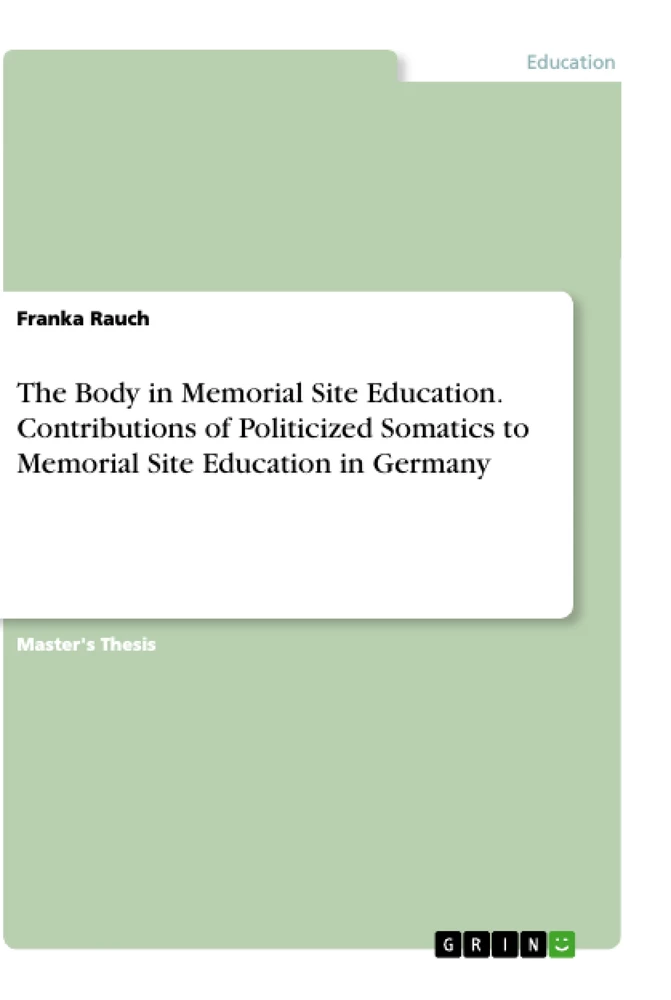
Table of Contents
1 Writing on the land of my ancestry
2 Grounding: the body (in)to Peace and Conflict Studies
2.1 Searching for the body in PACS
2.1.1 Touched by war: explicit bodies in PACS
2.1.2 Entryways of the body: implicit bodies in PACS
2.1.2.1 The body entering through the arts in peacebuilding
2.1.2.2 The body entering through the embodied turn in the social sciences
2.1.2.3 The body entering through feminist peace research
2.1.2.4 The body entering through postcolonial and decolonial critique
2.1.2.5 The body in PACS: where to go from here?
2.2 From body to soma: bringing politicized somatics into PACS
2.2.1 Somatics
2.2.2 Politicized somatics
3 Exploring: the body in memorial site education
3.1 A politicized somatic context analysis: somas at memorial sites
3.1.1.1 The site of Germany: WWII and the Holocaust
3.1.1.2 The site of family: trauma and intergenerational transference
3.1.1.3 The site of community: collective trauma and collective memory
3.1.1.4 The site of institutions: shaping collective memory and memorial sites
3.2 Memorial site education in Germany
3.2.1 The pedagogy of memorial site education
3.2.2 The profession of memorial site education
3.3 Politicized somatic contributions to memorial site education
3.3.1 Bringing politicized somatic awareness to existing approaches
3.3.2 Integrating politicized somatic elements into existing formats
3.3.3 Offering formats based on politicized somatic methodology
4 Walking towards a somatic society of peace
Research Objective and Core Topics
This thesis investigates the role of the human body within memorial site education at former Nazi concentration camps in Germany. The research aims to answer how the perspective of politicized somatics can contribute to memorial site education, hypothesizing that recognizing the body can facilitate more holistic, multidimensional, and transformative educational practices that move beyond purely cognitive or emotionalizing approaches.
- Theoretical foundation of the body in Peace and Conflict Studies (PACS)
- Politicized somatics as an analytical and practical framework
- Somatic context analysis of memorial sites and their visitors
- Pedagogical and professional assessment of current memorial site education
- Proposals for integrating politicized somatic approaches into memorial site education
Excerpt from the Book
The site of family: trauma and intergenerational transference
In the model of sites of shaping/change, family entails “people close to us with whom we form bonds, or attempt to, both in our youth and our adult lives. These are the people we are a part of or ‘belong to’ through biology, circumstance, or choice” (Haines, 2019, p. 49). This is the site where somatic influences of WWII and the Holocaust as historical forces are actually studied and recognized. The concept and recognition of intergenerational trauma largely emerged from research about intergenerational effects of trauma in second generation descendants of survivors of the Holocaust. It has, however, been only in the last 20 years that intergenerational trauma has gained scientific attention and validation. Today, epigenetic, molecular and biochemical mechanisms of intergenerational trauma transference are known and being studied further (Levine, 2016, p. 211). Concepts of how trauma is transferred across generations take into account both environmental and hereditary factors (O'Neill, Fraser, Kitchenham, & McDonald, 2018, p. 173). Differing theories of intergenerational trauma range from emphasizing the actual bodily components as responsible for the process of transferring the trauma – a transmission of the primary trauma itself – to understanding intergenerational effects of trauma as secondary traumatization resulting from the behaviour of parents with trauma symptoms.
Chapter Summaries
1 Writing on the land of my ancestry: This chapter introduces the research topic, providing personal context and outlining the relevance of the body in memorial site education.
2 Grounding: the body (in)to Peace and Conflict Studies: This chapter establishes the theoretical framework by exploring how the human body has been addressed, both explicitly and implicitly, within the field of Peace and Conflict Studies.
3 Exploring: the body in memorial site education: This chapter provides a politicized somatic context analysis of memorial sites and their visitors, evaluates current pedagogical approaches, and proposes politicized somatic contributions.
4 Walking towards a somatic society of peace: This chapter concludes the thesis by summarizing the findings and the journey from an absent body to a central role in politicized somatics.
Keywords
Memorial site education, Politicized somatics, Peace and Conflict Studies, Embodiment, Collective trauma, Intergenerational transference, Holocaust memory, Somatic awareness, Trauma-sensitive practice, Historical forces, Collective memory, Somatic society, Social healing, Germany, Nazi concentration camps
Frequently Asked Questions
What is the core focus of this research?
The work explores how the perspective of politicized somatics can enrich memorial site education at former Nazi concentration camps in Germany, specifically by addressing the somatic dimensions of trauma and memory.
What are the primary themes discussed?
Central themes include the embodiment of historical trauma, the role of the body in Peace and Conflict Studies, the pedagogical landscape of German memorial sites, and the potential of politicized somatic methodologies.
What is the main objective of this study?
The primary objective is to investigate if and how recognizing the body's role can create more holistic, transformative, and inclusive educational experiences for visitors at memorial sites.
Which scientific methodology is employed?
The research is a theoretical case study utilizing a politicized somatic context analysis, drawing on literature from Peace and Conflict Studies, sociology, trauma studies, and somatic practices.
What is covered in the main part of the thesis?
The main part maps the body's role within PACS, introduces politicized somatics as a framework, conducts a context analysis of visitors at memorial sites, and proposes specific pedagogical applications.
What key terms define this work?
Key terms include politicized somatics, embodied trauma, intergenerational transference, memorial site education (Gedenkstättenpädagogik), and collective memory.
How does this work differentiate between "body" and "soma"?
The author deliberately distinguishes between "body" and "soma/somatic," using "soma" to emphasize an integrated system of mind, body, and emotion as an ever-evolving process, rather than an object.
Why is "politicized" somatics important here?
While standard somatics often operates within an individualistic healing framework, "politicized" somatics integrates social context and political analysis, making it essential for addressing collective and intergenerational trauma in a public history context.
Ende der Leseprobe aus 96 Seiten
- nach oben
- Arbeit zitieren
- Franka Rauch (Autor:in), 2020, The Body in Memorial Site Education. Contributions of Politicized Somatics to Memorial Site Education in Germany, München, Page::Imprint:: GRINVerlagOHG, https://www.diplomarbeiten24.de/document/1041099

neugierig - aktuell - relevant
Entdecken Sie hilfreiche Tipps und Tricks rund ums Studium!

Entdecken Sie hilfreiche Tipps und Tricks rund ums Studium!
Ihre Hausarbeit / Abschlussarbeit:

- - Publikation als E-Book und Buch
- - Hohes Honorar auf die Verkäufe
- - Für Sie komplett kostenlos - mit ISBN
- - Es dauert nur 5 Minuten
- - Jede Arbeit findet Leser

- © GRIN Publishing GmbH.
- Alle Inhalte urheberrechtlich geschützt. Kopieren und verbreiten untersagt.
- info@grin.com
- AGB
- Open Publishing
Der GRIN Verlag hat sich seit 1998 auf die Veröffentlichung akademischer eBooks und Bücher spezialisiert. Der GRIN Verlag steht damit als erstes Unternehmen für User Generated Quality Content. Die Verlagsseiten GRIN.com, Hausarbeiten.de und Diplomarbeiten24 bieten für Hochschullehrer, Absolventen und Studenten die ideale Plattform, wissenschaftliche Texte wie Hausarbeiten, Referate, Bachelorarbeiten, Masterarbeiten, Diplomarbeiten, Dissertationen und wissenschaftliche Aufsätze einem breiten Publikum zu präsentieren.
Kostenfreie Veröffentlichung: Hausarbeit, Bachelorarbeit, Diplomarbeit, Dissertation, Masterarbeit, Interpretation oder Referat jetzt veröffentlichen!
Folgen Sie GRIN auf


- GRIN Verlag GmbH
-
- Nymphenburger Str. 86
- 80636
- Munich, Deutschland
- +49 89-550559-0
- +49 89-550559-10
- info@grin.com
-
