
präsentiert von

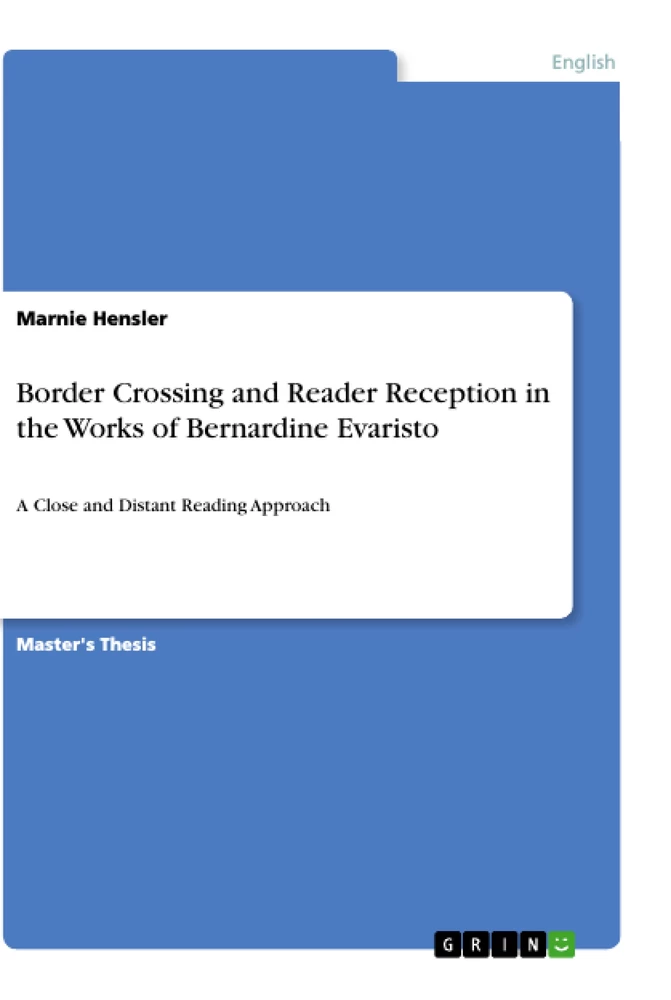
Table of Contents
I. Border-Crossing Fiction
II. Theoretical Introduction
1. Border Crossing and Reader Transportation
2. Reader-Response Criticism and Reception Theory
3. Cognitive Literary Studies: Theory of Mind & Narrative Empathy
4. The Empirical About Literary and Reception Studies
III. Methodological Introduction
IV. Results
1. General Findings
2. The Emperor’s Babe (2001)
a) Reader Profiles, Ratings and Reviews
b) Historicity
c) Zuleika
d) Language
e) Form
3. Mr. Loverman (2013)
a) Reader Profiles, Ratings and Reviews
b) Barry
c) Carmel
d) Morris
e) Humour
4. Girl, Woman, Other (2019)
a) Reader Profiles, Ratings and Reviews
b) Intersectionality
c) Polyphony
d) Form
e) Stereotyping
V. Discussion
VI. Conclusion & Outlook
VII. Appendix
Research Objectives and Themes
The primary objective of this thesis is to empirically analyze the border-crossing and educational effects of literature by examining the reception of Bernardine Evaristo’s novels. The research aims to understand how textual strategies, such as narrative techniques and character development, intersect with reader variables to facilitate cognitive transportation into story worlds and influence real-life cognition.
- Empirical analysis of reader reception using Goodreads data
- Application of "distant" and "close" reading methods
- Investigation of cognitive literary theories including Theory of Mind and narrative empathy
- Examination of intersectionality, identity, and social categorization in contemporary British literature
- Evaluation of how narrative structures, such as polyphony and experimental form, influence reader engagement
Excerpt from the Book
b) Historicity
The Emperor’s Babe’s epigraph by Oscar Wilde (“The one duty we owe to history is to rewrite it” (Evaristo, TEB viii) already hints at the verse-novel’s temporal border crossing. Set in 211 CE, The Emperor’s Babe takes the 21st century reader on a historical journey to Roman Londinium. Similar to historical novels, The Emperor’s Babe is set more than 40 to 60 years in the past (3rd century CE), evolves around important, public events, which affect the fictional characters (i.e., war with Caledonia, “from Hadrian’s Wall // to the Antonine Wall // and way up to the North Sea” (Evaristo, TEB 130f.)), and features a real historical figure (Septimius Severus, the Roman Emperor) (Fleishman qtd. in Gendusa 50).
The Emperor’s Babe’s historicity is paired with 21st-century references to facilitate reader transportation into the story world. For example, several geographical references to present-day London like “Fenchurch” street (Evaristo, TEB 11) “Kent”, “Greenwich”, “River Fleet”, “River Ravensbourne” and “Thamesmead” (168), amongst many others, complement the novel’s historicity as observed by one reviewer: “While the setting is Roman Londinium AD and many of the details of living conditions, clothing, and food are historically accurate, modern idioms and place names like St. Paul’s and Greenwich establish links with present-day London”8.
Summary of Chapters
I. Border-Crossing Fiction: Introduces the theoretical framework regarding literature's power to influence social cognition and outlines the dual method of distant and close reading used to analyze Evaristo's works.
II. Theoretical Introduction: Provides the academic background on border studies, reader-response criticism, and the cognitive turn in literary theory, specifically focusing on Theory of Mind and narrative empathy.
III. Methodological Introduction: Describes the data collection process using Goodreads, detailing the extraction of reader reviews and the rationale for using internet-based empirical data.
IV. Results: Presents the statistical findings and thematic analyses for each of the three novels, examining how narrative strategies influence reader reception.
V. Discussion: Compares the findings across the novels, evaluating the role of extra-textual factors like gender and location in shaping reader engagement and empathy.
VI. Conclusion & Outlook: Summarizes the research results and suggests future directions for empirical reception studies in the context of transformative literature.
Keywords
Border-crossing, Reader Reception, Empirical Literary Studies, Narrative Empathy, Theory of Mind, Bernardine Evaristo, The Emperor’s Babe, Mr. Loverman, Girl Woman Other, Distant Reading, Close Reading, Cognitive Literary Studies, Intersectionality, Polyphony, Reader Transportation
Frequently Asked Questions
What is the core focus of this research?
This thesis explores the intersection of literature and social cognition, specifically how fictional works can influence a reader's real-life beliefs and values through "border-crossing" narratives.
Which specific Evaristo novels are analyzed?
The study examines "The Emperor’s Babe" (2001), "Mr. Loverman" (2013), and "Girl, Woman, Other" (2019).
What is the primary research goal?
The goal is to empirically evaluate whether narrative strategies in these novels effectively transport readers into story worlds and induce educational effects regarding social categorizations.
What scientific methods are utilized?
The research employs a combination of quantitative and qualitative methods, including distant reading (statistical analysis of Goodreads data) and close reading (hermeneutic analysis of narrative techniques).
What themes are central to the main chapters?
The chapters focus on historicity, character perspective, language usage, intersectionality, polyphony, and the role of stereotyping in guiding reader empathy.
Which keywords best characterize this work?
Key concepts include border-crossing, narrative empathy, cognitive literary studies, empirical reception, and intersectionality.
How does the author analyze reader reception?
The author scrapes and analyzes 714 reader reviews from Goodreads to identify patterns in rating and thematic focus across different demographic reader groups.
How is the "polyphony" in "Girl, Woman, Other" defined?
Polyphony is analyzed based on Bakhtin's concept, where the novel's twelve female characters each provide an internally focalized perspective, creating a multi-voiced narrative that challenges absolute truth.
What role does humor play in "Mr. Loverman"?
Humor is identified as a narrative strategy that serves as a coping mechanism for the protagonist, Barry, while simultaneously engaging the reader and facilitating empathy for a flawed, complex character.
Ende der Leseprobe aus 84 Seiten
- nach oben
- Arbeit zitieren
- Marnie Hensler (Autor:in), 2021, Border Crossing and Reader Reception in "The Emperor’s Babe", "Mr. Loverman" and "Girl, Woman, Other" by Bernardine Evaristo, München, Page::Imprint:: GRINVerlagOHG, https://www.diplomarbeiten24.de/document/1060169

neugierig - aktuell - relevant
Entdecken Sie hilfreiche Tipps und Tricks rund ums Studium!

Entdecken Sie hilfreiche Tipps und Tricks rund ums Studium!
Ihre Hausarbeit / Abschlussarbeit:

- - Publikation als E-Book und Buch
- - Hohes Honorar auf die Verkäufe
- - Für Sie komplett kostenlos - mit ISBN
- - Es dauert nur 5 Minuten
- - Jede Arbeit findet Leser

- © GRIN Publishing GmbH.
- Alle Inhalte urheberrechtlich geschützt. Kopieren und verbreiten untersagt.
- info@grin.com
- AGB
- Open Publishing
Der GRIN Verlag hat sich seit 1998 auf die Veröffentlichung akademischer eBooks und Bücher spezialisiert. Der GRIN Verlag steht damit als erstes Unternehmen für User Generated Quality Content. Die Verlagsseiten GRIN.com, Hausarbeiten.de und Diplomarbeiten24 bieten für Hochschullehrer, Absolventen und Studenten die ideale Plattform, wissenschaftliche Texte wie Hausarbeiten, Referate, Bachelorarbeiten, Masterarbeiten, Diplomarbeiten, Dissertationen und wissenschaftliche Aufsätze einem breiten Publikum zu präsentieren.
Kostenfreie Veröffentlichung: Hausarbeit, Bachelorarbeit, Diplomarbeit, Dissertation, Masterarbeit, Interpretation oder Referat jetzt veröffentlichen!
Folgen Sie GRIN auf


- GRIN Verlag GmbH
-
- Nymphenburger Str. 86
- 80636
- Munich, Deutschland
- +49 89-550559-0
- +49 89-550559-10
- info@grin.com
-
