
präsentiert von

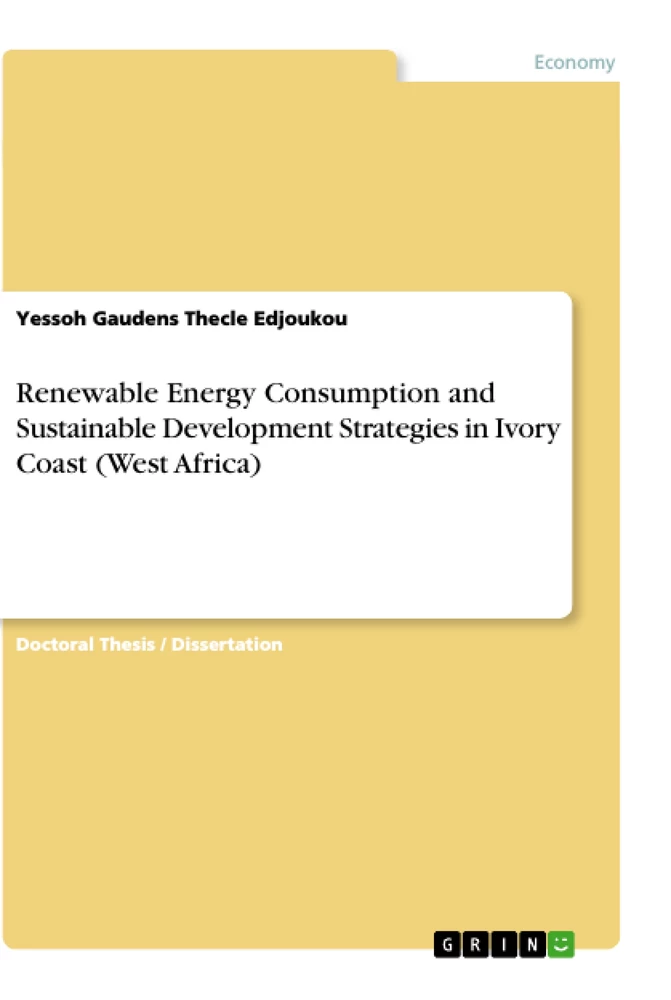
Table of Contents
CHAPTER I: INTRODUCTION
1.1 General introduction
1.2 Theoretical frameworks
1.3 Research objectives and findings
1.4 Research and conceptual frameworks
1.5 Originality and significance of the study
CHAPTER II: LITERATURE REVIEW
2.1 Energy demand forecast
2.2 Multi-criteria decision analysis
2.3 Renewable energy consumption and sustainable development strategies
2.4 Comparison with other studies
2.5 Summary of the chapter
CHAPTER III: OVERVIEW OF THE ENERGY SECTOR IN IVORY COAST
3.1 Organization of the Ivorian energy sector
3.2 Energy resources, supply, and demand
3.3 Power sector and energy access
3.4 Economy and demographic trend
3.5 Summary of the chapter
CHAPTER IV: FORECAST MODEL RESULTS
4.1 Forecast methodological approach
4.2 Data description
4.3 Forecast model’s results
4.4 Summary of the chapter
CHAPTER V: BACK-CASTING APPROACH RESULTS
5.1 Back-casting approach
5.2 Data description
5.3 Back-casting approach results
5.4 Summary of the chapter
CHAPTER VI: DESIGN OF THE NATIONAL ENERGY ACTION PLAN
6.1 AHP model
6.2 Data description
6.3 National energy action plan
6.4 Summary of the chapter
CHAPTER VII: CONCLUSIONS AND POLICY RECOMMENDATIONS
7.1 General conclusion
7.2 Policy recommendations
7.3 Final Discussion
7.4 Research limitations
Research Objectives and Themes
This study aims to determine the conditions necessary for achieving a sustainable energy path in Ivory Coast by 2030, addressing the nation's energy inefficiencies and reliance on conventional, carbon-based fuels to foster inclusive economic and social development.
- Energy demand forecasting using a hybrid PSOSVR-ARIMA model.
- Assessment of alternative energy scenarios via back-casting techniques.
- Design of a national energy action plan using multi-criteria decision analysis (Fuzzy AHP).
- Analysis of the relationship between renewable energy deployment and socioeconomic welfare.
- Evaluation of climate change mitigation strategies in the Ivorian energy sector.
Excerpt from the Book
1.2.1 SUSTAINABILITY AND SUSTAINABLE ENERGY
Sustainability and sustainable development had several definitions throughout these three last decades. The well-known definition and the most cited one is that of the Brundtland Report [7] which is the following:
Sustainable development is a development that meets the needs of the present without compromising the ability of future generations to meet their own needs. This definition stresses the time framework of sustainability, implicitly stating that sustainability should be measured in the long-term. There is also a requirement for equitable development between generations. However, this definition suffers a significant drawback. As discussed by Diesendorf and Andrew, the Bruntland Report emphasizes human needs and fails to mention any requirements concerning natural environments. Though we, human beings, are entirely dependent for our survival on the proper functioning of natural systems. In other words, anything that jeopardizes natural systems’ existence will automatically threaten sustainability, as human beings will be directly affected.
Other definitions that came after the Brundtland Report added ecological considerations. For instance, the International Union for Conservation of Nature and Natural Resources [8]defined sustainable development as ‘‘improving the quality of human life while living within the carrying capacity of supporting ecosystems.’’ In the same perspective, Altwegg et al. [9] defined sustainable development as the ‘‘means ensuring dignified living conditions concerning human rights by creating and maintaining the largest possible range of options for freely defining life plans.’’ These definitions, compared to the Brundtland Report, give explicit provisions for environmental protection. In other words, the stability and the equilibrium of biodiversity and the whole ecosystem is a concern. Another similar definition includes that of Costanza and Patten for who a sustainable system is one that survives and persists [10].
Summary of Chapters
CHAPTER I: INTRODUCTION: This chapter provides the background, objectives, and significance of the study, emphasizing the need for a sustainable energy path in Ivory Coast to combat poverty and ecological degradation.
CHAPTER II: LITERATURE REVIEW: The literature review examines methods for energy demand forecasting, multi-criteria decision analysis techniques, and the socioeconomic impacts of renewable energy.
CHAPTER III: OVERVIEW OF THE ENERGY SECTOR IN IVORY COAST: This chapter details the institutional framework, stakeholders, energy resources, and the supply-demand dynamics currently present in the Ivorian energy sector.
CHAPTER IV: FORECAST MODEL RESULTS: This chapter presents the hybrid PSOSVR-ARIMA modeling approach and its results for predicting primary and sectoral energy demand up to 2030.
CHAPTER V: BACK-CASTING APPROACH RESULTS: This chapter uses the LEAP model to simulate different energy scenarios and pinpoint the most sustainable development path for the country.
CHAPTER VI: DESIGN OF THE NATIONAL ENERGY ACTION PLAN: This chapter details the use of the Fuzzy AHP methodology to rank renewable energy projects based on expert inputs regarding technical, economic, social, and environmental criteria.
CHAPTER VII: CONCLUSIONS AND POLICY RECOMMENDATIONS: The final chapter summarizes the research findings, offers policy recommendations for policymakers, and acknowledges research limitations.
Keywords
energy demand, energy forecast, sustainable energy, energy planning, Ivory Coast, renewable energy, hybrid model, PSOSVR, ARIMA, back-casting, LEAP, multi-criteria decision analysis, Fuzzy AHP, socioeconomic impact, sustainable development
Frequently Asked Questions
What is the fundamental goal of this research?
The research aims to identify the conditions required to establish a sustainable energy path for Ivory Coast by 2030, moving beyond current inefficiencies and reliance on conventional fuel sources.
What are the primary thematic areas explored in the thesis?
The study centers on energy demand forecasting, scenario building for energy transition (back-casting), and the prioritization of renewable energy projects using expert-based decision analysis.
What is the core research question?
The central question asks what specific conditions must be fulfilled to achieve a sustainable energy path for Ivory Coast by the next decade, ensuring economic, environmental, and social advancement.
Which scientific methodologies are employed?
The research utilizes a hybrid PSOSVR-ARIMA model for forecasting, the Long-range Energy Alternative Planning (LEAP) system for scenario building, and the Fuzzy Analytic Hierarchy Process (AHP) for decision making.
What topics are covered in the main body?
The main body covers the current energy sector overview in Ivory Coast, the detailed forecast model results, the evaluation of back-casting energy scenarios, and the design of a national energy action plan based on expert criteria.
What key terms define this work?
Key terms include energy demand, sustainable energy, Ivory Coast, hybrid forecasting models (PSOSVR-ARIMA), back-casting, and multi-criteria decision analysis (Fuzzy AHP).
Why is the "Green Scenario" considered the most sustainable?
The green scenario is deemed most sustainable because it maximizes energy savings, promotes significant renewable energy penetration, and ensures the lowest carbon emission levels compared to other pathways.
How does this study contribute to Ivorian policy?
The study provides a detailed roadmap, the "National Energy Action Plan," which helps decision-makers rank potential renewable energy projects based on technical, economic, social, and environmental factors.
Ende der Leseprobe aus 179 Seiten
- nach oben
- Arbeit zitieren
- Yessoh Gaudens Thecle Edjoukou (Autor:in), 2020, Renewable Energy Consumption and Sustainable Development Strategies in Ivory Coast (West Africa), München, Page::Imprint:: GRINVerlagOHG, https://www.diplomarbeiten24.de/document/1119900

neugierig - aktuell - relevant
Entdecken Sie hilfreiche Tipps und Tricks rund ums Studium!

Entdecken Sie hilfreiche Tipps und Tricks rund ums Studium!
Ihre Hausarbeit / Abschlussarbeit:

- - Publikation als E-Book und Buch
- - Hohes Honorar auf die Verkäufe
- - Für Sie komplett kostenlos - mit ISBN
- - Es dauert nur 5 Minuten
- - Jede Arbeit findet Leser

- © GRIN Publishing GmbH.
- Alle Inhalte urheberrechtlich geschützt. Kopieren und verbreiten untersagt.
- info@grin.com
- AGB
- Open Publishing
Der GRIN Verlag hat sich seit 1998 auf die Veröffentlichung akademischer eBooks und Bücher spezialisiert. Der GRIN Verlag steht damit als erstes Unternehmen für User Generated Quality Content. Die Verlagsseiten GRIN.com, Hausarbeiten.de und Diplomarbeiten24 bieten für Hochschullehrer, Absolventen und Studenten die ideale Plattform, wissenschaftliche Texte wie Hausarbeiten, Referate, Bachelorarbeiten, Masterarbeiten, Diplomarbeiten, Dissertationen und wissenschaftliche Aufsätze einem breiten Publikum zu präsentieren.
Kostenfreie Veröffentlichung: Hausarbeit, Bachelorarbeit, Diplomarbeit, Dissertation, Masterarbeit, Interpretation oder Referat jetzt veröffentlichen!
Folgen Sie GRIN auf


- GRIN Verlag GmbH
-
- Nymphenburger Str. 86
- 80636
- Munich, Deutschland
- +49 89-550559-0
- +49 89-550559-10
- info@grin.com
-
