
präsentiert von

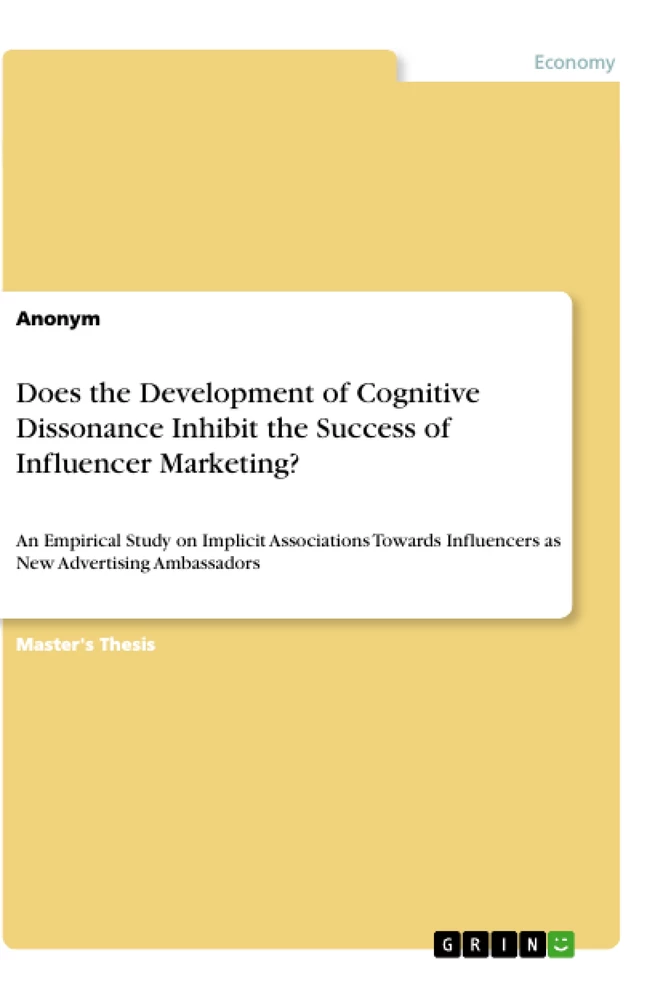
Table of Contents
1. Introduction
1.1 Changes in Marketing
1.2 Aims and Objectives
1.3 Methodological Approach and Structure of the Thesis
2. Identification and Initial Review of Key Literature
2.1 Opinion Leadership
2.1.1 The Two-Step-Flow of Communication
2.1.2 Functions and characteristics of opinion leaders
2.1.3 Typology
2.1.4 The Role of Opinion Leaders in Diffusion Theory
2.1.5 Opinion Leadership - Online
2.2 Influencer Marketing
2.2.1 Definition of Influencer Marketing
2.2.2 Classification and Distinction from other Forms of Marketing
2.2.3 Types of Influencer
2.2.4 Consumer Attitude towards Influencer Marketing
2.2.5 Influencer Marketing in Germany
2.2.6 Influencer Marketing during Corona
2.3 The Concept of Stereotypes
2.3.1 Homo Categoricus
2.3.2 Emergence of Stereotypes
2.3.3 Functions
2.3.4 Application to Influencer Marketing
2.4 Influencing Factors in the Purchasing Process
2.4.1 The Purchase Decision Process
2.4.2 Principles of Influence
2.4.3 Authenticity
2.4.4 Credibility
2.4.5 Alternative Models
2.5 Theory of Cognitive Dissonances
2.5.1 Principles
2.5.2 Emergence of Dissonance
2.5.3 Strength of Dissonance
2.5.4 Purchasing Dissonances
2.5.5 Dissonance Reduction and Elimination
2.5.6 Extensions and Modification of Festinger's Theory
2.6 Research Gap
3. Research Design
3.1 Objectives
3.2 Hypothesis
3.3 Method
3.3.1 Measurement of Attitudes
3.3.2 Implicit Association Test (IAT)
3.3.3 Participants
3.3.4 Structure of the Empirical Study
3.3.5 Structure of the IAT
3.4 Measures
3.5 Results and Interpretation
3.6 Limitation
3.6.1 General Limitation
3.6.2 Limitation of the IAT
4. Discussion
4.1 Summary of Key Findings
4.2 Perspective
Research Objectives and Focus
The master's thesis investigates the influence of stereotypes on consumers within the context of influencer marketing, specifically focusing on whether these stereotypes trigger cognitive dissonance and affect purchasing decisions. The research aims to determine if implicit negative attitudes toward influencers exist and if they create a measurable inhibitory effect on consumer behavior.
- Analysis of the theoretical framework regarding opinion leadership, influencer marketing, and cognitive dissonance.
- Examination of the psychological role of stereotypes in consumer perception of influencers.
- Conducting an empirical Implicit Association Test (IAT) to measure explicit and implicit consumer attitudes.
- Evaluation of whether cognitive dissonance hinders the conversion of marketing efforts into actual purchases.
- Assessment of how influencers can utilize specific principles of influence to mitigate dissonance.
Excerpt from the Book
2.4.2 Principles of Influence
To comprehend the concept of influencer marketing, it is relevant to find out how influencing individuals can work. As the term influencer already implies, consumers are being influenced within their purchasing decisions. In 1984 Robert Cialdini devoted himself to the theory of persuasion. The basic presumption he posited was that people are easily influenced and consequently their actions can be controlled to some extent. After detailed observation, Cialdini found that, due to the increasing complexity of everyday life, people no longer inform themselves about all topics, but rather base their decisions on the advice of influencers (Nirschl & Steinberg, 2018). In his work Influence: Science and Practice the psychologist defined six primary principles according to which humans can be influenced. Since the publication in 2001, the scientific bestseller serves as the basis for the conceptualization of influencer marketing (Brown & Hayes 2008). Cialdini himself defined influencers as individuals with social authority, trustworthiness, devotion and consistent behaviour (Cialdini, 2017).
In this section, the principles will be described and afterwards directly applied to the construct of influencer marketing. The ability to understand the Principles of Influence can help on the one side the influencers to maintain their relationship to their followers and on the other hand the companies to use their marketing budget effectively.
Summary of Chapters
1. Introduction: Outlines the shift in marketing toward influencer-led communication and defines the research objective regarding cognitive dissonance.
2. Identification and Initial Review of Key Literature: Provides a theoretical foundation covering opinion leadership, influencer marketing, stereotype theory, and the mechanics of cognitive dissonance.
3. Research Design: Describes the methodology, including the Implicit Association Test (IAT) framework, participant demographics, and the structural planning of the study.
4. Discussion: Summarizes the key findings of the empirical research and provides a critical outlook on the future of influencer marketing and the management of consumer attitudes.
Keywords
Influencer Marketing, Cognitive Dissonance, Opinion Leadership, Consumer Behavior, Stereotypes, Implicit Association Test, IAT, Purchasing Process, Social Influence, Authenticity, Credibility, Marketing Strategy, Brand Perception, Consumer Attitude, Psychosocial Factors
Frequently Asked Questions
What is the core focus of this research?
The research examines the relationship between consumer stereotypes about influencers and the development of cognitive dissonance during the purchasing process, exploring whether this dissonance inhibits consumer buying behavior.
What are the central topics explored?
The work covers opinion leadership theory, the evolution and structure of influencer marketing, the concept of 'Homo Categoricus' and stereotypes, the psychology of cognitive dissonance, and the application of Cialdini's principles of influence.
What is the primary research question?
The study seeks to answer: "Which effect do cognitive dissonances have on the purchase of products advertised by Influencers?"
Which scientific method is applied?
The author uses a mixed-methods approach, relying on a theoretical literature analysis and an empirical study consisting of an Implicit Association Test (IAT) to capture subconscious attitudes.
What does the main body cover?
It establishes the conceptual framework, discusses the theoretical underpinnings of influence, details the design and implementation of the IAT, and analyzes the resulting data to draw conclusions about consumer attitudes.
Which keywords define this thesis?
The study is defined by terms such as Influencer Marketing, Cognitive Dissonance, Opinion Leadership, Consumer Behavior, Stereotypes, and Implicit Association Test.
How does the author define the 'D-Score' in the context of the study?
The D-Score is a metric derived from the IAT to quantify the strength of an implicit preference. A score between 0.35 and 0.65 indicates a medium preference, while values above 0.65 suggest a strong preference.
Why are micro-influencers highlighted in the final perspective?
The author suggests that micro-influencers are more effective at building strong bonds and credibility with followers, which can reduce negative implicit attitudes and mitigate the development of cognitive dissonance.
Ende der Leseprobe aus 102 Seiten
- nach oben
- Arbeit zitieren
- Anonym (Autor:in), 2020, Does the Development of Cognitive Dissonance Inhibit the Success of Influencer Marketing?, München, Page::Imprint:: GRINVerlagOHG, https://www.diplomarbeiten24.de/document/1127948

neugierig - aktuell - relevant
Entdecken Sie hilfreiche Tipps und Tricks rund ums Studium!

Entdecken Sie hilfreiche Tipps und Tricks rund ums Studium!
Ihre Hausarbeit / Abschlussarbeit:

- - Publikation als E-Book und Buch
- - Hohes Honorar auf die Verkäufe
- - Für Sie komplett kostenlos - mit ISBN
- - Es dauert nur 5 Minuten
- - Jede Arbeit findet Leser

- © GRIN Publishing GmbH.
- Alle Inhalte urheberrechtlich geschützt. Kopieren und verbreiten untersagt.
- info@grin.com
- AGB
- Open Publishing
Der GRIN Verlag hat sich seit 1998 auf die Veröffentlichung akademischer eBooks und Bücher spezialisiert. Der GRIN Verlag steht damit als erstes Unternehmen für User Generated Quality Content. Die Verlagsseiten GRIN.com, Hausarbeiten.de und Diplomarbeiten24 bieten für Hochschullehrer, Absolventen und Studenten die ideale Plattform, wissenschaftliche Texte wie Hausarbeiten, Referate, Bachelorarbeiten, Masterarbeiten, Diplomarbeiten, Dissertationen und wissenschaftliche Aufsätze einem breiten Publikum zu präsentieren.
Kostenfreie Veröffentlichung: Hausarbeit, Bachelorarbeit, Diplomarbeit, Dissertation, Masterarbeit, Interpretation oder Referat jetzt veröffentlichen!
Folgen Sie GRIN auf


- GRIN Verlag GmbH
-
- Nymphenburger Str. 86
- 80636
- Munich, Deutschland
- +49 89-550559-0
- +49 89-550559-10
- info@grin.com
-
