
präsentiert von

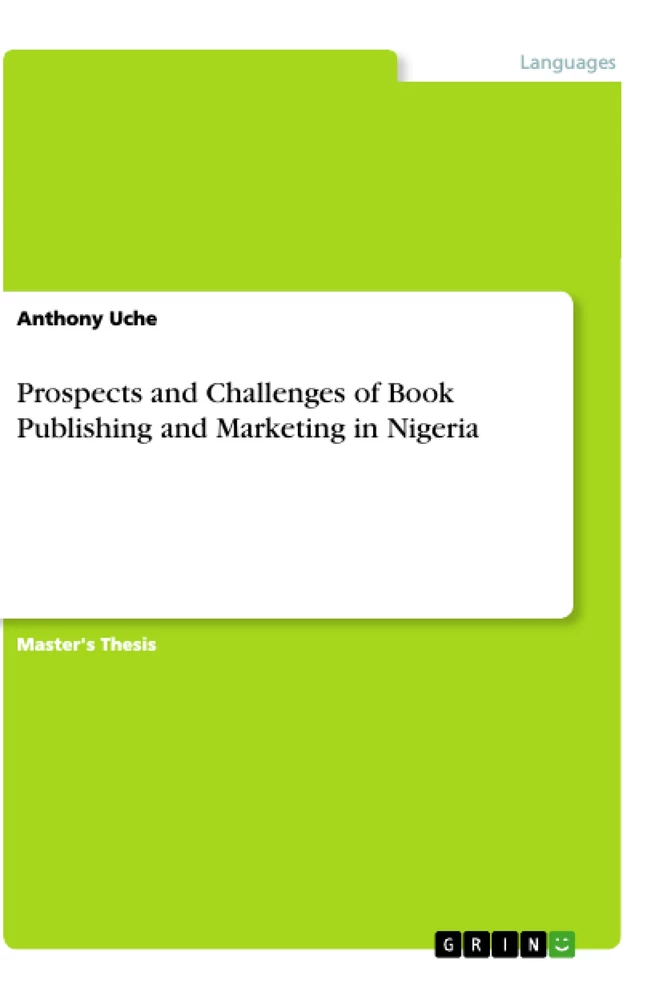
Table of Contents
CHAPTER ONE: INTRODUCTION
1.1 BACKGROUND OF THE STUDY
1.2 STATEMENT OF PROBLEM
1.3 OBJECTIVES OF THE STUDY
1.4 RESEARCH QUESTIONS
1.5 SIGNIFICANCE OF THE STUDY
1.6 SCOPE OF THE STUDY
1.7 DEFINITION OF TERMS
CHAPTER TWO: LITERATURE REVIEW
2.1 AN OVERVIEW OF THE PUBLISHING INDUSTRY’S LANDSCAPE
2.2 BRIEF HISTORY OF LITERAMED PUBLICATIONS NIGERIA LIMITED
2.3 HISTORY OF PUBLISHING
2.4 NIGERIAN PUBLISHING JOURNEY
2.5 PARTNERS IN PUBLISHING
2.5.1 THE WRITER
2.5.2 THE PUBLISHER
2.5.3 THE PRINTER
2.6 BOOK PUBLISHING AS A MASS COMMUNICATION MEDIUM
2.7 THE PUBLISHING PROCESS
2.8 CATEGORIES/BRANCHES OF BOOK PUBLISHING
2.9 MAJOR DEPARTMENTS IN A PUBLISHING COMPANY
2.9.1 THE EDITORIAL DEPARTMENT
2.9.2 THE PRODUCTION DEPARTMENT
2.9.3 MARKETING DEPARTMENT
2.9.4 THE ADMINISTRATION DEPARTMENT
2.10 BOOK PUBLISHING AND THE SOCIO-ECONOMIC SITUATION OF NIGERIA
2.11 FACTORS MILITATING AGAINST BOOK PUBLISHING
2.11.1 POOR READERSHIP/BOOK BUYING CULTURE
2.11.2 COST OF PUBLISHING
2.11.3 PIRACY
2.11.4 WEAK DISTRIBUTION FRAMEWORK
2.12 PROSPECTS IN BOOK PUBLISHING
2.13 GOVERNMENT INTERVENTIONS IN THE NIGERIAN BOOK INDUSTRY
2.14 BOOK MARKETING IN NIGERIA
2.15.1 DISTRIBUTOR/WHOLESALER
2.14.2 BOOKSHOPS
2.14.3 DISTRIBUTION BY DIRECT SALE
2.15 BOOK MARKETING IN LITERAMED PUBLICATIONS LIMITED
2.15.1 Company Sales Representatives
2.15.2 Distributors and Stockists:
2.15.3 Retailers
2.15.4 Institutional Sales:
2.15.5 Teachers Workshops
2.16 EMPIRICAL STUDIES
2.16.1 Electronic publishing
2.16.2 The Impact of Internet on Book Publishing and Readership
2.17 THEORETICAL FRAMEWORK
CHAPTER THREE: METHODOLOGY
3.1 RESEARCH DESIGN
3.2 POPULATION OF STUDY
3.3 SAMPLING PROCEDURE
3.4 SAMPLE SIZE
3.5 DATA COLLECTION INSTRUMENT
3.6 PRETEST AND VALIDATION OF RESEARCH INSTRUMENT
3.7 DATA COLLECTION
3.8 METHOD OF DATA ANALYSIS
CHAPTER FOUR: DATA PRESENTATION AND ANALYSIS
4.1 ANALYSIS OF RESEARCH QUESTIONS
4.2 DISCUSSION OF FINDINGS
CHAPTER FIVE: SUMMARY, CONCLUSION AND RECOMMENDATIONS
5.1 SUMMARY OF FINDINGS
5.2 CONCLUSION
5.3 RECOMMENDATIONS
5.4 SUGGESTIONS FOR FURTHER STUDIES
5.5 LIMITATIONS OF THE STUDY
Research Objectives and Themes
This study aims to investigate the opportunities and challenges facing the book publishing and marketing sector in Nigeria, specifically focusing on the indigenous company Literamed Publications Nigeria Limited. It seeks to understand the role of indigenous publishers in economic development and identify effective marketing strategies and operational hurdles in the industry.
- Contributions of indigenous publishers to the Nigerian economy.
- Challenges within the Nigerian book publishing industry.
- Marketing strategies employed by Literamed Publications.
- Impact of piracy and infrastructure on publishing operations.
- Prospects for industry growth through educational policy and enrollment.
Excerpt from the Book
2.11.3 PIRACY
Book piracy is perhaps the most controversial issue in the Nigerian book industry today (Okoro, 1990, p. 207). All creative artists in Nigeria are victims of pirates who rob them of the products of their ingenuity this acts as a great disincentive to creativity and the society is worse for it (Uzochukwu, 2005, p. 25). Adegbola (2009, p. 42) identified the major hotbeds of piracy to include Ajegunle, Aba and Onitsha. According to Smith (1989, p. 8) the main argument against piracy—frequently ignored in developing countries—is that piracy prevents the growth of the indigenous book industry.”
In his paper presentation in Enugu on Indigenous publishing and national development, Dan Obidiegwu asserts that indigenous publishing business in Nigeria today is fast crumbling under the weight of organized book piracy, which is the infringement of copyright (Obidiegwu, 2006, p. 112). The piracy cankerworm which reared its ugly head somewhat in the 1980s has become a full blown monster to the book industry in Nigeria. Up till the early 90s, pirates were considered to be responsible for stealing between 40% and 60% of the publishers’ legitimate income and market. Today, as a result of the failure of the combined might of the (very effeminate and slow) judicial system and copyright owners to secure conviction and appropriate punishment for offenders, we are talking of up to 80% or more criminal market encroachment by book pirates. This menace is indeed a major disincentive to the mental and physical vigours of creative thought and expression demanded of the writer, as well as the professional processing and financial risk-taking expected of the publisher (Obidiegwu, 2009, 17).
Summary of Chapters
CHAPTER ONE: INTRODUCTION: This chapter provides an overview of the Nigerian publishing landscape, establishes the problem of industry underdevelopment, and defines the research objectives and scope.
CHAPTER TWO: LITERATURE REVIEW: This chapter reviews existing academic discourse on the publishing industry, including its history, the role of various partners, industry categories, and the specific challenges like piracy and poor distribution.
CHAPTER THREE: METHODOLOGY: This chapter details the survey research design, the population of Literamed Publications staff, and the multi-stage sampling procedure used for data collection.
CHAPTER FOUR: DATA PRESENTATION AND ANALYSIS: This chapter presents the statistical data gathered from staff questionnaires and analyzes the findings regarding the publishing industry's performance and challenges.
CHAPTER FIVE: SUMMARY, CONCLUSION AND RECOMMENDATIONS: This chapter summarizes the key findings, concludes the study's implications, and offers actionable recommendations for stakeholders in the publishing industry.
Keywords
Book publishing, Nigeria, Literamed Publications, marketing, piracy, educational development, indigenous publishers, readership culture, copyright, printing industry, distribution framework, mass communication, economic growth, infrastructure, literary development.
Frequently Asked Questions
What is the primary focus of this research?
This research focuses on the prospects and challenges of the book publishing and marketing industry in Nigeria, with an in-depth case study of Literamed Publications Nigeria Limited.
What are the central themes discussed in the study?
The central themes include the economic impact of publishing, the obstacles such as piracy and poor infrastructure, and the role of marketing strategies in overcoming market saturation and distribution issues.
What is the main research objective?
The main objective is to identify the contributions of indigenous publishers to the Nigerian economy, analyze their challenges, and evaluate the specific marketing strategies and future prospects for Literamed Publications.
What research methodology was employed?
The study utilized a survey research method, using a structured 17-point questionnaire administered to a randomly selected sample of 190 staff members from Literamed Publications.
What major challenges does the Nigerian publishing industry face?
The study highlights book piracy as the most significant challenge, alongside inadequate electricity, the high cost of raw materials like paper, and a weak distribution framework.
Which keywords best describe this work?
Key terms include book publishing, piracy, indigenous publishers, market strategies, copyright, educational textbooks, and infrastructure.
How does Literamed Publications market its books?
Literamed employs a multi-sectoral approach, including direct sales to schools, collaboration with distributors and bookshops, institutional sales, and the use of company sales representatives.
What role does the government play in the publishing sector according to the findings?
Respondents indicated that the government has a crucial role to play, particularly in providing adequate infrastructure (like electricity), offering credit facilities, and aggressively fighting book piracy to protect intellectual property.
Ende der Leseprobe aus 78 Seiten
- nach oben
- Arbeit zitieren
- Anthony Uche (Autor:in), 2014, Prospects and Challenges of Book Publishing and Marketing in Nigeria, München, Page::Imprint:: GRINVerlagOHG, https://www.diplomarbeiten24.de/document/1129258

neugierig - aktuell - relevant
Entdecken Sie hilfreiche Tipps und Tricks rund ums Studium!

Entdecken Sie hilfreiche Tipps und Tricks rund ums Studium!
Ihre Hausarbeit / Abschlussarbeit:

- - Publikation als E-Book und Buch
- - Hohes Honorar auf die Verkäufe
- - Für Sie komplett kostenlos - mit ISBN
- - Es dauert nur 5 Minuten
- - Jede Arbeit findet Leser

- © GRIN Publishing GmbH.
- Alle Inhalte urheberrechtlich geschützt. Kopieren und verbreiten untersagt.
- info@grin.com
- AGB
- Open Publishing
Der GRIN Verlag hat sich seit 1998 auf die Veröffentlichung akademischer eBooks und Bücher spezialisiert. Der GRIN Verlag steht damit als erstes Unternehmen für User Generated Quality Content. Die Verlagsseiten GRIN.com, Hausarbeiten.de und Diplomarbeiten24 bieten für Hochschullehrer, Absolventen und Studenten die ideale Plattform, wissenschaftliche Texte wie Hausarbeiten, Referate, Bachelorarbeiten, Masterarbeiten, Diplomarbeiten, Dissertationen und wissenschaftliche Aufsätze einem breiten Publikum zu präsentieren.
Kostenfreie Veröffentlichung: Hausarbeit, Bachelorarbeit, Diplomarbeit, Dissertation, Masterarbeit, Interpretation oder Referat jetzt veröffentlichen!
Folgen Sie GRIN auf


- GRIN Verlag GmbH
-
- Nymphenburger Str. 86
- 80636
- Munich, Deutschland
- +49 89-550559-0
- +49 89-550559-10
- info@grin.com
-
