
präsentiert von

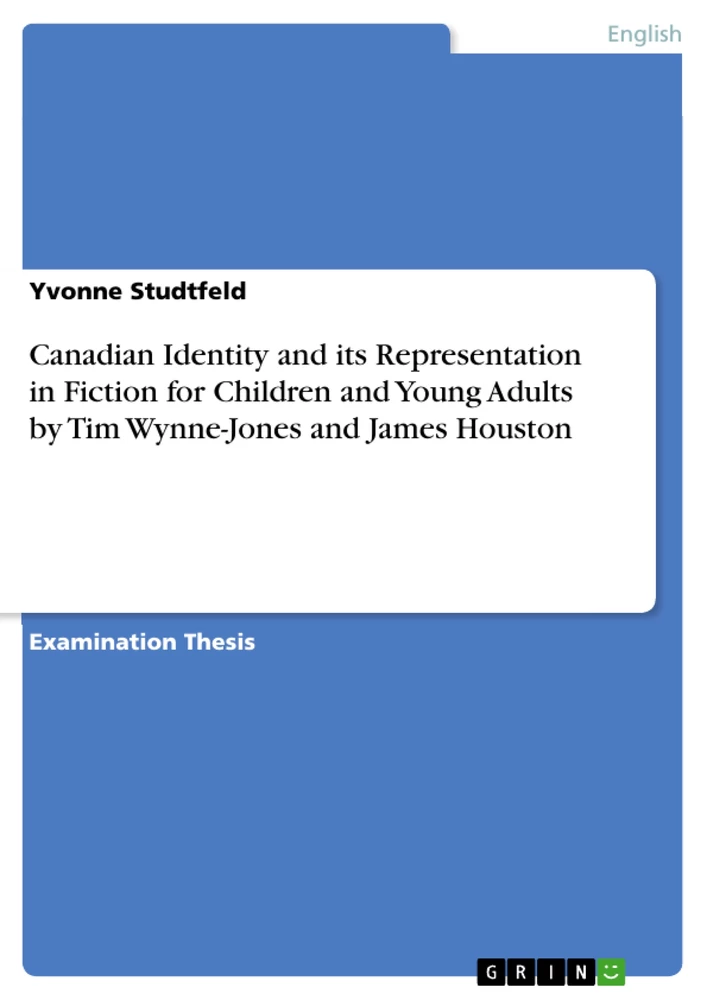
Table of Contents
1. Introduction
2. The concept of identity
3. Personal identity
3.1. Growing up
3.2 Proper names
4. National identity
4.1 Authorship and publishing
4.2 Identity through place
4.2.1 The North
4.2.2 The wilderness
4.2.3 The northern wilderness
4.3 The role of religion
4.4 The role of multiculturalism
4.4.1 The role of language
4.4.2 The First Nations
4.5 The role of history
4.6 The role of the social community
5. National literature in Canadian classrooms
6. Conclusion
Objectives & Themes
This work examines the representation of identity in children's and young adult literature by authors Tim Wynne-Jones and James Houston, specifically analyzing how Canadian national identity is reflected in their narratives.
- The intersection of personal and national identity development in adolescence.
- The significance of geographical place, wilderness, and the "North" as Canadian cultural symbols.
- The influence of multiculturalism, language, and historical narrative on national belonging.
- The pedagogical role of Canadian literature in the classroom for shaping future citizen identity.
Excerpt from the Book
3.2 Proper names
“The relationships between the name and personality of the bearer have been close in all cultures and times.”56 Thus, the name of a person is an important identity element. Through it, others may refer to us and in western culture, identification papers bearing one’s name are important when dealing with authorities as well as in numerous other contexts.
James Houston makes intensive use of the name as an identity element in all three works Drifting Snow, Whiteout and RiverRunners. In Drifting Snow, the changes in the protagonist’s name reflect her search for identity. As a baby, the Inuit girl is brought south in order to cure her of tuberculosis. Her identification papers get lost and she grows up in the south of Canada by the made-up name of Elizabeth Queen, away from her true parents and home in the Arctic. When she returns to find her true identity, she recalls:
I thought my real name was Elizabeth Queen, but a teacher told me later that it was only a made-up name. Because the picture of Queen Elizabeth of England was on the paper money they used, they decided to name me Elizabeth Queen.57
At this point, the girl’s name openly refers to Great Britain and to the colonial heritage of Canada. Aware that she knows neither her true name, nor her age and place of birth, Elizabeth is uncertain about her identity: “I don’t know who I am, or where I came from. I’ve got to find out more about myself, my place, my people.”58 After several unsuccessful visits to small settlements and Inuit camps that are only briefly mentioned in the novel59, she arrives in an Inuit camp where she will end up staying in order to become familiar with Inuit culture. Here Poota, an Inuit boy, immediately alters her name into Elizapee, and sticks to the change even though Elizabeth corrects him: “My name is Elizabeth, not Elizapee!”60
Summary of Chapters
1. Introduction: Presents the research focus on Canadian identity within children’s literature and establishes the relevance of the chosen authors.
2. The concept of identity: Defines identity through social, personal, and collective lenses, emphasizing the interdisciplinary theoretical framework.
3. Personal identity: Analyzes the adolescent transition phase and the role of naming as fundamental aspects of self-definition in the selected novels.
4. National identity: Explores key cultural commonplaces such as the North, wilderness, religion, and multiculturalism as defining factors of Canadianness.
5. National literature in Canadian classrooms: Discusses the educational importance of including national literature in curricula to foster identity and cultural awareness.
6. Conclusion: Summarizes how the studied novels reflect the multilayered and evolving nature of Canadian identity through literature.
Keywords
Canadian identity, children's literature, young adult fiction, James Houston, Tim Wynne-Jones, personal identity, national identity, Canadian wilderness, North, multiculturalism, adolescence, literary analysis, culture, narrative, self-discovery
Frequently Asked Questions
What is the fundamental focus of this research paper?
The paper explores how Canadian identity, both personal and national, is represented in selected children's and young adult novels by Tim Wynne-Jones and James Houston.
What are the primary themes discussed throughout the work?
Central themes include the search for self during adolescence, the symbolic importance of the Canadian North and wilderness, and the nation's struggle with defining a cohesive collective identity.
What is the main research objective?
The goal is to determine how Canadian authors thematize national identity and whether these works serve as effective tools for young readers to explore their own sense of belonging.
Which scientific methodology is applied?
The author uses a literary and cultural studies approach, applying social science theories (e.g., identity, socialization) to analyze six specific novels and their cultural context.
What topics are covered in the main body of the work?
The body analyzes personal identity through names and growing up, followed by national identity elements like religion, multiculturalism, history, and the social community.
Which keywords best characterize this academic study?
The work is defined by concepts such as Canadianness, CanLit, adolescent identity formation, the Canadian mosaic, and the symbolic geography of the North.
How does the author characterize the role of the Canadian wilderness in these novels?
The wilderness is depicted as both a physical challenge and a psychological space that forces protagonists to confront their self-image and adapt to survive.
In what way does the study address the role of names in identity formation?
The author examines how characters like Elizapee (Drifting Snow) and Stephen Fair use naming to negotiate their cultural background, history, and personal sense of self.
Ende der Leseprobe aus 70 Seiten
- nach oben
- Arbeit zitieren
- Yvonne Studtfeld (Autor:in), 2008, Canadian Identity and its Representation in Fiction for Children and Young Adults by Tim Wynne-Jones and James Houston, München, Page::Imprint:: GRINVerlagOHG, https://www.diplomarbeiten24.de/document/113140

neugierig - aktuell - relevant
Entdecken Sie hilfreiche Tipps und Tricks rund ums Studium!

Entdecken Sie hilfreiche Tipps und Tricks rund ums Studium!
Ihre Hausarbeit / Abschlussarbeit:

- - Publikation als E-Book und Buch
- - Hohes Honorar auf die Verkäufe
- - Für Sie komplett kostenlos - mit ISBN
- - Es dauert nur 5 Minuten
- - Jede Arbeit findet Leser

- © GRIN Publishing GmbH.
- Alle Inhalte urheberrechtlich geschützt. Kopieren und verbreiten untersagt.
- info@grin.com
- AGB
- Open Publishing
Der GRIN Verlag hat sich seit 1998 auf die Veröffentlichung akademischer eBooks und Bücher spezialisiert. Der GRIN Verlag steht damit als erstes Unternehmen für User Generated Quality Content. Die Verlagsseiten GRIN.com, Hausarbeiten.de und Diplomarbeiten24 bieten für Hochschullehrer, Absolventen und Studenten die ideale Plattform, wissenschaftliche Texte wie Hausarbeiten, Referate, Bachelorarbeiten, Masterarbeiten, Diplomarbeiten, Dissertationen und wissenschaftliche Aufsätze einem breiten Publikum zu präsentieren.
Kostenfreie Veröffentlichung: Hausarbeit, Bachelorarbeit, Diplomarbeit, Dissertation, Masterarbeit, Interpretation oder Referat jetzt veröffentlichen!
Folgen Sie GRIN auf


- GRIN Verlag GmbH
-
- Nymphenburger Str. 86
- 80636
- Munich, Deutschland
- +49 89-550559-0
- +49 89-550559-10
- info@grin.com
-
