
präsentiert von

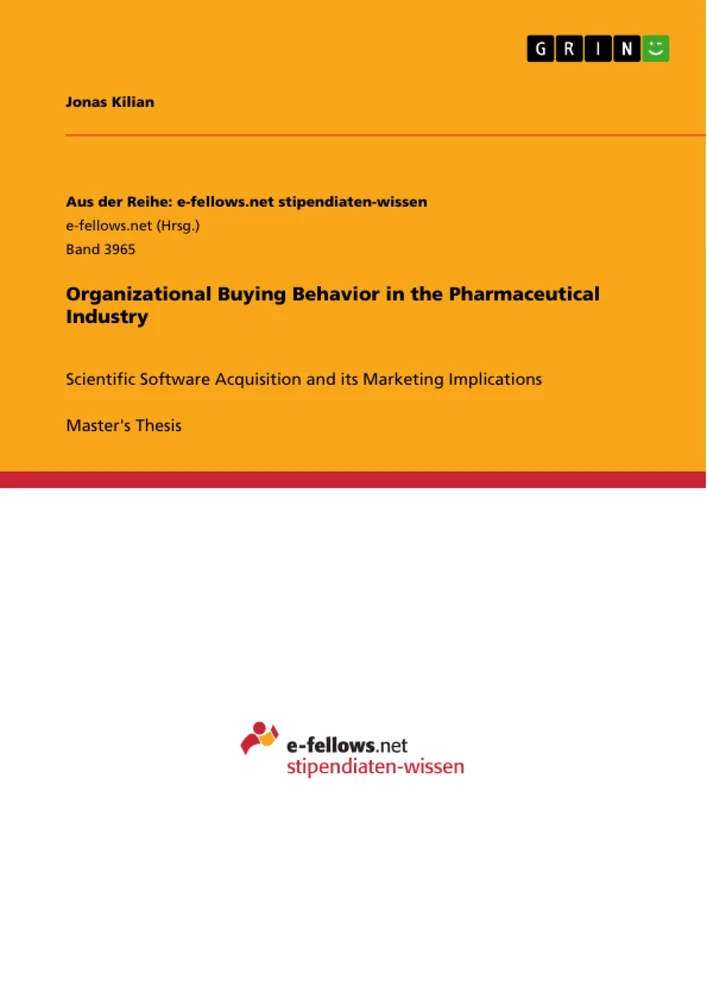
Table of Contents
Chapter 1: Introduction
1.1 Background
1.2 Research Questions
1.3 Research Objectives
1.4 Thesis Outline
Chapter 2: Literature Review
2.1 Organizational Buying Behavior
2.2 The Organizational Buying Process
2.2.1 Factors Affecting The Organizational Buying Process
2.2.2 Purchase Decision Drivers
2.3 Participants in The Organizational Buying Process – Buying Center
2.3.1 Decider Typology
2.3.2 Buying Center-Map
2.4 B2B Marketing Approaches
2.4.1 Content Marketing
2.4.2 Thought Leadership
Chapter 3: Methodology
3.1 Guiding Paradigm and Research Design
3.2 Data Collection
3.3 Sample Selection
3.4 Data Analysis and Interpretation
3.5 Ethical Issues
3.6 Quality Criteria in Qualitative Research
3.6.1 Validity
3.6.2 Reliability
Chapter 4: Findings
4.1 Brand Awareness
4.1.1 Direct Vendor-Customer Interaction
4.1.2 Indirect Vendor-Customer Interaction
4.2 Deciding Factors
4.2.1 Product Features
4.2.2 Soft Factors
4.2.3 Economic Factors
4.3 Decision-Making Unit
4.3.1 Scientific Personnel
4.3.2 Non-Scientific Personnel
4.4 Buying Process
4.4.1 Need Identification
4.4.2 Team Building
4.4.3 Evaluation
4.4.4 Decision-Making
Chapter 5: Discussion & Conclusions
5.1 Discussion
5.1.1 The Buying Center
5.1.2 The Buying Process
5.1.3 Deciding Factors
5.2 Marketing Implications
5.3 Conclusions
5.4 Limitations and Future Research
Research Objective & Themes
The primary objective of this dissertation is to examine the organizational buying behavior (OBB) within the pharmaceutical industry specifically regarding the acquisition of scientific software. By identifying the key participants, the sequential buying process, and the core factors influencing decisions, the study aims to provide strategic marketing recommendations for scientific software vendors to effectively reach their B2B target groups.
- Analysis of the organizational buying process in scientific software acquisition.
- Identification of key influencers and decision-makers within pharmaceutical companies.
- Evaluation of product, soft, and economic factors influencing purchase decisions.
- Development of a conceptual framework for marketing and thought leadership strategies.
Excerpt from the Book
4.1.1 Direct Vendor-Customer Interaction
Among the various touchpoints belonging to this sub-theme, one consistently stood out: conference booths and presentations (Respondents A1, B1, C1, C2, D1, E1, F1, F2, G2, H1, I1, K1, K2, M1, and N1).
“The value of conferences cannot be emphasized often enough.” (Respondent D1)
Scientific conferences are seen as convenient venues where one can get an overview over the “state-of-the-art options” of the scientific software market (Respondent C1). Especially newer vendors can raise their level of awareness by being present at these conferences (Respondents C2 and F1). It is also important to note that encounters with SSVs at conferences are not merely by chance, instead, it has been noted that scientists often are pro-actively on the look (Respondents H1 and F2).
However, the ongoing coronavirus pandemic and the associated travelling restrictions and social distancing measures have led to the cancellation of numerous scientific conferences (Fulcher et al., 2020). Thus, as a digital alternative to keep track of current developments in the field of scientific software, many respondents mentioned webinars (Respondents A2, C1, C2, E1, F2, G2, H1, K2, and L1). The major benefits of webinars seem to be the ease of participation, by taking only “an hour of your time” (Respondent A2), and the absence of any fees (Respondents E1 and H1). Notably, it seems more likely to join the webinar of a company which is already on one’s mind (Respondents C1 and G2). What, however, seems to be a no-go, is an advertising heavy Webinar (Respondents A2 and B1).
“I know that a webinar is an advert, so then I'll be looking if the webinar is talking about a lot of science. That's good. If it's purely an advertising pitch, I'll probably turn it off.” (Respondent B1)
Summary of Chapters
Chapter 1: Introduction: Introduces the critical importance of scientific software for R&D efficiency in the pharmaceutical industry and outlines the research questions and objectives of the study.
Chapter 2: Literature Review: Provides the theoretical grounding by discussing organizational buying behavior models, the buying center concept, and contemporary B2B marketing strategies like content marketing and thought leadership.
Chapter 3: Methodology: Explains the qualitative research design, detailing the semi-structured interview approach, sampling selection criteria, and the thematic analysis methodology used.
Chapter 4: Findings: Presents the empirical results of the study, structured into themes including brand awareness, deciding factors, the decision-making unit, and the multi-phase buying process.
Chapter 5: Discussion & Conclusions: Relates the findings back to the existing literature, derives practical marketing implications for software vendors, and identifies limitations alongside recommendations for future research.
Keywords
Organizational Buying Behavior, Pharmaceutical Industry, Scientific Software, B2B Marketing, Buying Center, Decision-Making Unit, Content Marketing, Thought Leadership, Qualitative Research, R&D Efficiency, Software Acquisition, Buying Process, Product Features, Soft Factors, Economic Factors
Frequently Asked Questions
What is the core focus of this research?
The research explores how pharmaceutical companies acquire scientific software and how software vendors can improve their marketing strategies to target this niche market effectively.
What are the primary themes discussed in this study?
The study centers on brand awareness, the factors driving purchase decisions (product, soft, and economic factors), the composition of the decision-making unit, and the actual buying process stages.
What is the ultimate goal of the thesis?
The goal is to provide scientific software vendors with informed recommendations on how to design their marketing activities by understanding the complex buying behavior of pharmaceutical R&D departments.
Which research methodology was utilized?
A qualitative approach was adopted, utilizing semi-structured interviews with 21 industry experts, followed by a generic thematic analysis to identify recurrent patterns.
What does the main body of the work cover?
It covers the theoretical foundations of organizational buying, the methodology of data collection, empirical findings mapped through thematic analysis, and a final discussion relating these findings to known theories.
Which keywords define this work?
Core keywords include Organizational Buying Behavior, Pharmaceutical Industry, Scientific Software, B2B Marketing, and Buying Center.
What role do scientists play in the acquisition of software?
Scientists are identified as the key participants who initiate the buying process and play a pivotal role as influencers and users throughout the entire decision-making journey.
How does the "buying center" for scientific software function?
The buying center consists of a fluid, informal team of scientists, with management only becoming involved for final financial and legal approvals, rather than making the initial technical choices.
What is the recommended marketing approach for vendors?
Vendors are advised to follow a science-heavy content marketing strategy, aiming to become a thought leader rather than relying on aggressive advertising pitches.
Do IT and procurement departments have a significant influence on software choices?
No, their role is primarily formal and technical (security, compliance, and negotiation). They generally do not influence the specific software choices made by scientists.
Ende der Leseprobe aus 55 Seiten
- nach oben
- Arbeit zitieren
- Jonas Kilian (Autor:in), 2021, Organizational Buying Behavior in the Pharmaceutical Industry, München, Page::Imprint:: GRINVerlagOHG, https://www.diplomarbeiten24.de/document/1131867

neugierig - aktuell - relevant
Entdecken Sie hilfreiche Tipps und Tricks rund ums Studium!

Entdecken Sie hilfreiche Tipps und Tricks rund ums Studium!
Ihre Hausarbeit / Abschlussarbeit:

- - Publikation als E-Book und Buch
- - Hohes Honorar auf die Verkäufe
- - Für Sie komplett kostenlos - mit ISBN
- - Es dauert nur 5 Minuten
- - Jede Arbeit findet Leser

- © GRIN Publishing GmbH.
- Alle Inhalte urheberrechtlich geschützt. Kopieren und verbreiten untersagt.
- info@grin.com
- AGB
- Open Publishing
Der GRIN Verlag hat sich seit 1998 auf die Veröffentlichung akademischer eBooks und Bücher spezialisiert. Der GRIN Verlag steht damit als erstes Unternehmen für User Generated Quality Content. Die Verlagsseiten GRIN.com, Hausarbeiten.de und Diplomarbeiten24 bieten für Hochschullehrer, Absolventen und Studenten die ideale Plattform, wissenschaftliche Texte wie Hausarbeiten, Referate, Bachelorarbeiten, Masterarbeiten, Diplomarbeiten, Dissertationen und wissenschaftliche Aufsätze einem breiten Publikum zu präsentieren.
Kostenfreie Veröffentlichung: Hausarbeit, Bachelorarbeit, Diplomarbeit, Dissertation, Masterarbeit, Interpretation oder Referat jetzt veröffentlichen!
Folgen Sie GRIN auf


- GRIN Verlag GmbH
-
- Nymphenburger Str. 86
- 80636
- Munich, Deutschland
- +49 89-550559-0
- +49 89-550559-10
- info@grin.com
-
