
präsentiert von

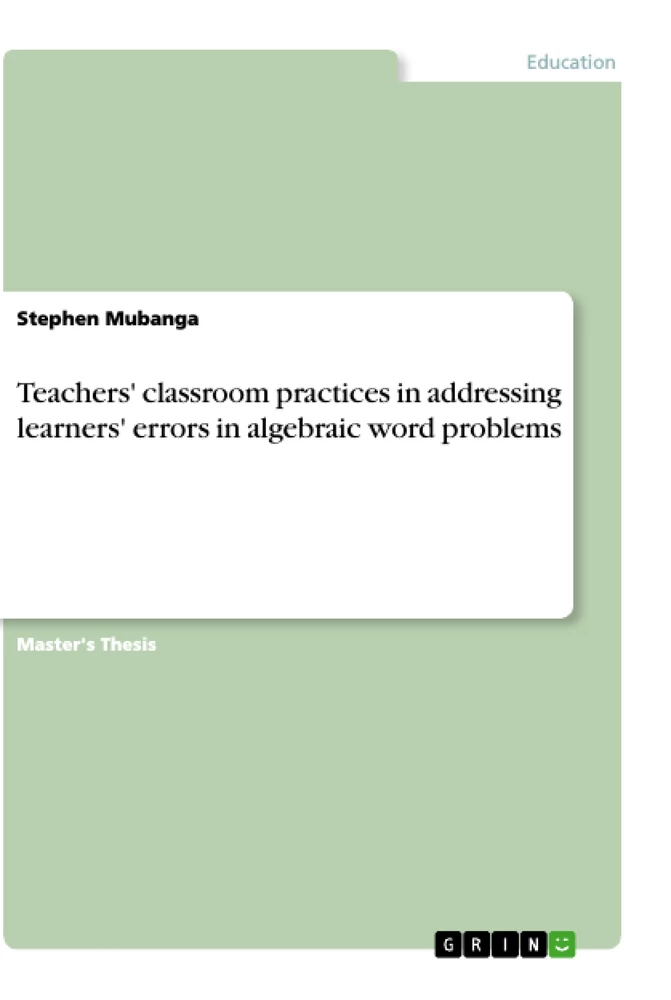
Table of Contents
CHAPTER 1
INTRODUCTION
1.1 Overview
1.2 Background of the study
1.2.1 Poor learner performance in mathematics and curriculum revision
1.2.2 Teachers’ classroom practices in algebra
1.2.3 My personal experience
1.3 Statement of the problem
1.4 Purpose of the study
1.5 Study objectives
1.5.1 General objective
1.5.2 Specific objectives
1.6 Research questions
1.7 Significance of the study
1.8 Scope of the study
1.8.1 Delimitation of the study
1.8.2 Limitation of the study
1.9 Theoretical framework
1.10 Conceptual framework
1.11 Operational definition of terms
1.12 Organisation of the dissertation
CHAPTER 2
REVIEW OF RELATED LITERATURE
2.1 Introduction
2.2 Importance of algebra
2.3 Criterion for error causes or performance strategies
2.4 Learners’ errors in algebra
2.5 Teachers’ classroom practices and learners’ errors
2.6 Studies on learners’ errors in algebra and related topics, and gaps identified
2.7 Summary of the chapter
CHAPTER 3
RESEARCH METHODOLOGY
3.1 Introduction
3.2 Research paradigm
3.3 Research design
3.4 Study area
3.5 Study population
3.6 Study sample
3.7 Sampling techniques
3.8 Data collection methods and instruments
3.8.1 Lesson observations
3.8.2 Semi-structured interviews
3.8.3 Focus group discussions
3.8.4 Document analysis
3.9 Data collection procedures and time line
3.10 Data analysis
3.11 Credibility and trustworthiness of the study
3.12 Ethical considerations
3.13 Summary of the chapter
CHAPTER 4
FINDINGS
4.1 Overview
4.2 Research question 1: How do teachers engage learners in reading algebraic word problems?
4.2.1 Giving chance to learners to read algebraic word problems
4.2.2 Reading the questions for learners
4.3 Research question 2: How do teachers probe learners’ understanding of algebraic word problems?
4.3.1 Comprehension abilities (Literal and specific terminology understanding)
4.3.2 Transformation abilities
4.4 Research question 3: What do teachers do to enhance learners’ process skills and encoding abilities in algebraic word problems?
4.4.1 Process skills
4.4.2 Encoding abilities (Word and symbol recognition)
4.5 Summary of findings for research question 1
4.6 Summary of findings for research question 2
4.7 Summary of findings for research question 3
4.8 Summary of the chapter
CHAPTER 5
DISCUSSION OF FINDINGS
5.1 Introduction
5.2 Reading abilities (Word and Symbol recognition)
5.2.1 Giving chance to learners to read algebraic word problems
5.2.2 Reading the questions for learners
5.3 Understanding of algebraic word problems
5.3.1 Comprehension abilities (Literal and specific terminology understanding)
5.3.2 Transformation abilities
5.4 Process skills and encoding abilities in algebraic word problems
5.4.1 Process skills
5.4.2 Encoding abilities (Word and symbol recognition)
5.5 Summary of the chapter
CHAPTER 6
CONCLUSION AND RECOMMENDATIONS
6.1 Introduction
6.2 Conclusion
6.3 Contribution to the field
6.4 Recommendations
6.4.1 Policy
6.4.2 Practice
6.4.3 Further research
Objectives and Research Themes
The study aims to investigate teachers' classroom practices regarding the identification and correction of grade eight learners' errors in algebraic word problems. The research seeks to understand how teachers engage students in the various stages of problem-solving as outlined by the Newman Error Analysis model, with the ultimate goal of improving conceptual understanding and academic performance in mathematics.
- Teachers' classroom practices in algebraic word problem instruction.
- Identification and correction of learners' common errors.
- Application of the Newman Error Analysis Model.
- Engagement strategies for reading, understanding, and solving algebraic problems.
- The impact of teacher intervention on learner conceptual development.
Excerpt from the Book
1.2.3. My personal experience
The year 2009 was a year of great change in my life. In that year I graduated from the college and began teaching in a private sector on the Copperbelt. I thought teaching mathematics was a very easy task, and I was wrong as it required a lot of time to interact with learners, discovering their errors and challenges in the subject and helping them out. This gave me an opportunity to interact with learners in urban areas. In October the same year, I was employed in the Zambian civil service under the Ministry of General Education and sent to a remote upper basic school in Northern province (now part of Muchinga province). After serving at that station for four months, I was transferred to a nearby secondary school. This also presented another opportunity for me to interact with learners in rural areas and appreciate their challenges in mathematics especially in word problems.
Through the interactions I had with learners in both urban and rural areas, I came to realise that learners found it difficult to solve mathematical problems which were expressed in words. At times I tried to test my learners’ problem solving abilities by giving them the same question, one expressed symbolically and the other one expressed in words. To my surprise, my learners answered correctly the questions expressed symbolically and had challenges in answering the ones expressed in words. For example, “Find x in, 2x – 5 = 11” and “Twice the number minus five equals eleven, find the number”. Learners could find it easy to solve the first one than the second one, as the first one seemed more direct to them than the second one where they were required to understand the words first and then express it symbolically.
Summary of Chapters
Chapter 1: Provides an introduction to the research, outlining the study's background, problem statement, objectives, and theoretical foundation using the ZPD framework.
Chapter 2: Reviews relevant literature on algebraic word problem-solving, the Newman Error Analysis model, and common learner misconceptions in algebra.
Chapter 3: Describes the research methodology, including the constructivist paradigm, qualitative approach, and descriptive case study design used to conduct the investigation.
Chapter 4: Presents the qualitative findings from lesson observations, interviews, and document analysis regarding how teachers engage with learners' problem-solving processes.
Chapter 5: Discusses the findings of the study, linking them back to the literature and the theoretical frameworks to evaluate teaching effectiveness.
Chapter 6: Concludes the research with key findings and provides actionable recommendations for policy, practice, and further academic study.
Keywords
Algebraic word problems, Performance strategies, Reading ability, Comprehension ability, Transformation ability, Process skills, Encoding ability, Error identification, Teacher practice, Mathematics education, Grade eight learners, Newman Error Analysis, Conceptual understanding, Pedagogical skills, ZPD.
Frequently Asked Questions
What is the core focus of this dissertation?
The study focuses on exploring teachers' classroom practices when teaching algebraic word problems to grade eight learners, specifically examining how teachers identify and correct learner errors.
What are the primary themes investigated in this work?
The primary themes include the use of Newman's performance strategies (reading, comprehension, transformation, process skills, and encoding) as a framework to evaluate teachers' effectiveness in addressing learner difficulties.
What is the ultimate goal of the research?
The main goal is to identify effective classroom practices that enhance learners' conceptual understanding of algebraic word problems and minimize common procedural and conceptual errors.
Which research methodology was adopted?
The study utilizes a qualitative approach, specifically a descriptive case study design, employing lesson observations, semi-structured interviews, document analysis, and focus group discussions.
What does the main body of the research address?
The main body investigates how teachers engage students in reading algebraic problems, how they probe student understanding, and what specific steps are taken to refine process skills and final answer encoding.
Which keywords best characterize the study?
The research is characterized by terms such as Algebraic word problems, Performance strategies, Error identification, Teacher practice, and Conceptual understanding.
How does the author interpret learner challenges?
The author identifies that learners often struggle to translate linguistic word statements into mathematical symbols, attributing this to a lack of comprehension and foundational algebraic knowledge.
What specific role does the teacher play in the classroom according to the findings?
The findings suggest that the teacher's role should be that of a mediator within the student's Zone of Proximal Development (ZPD), moving away from simple explanation toward proactive identification of student errors during the learning process.
Ende der Leseprobe aus 138 Seiten
- nach oben
- Arbeit zitieren
- Stephen Mubanga (Autor:in), 2020, Teachers' classroom practices in addressing learners' errors in algebraic word problems, München, Page::Imprint:: GRINVerlagOHG, https://www.diplomarbeiten24.de/document/1133136

neugierig - aktuell - relevant
Entdecken Sie hilfreiche Tipps und Tricks rund ums Studium!

Entdecken Sie hilfreiche Tipps und Tricks rund ums Studium!
Ihre Hausarbeit / Abschlussarbeit:

- - Publikation als E-Book und Buch
- - Hohes Honorar auf die Verkäufe
- - Für Sie komplett kostenlos - mit ISBN
- - Es dauert nur 5 Minuten
- - Jede Arbeit findet Leser

- © GRIN Publishing GmbH.
- Alle Inhalte urheberrechtlich geschützt. Kopieren und verbreiten untersagt.
- info@grin.com
- AGB
- Open Publishing
Der GRIN Verlag hat sich seit 1998 auf die Veröffentlichung akademischer eBooks und Bücher spezialisiert. Der GRIN Verlag steht damit als erstes Unternehmen für User Generated Quality Content. Die Verlagsseiten GRIN.com, Hausarbeiten.de und Diplomarbeiten24 bieten für Hochschullehrer, Absolventen und Studenten die ideale Plattform, wissenschaftliche Texte wie Hausarbeiten, Referate, Bachelorarbeiten, Masterarbeiten, Diplomarbeiten, Dissertationen und wissenschaftliche Aufsätze einem breiten Publikum zu präsentieren.
Kostenfreie Veröffentlichung: Hausarbeit, Bachelorarbeit, Diplomarbeit, Dissertation, Masterarbeit, Interpretation oder Referat jetzt veröffentlichen!
Folgen Sie GRIN auf


- GRIN Verlag GmbH
-
- Nymphenburger Str. 86
- 80636
- Munich, Deutschland
- +49 89-550559-0
- +49 89-550559-10
- info@grin.com
-
