
präsentiert von

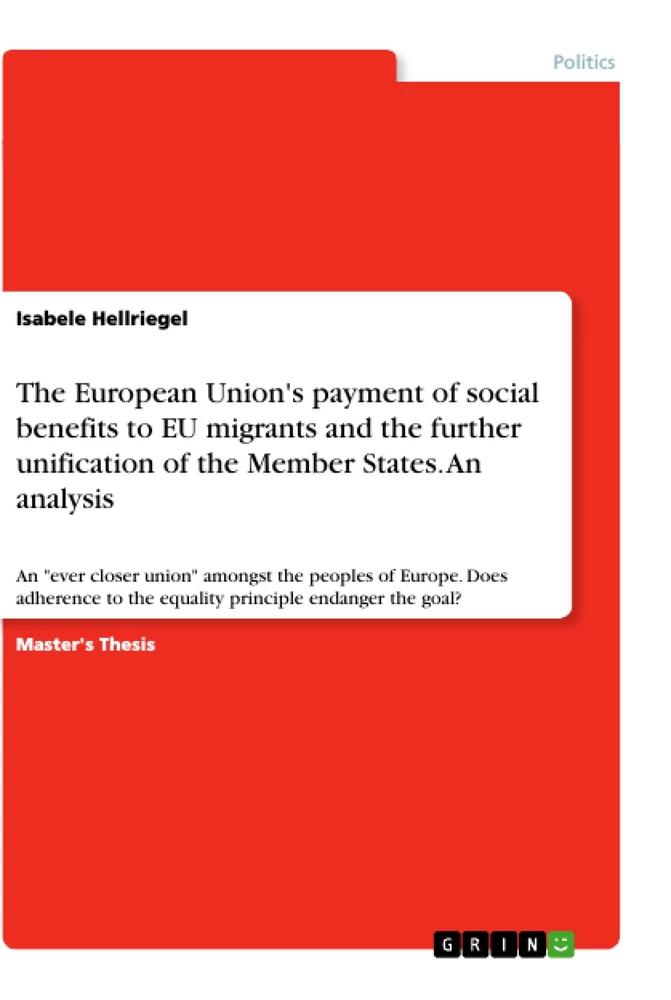
Table of Contents
INTRODUCTION
CHAPTER 1
The Duty: Equal Treatment of nationals and EU migrants in the access to social benefits
I. The general equality principle in Union Law as the origin of the Duty
II. The obligation to pay social benefits also to EU migrants
CHAPTER 2
The Risk: Financial Expenditure of the Member States and Eurosceptic Parties on the rise
I. Facts and Figures
II. Debates about benefit tourism and rising dissatisfaction with the EU
CHAPTER 3
Possible Solutions: Other ways of handling the Duty to reduce the Risk
I. Hypothesis 1: Amendment of the comparison groups resembling equality in accordance with applicable primary law
1. Equality between non-working persons and nationals
a) Proposed amendment: Equality between non-working persons and nationals only after five years of residence
b) Admissibility under primary law
2. Equality between workers and nationals
a) Proposed amendment: Equality between workers and nationals only under the additional criterion of sufficient means of subsistence
b) Admissibility under primary law
3. Equality between jobseekers and nationals
a) Proposed amendment: Equality between jobseekers and nationals not indefinitely after one year of work
b) Admissibility under primary law
4. Separation of legal residence from entitlement to social benefits
II. Hypothesis 2: Reducing the Risk by sharing financial expenditure between the Member States
1. Adoption of social insurances at the Union level
a) Possible Variations
b) Admissibility under EU Law
(1) Art.153 TFEU
(2) Art.122(2) TFEU
(3) Art.352 TFEU
(4) Amendment of the Treaties
2. Relief of State budget
Objectives and Key Themes
This Master Thesis investigates whether the European Union's general principle of equality, specifically the obligation of Member States to provide social benefits to EU migrants as stipulated by Directive 2004/38/EC, threatens the ongoing unification of the Union. It aims to determine if the potential social and financial risks associated with this obligation could be mitigated through alternative strategies that remain compliant with EU primary law.
- Analysis of the equality principle in Union Law and its impact on social benefit access for EU migrants.
- Evaluation of the financial burden on Member States and the correlation with rising Euroscepticism.
- Examination of potential legislative amendments to comparison groups for determining equality.
- Exploration of a centralized European compensation mechanism for social expenditure.
Extract from the Book
I. The general equality principle in Union Law as the origin of the Duty
If we ask ourselves what norm constitutes the foundation of modern normative orders, a fundamental precept of equality would stand the best chance of taking that place. Equality, égalité, is a postulate that accompanies both legal and political debates. It is based on the idea that no one is per se worth more than another or, in the words of R. Dworkin, that everyone is entitled to be treated "as an equal".
How the equality principle was defined and interpreted over time largely depended on the spirit of the times and the values and norms of the particular legal system. In 1950, the European Coal and Steel Community was founded, which aimed at the political unification of European countries to secure lasting peace after numerous wars in the past by creating a common internal market. Here, the obligation to equal treatment first took on a "market-unifying role" since it was seen as an important instrument to limit the protectionist behaviour of the Member States and to enhance the fundamental freedoms. According to the original conception of the Treaty, equality was aimed solely to prevent disadvantages based on nationality in the economic dimension of the common market.
Summary of Chapters
INTRODUCTION: Outlines the shift in sovereign competences to the EU and introduces the research question regarding the potential risk that the equality principle poses to European unification.
CHAPTER 1: The Duty: Equal treatment of nationals and EU migrants in the access to social benefits: Examines the development of the equality principle by the CJEU and how it evolved into an obligation for Member States to extend social benefit eligibility to EU migrants.
CHAPTER 2: The Risk: Financial Expenditure of the Member States and Eurosceptic Parties on the rise: Analyzes the fiscal impact of social benefits for EU migrants on net contributor States and correlates this financial burden with the rise of anti-EU political sentiment and Eurosceptic parties.
CHAPTER 3: Possible Solutions: Other ways of handling the Duty to reduce the Risk: Proposes legal strategies, such as redefining comparison groups for equality and establishing a European-level compensation mechanism, to alleviate the pressure on national budgets and safeguard the integration process.
Keywords
European Union, Equality Principle, Social Benefits, EU Migrants, Benefit Tourism, Member States, European Integration, Directive 2004/38/EC, Citizens Directive, Euroscepticism, Financial Expenditure, Social Rights, Free Movement, Primary Law, Unification.
Frequently Asked Questions
What is the core subject of this thesis?
The work investigates the tension between the EU equality principle, which mandates equal access to social benefits for EU migrants, and the political/financial pressure this places on individual Member States, potentially threatening the unity of the European project.
What are the primary thematic fields?
The main themes include EU law (specifically the equality principle), the economics of social welfare systems within the EU, and the political science aspect of rising Euroscepticism and its link to migration policies.
What is the main research question?
The thesis asks whether the current obligation to provide social benefits to EU migrants has the potential to jeopardize European unification and whether this risk can be mitigated through adjustments within the framework of EU primary law.
Which scientific methodology is applied?
The thesis employs a legal-analytical method, examining case law from the Court of Justice of the European Union (CJEU), evaluating economic data from Eurostat regarding social spending, and analyzing political developments in selected "net contributor" Member States.
What topics are discussed in the main body?
The body analyzes the origins of the equality principle in Union law, quantifies the financial exposure of net contributor States, and evaluates two hypotheses for reform: adjusting legal comparison groups and shifting financial responsibilities to the Union level.
Which keywords best describe this work?
The most relevant keywords are European Union, Equality Principle, Social Benefits, EU Migrants, Benefit Tourism, Euroscepticism, and European Integration.
How does the author define "Benefit Tourism"?
The author defines it for the purpose of this thesis as "immigration for the purpose of claiming social benefits," explicitly noting that this is a technical, value-free term used for simplification and not a personal opinion of the author.
What role do the "net contributor states" play in this analysis?
They are central to the analysis because their financial and political reactions to social benefit expenditures are seen as indicative of whether the European integration process faces a risk of reversal or stagnation due to public dissatisfaction.
Why are social benefits an issue for European unification?
The author argues that when citizens perceive an "overburdening" of national social systems by non-nationals, it is frequently exploited by Eurosceptic parties, which in turn undermines public support for the broader project of European integration.
Ende der Leseprobe aus 61 Seiten
- nach oben
- Arbeit zitieren
- Isabele Hellriegel (Autor:in), 2021, The European Union's payment of social benefits to EU migrants and the further unification of the Member States. An analysis, München, Page::Imprint:: GRINVerlagOHG, https://www.diplomarbeiten24.de/document/1133157

neugierig - aktuell - relevant
Entdecken Sie hilfreiche Tipps und Tricks rund ums Studium!

Entdecken Sie hilfreiche Tipps und Tricks rund ums Studium!
Ihre Hausarbeit / Abschlussarbeit:

- - Publikation als E-Book und Buch
- - Hohes Honorar auf die Verkäufe
- - Für Sie komplett kostenlos - mit ISBN
- - Es dauert nur 5 Minuten
- - Jede Arbeit findet Leser

- © GRIN Publishing GmbH.
- Alle Inhalte urheberrechtlich geschützt. Kopieren und verbreiten untersagt.
- info@grin.com
- AGB
- Open Publishing
Der GRIN Verlag hat sich seit 1998 auf die Veröffentlichung akademischer eBooks und Bücher spezialisiert. Der GRIN Verlag steht damit als erstes Unternehmen für User Generated Quality Content. Die Verlagsseiten GRIN.com, Hausarbeiten.de und Diplomarbeiten24 bieten für Hochschullehrer, Absolventen und Studenten die ideale Plattform, wissenschaftliche Texte wie Hausarbeiten, Referate, Bachelorarbeiten, Masterarbeiten, Diplomarbeiten, Dissertationen und wissenschaftliche Aufsätze einem breiten Publikum zu präsentieren.
Kostenfreie Veröffentlichung: Hausarbeit, Bachelorarbeit, Diplomarbeit, Dissertation, Masterarbeit, Interpretation oder Referat jetzt veröffentlichen!
Folgen Sie GRIN auf


- GRIN Verlag GmbH
-
- Nymphenburger Str. 86
- 80636
- Munich, Deutschland
- +49 89-550559-0
- +49 89-550559-10
- info@grin.com
-
