
präsentiert von

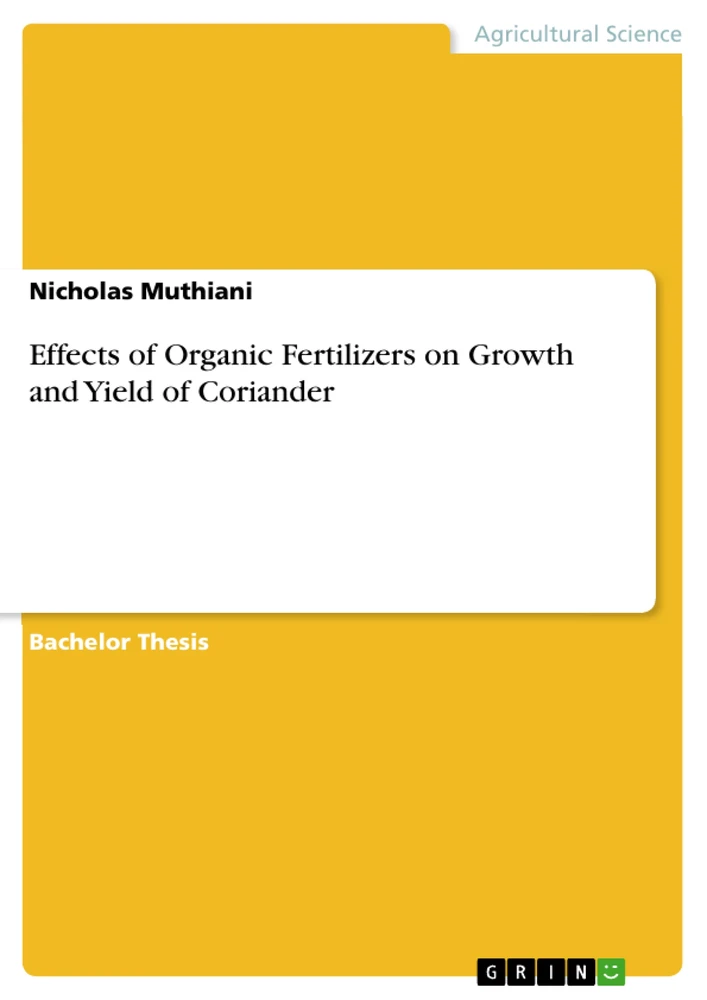
Table of Contents
1 INTRODUCTION
1.1 PROBLEM STATEMENT AND JUSTIFICATION
1.2 GENERAL OBJECTIVE
1.3 SPECIFIC OBJECTIVE
1.4 HYPOTHESIS:
2 LITERATURE REVIEW
2.1 Coriander Production
2.2 Coriander Varieties in Kenya
2.3 Ecological requirements
2.4 Scientific classification of coriander
2.5 Organic manure
2.6 Benefits of cattle manure
2.7 Nutrient composition of cow manure
2.8 Estimating manure application rates
2.9 Manure application
2.10 Nutritional deficiencies of coriander
2.11 Nutritional composition of coriander
2.12 Medicinal importance of coriander
2.13 Coriander processing
3 METHODOLOGY
3.1 STUDY LOCATION
3.2 FARM LAYOUT
3.3 SOIL SAMPLING
3.4 MATERIALS
3.5 STUDY DESIGN
3.6 DATA COLLECTION
3.7 DATA ANALYSIS
3.8 EXPERIMENTAL MODEL
4 RESULTS
4.1 Treatment effect on percentage germination
4.2 Treatment effect on the number of plants per plot
4.3 Treatment effect on percentage disease incidence
4.4 Treatment effect on the plant height of coriander
4.5 Treatment effect on the leaf length of coriander
4.6 Treatment effect on number of diseased plants per plot
4.7 Treatment effect on the weight of coriander
4.8 Treatment effect on leaf width of coriander
5 DISCUSSION
5.1 Treatment effect on percentage germination of coriander
5.2 Treatment effect on percentage disease incidence
5.3 Treatment effect on the plant height of coriander
5.4 Treatment effect on the leaf length of coriander
5.5 Effect of treatment on fresh weight
5.6 Effect of treatment on dry weight
5.7 Treatment effect on leaf width of coriander
5.8 Treatment effect on soil PH
6 CONCLUSION
7 RECOMMENDATIONS
Research Objectives and Focus Areas
The primary objective of this research is to evaluate the effectiveness of cow dung manure on the development and yield of coriander (Coriandrum sativum) in Western Kenya, specifically addressing the negative impacts of continuous mineral fertilizer use on soil structure and crop productivity.
- Effects of organic fertilizer application rates on coriander growth parameters.
- Assessment of soil pH and environmental impact in relation to organic matter usage.
- Vegetative development, including plant height, leaf length, and leaf width.
- Yield performance measured through fresh and dry weight.
- Disease incidence analysis under varying organic manure treatments.
Excerpt from the Book
1.1 PROBLEM STATEMENT AND JUSTIFICATION
Continuous use of mineral fertilizer in tropical soils is associated with reduced crop yield, increased soil acidity and nutrient imbalance. Use of organic materials is a better fertilizer management for these soils and the crops being planted. Inorganic fertilizers should be replenished every cultivation season because, the synthetic compounds of N, P and K fertilizer is rapidly lost by either evaporation or by leaching in drainage water and leads to dangerous environmental pollution. Continuous usage of organic fertilizer affects soil structure because it causes soil to clump, forming soil aggregate thus improving the soil structure, organic manure decompose to form humus which binds soil particles together thus improving the soil structure and its physical properties hence, organic manures can serve as alternative to mineral fertilizers for improving soil structure and improving crop yields.
Summary of Chapters
1 INTRODUCTION: Presents the background of coriander production and the environmental necessity for switching to organic fertilizers to improve soil structure and crop yields.
2 LITERATURE REVIEW: Explores the ecological requirements, nutritional composition, and benefits of cattle manure for sustainable coriander farming.
3 METHODOLOGY: Describes the experimental design, including site selection at Kibabii University, plot layout, and data collection procedures used for analysis.
4 RESULTS: Details the statistical findings regarding germination, plant height, disease incidence, fresh and dry weights, and soil pH under different manure treatment rates.
5 DISCUSSION: Interprets the findings by comparing them with previous scientific studies on the vegetative growth and soil improvement properties of cow dung manure.
6 CONCLUSION: Summarizes the key finding that cow dung manure significantly impacts coriander growth and development, with 15t/ha providing the most effective results.
7 RECOMMENDATIONS: Advises the use of 15t/ha of mature cow dung manure applied via broadcasting and incorporation as the optimal practice for coriander production.
Keywords
Coriander, Coriandrum sativum, Cow dung manure, Organic fertilizer, Soil fertility, Crop yield, Plant height, Leaf length, Fresh weight, Dry weight, Disease incidence, Sustainable agriculture, Soil pH, Randomized complete block design, Western Kenya.
Frequently Asked Questions
What is the core focus of this research project?
The project investigates the impact of varying application rates of cow dung manure on the growth and final yield of coriander in Western Kenya.
What are the central themes discussed in this work?
The work centers on sustainable soil management, the benefits of organic versus inorganic fertilizers, and the specific physiological responses of coriander plants to nutrient application.
What is the primary objective of the study?
The goal is to determine the effectiveness of cow dung manure in improving the development and yield of coriander plants.
Which scientific methodology was applied?
The experiment utilized a Randomized Complete Block Design (RCBD) with four treatments (0t/ha, 5t/ha, 10t/ha, and 15t/ha) and three replications, analyzed via ANOVA and Duncan Multiple Range Test.
What key findings are presented in the main section?
The results indicate that manure treatments had a significant positive effect on plant height, leaf length, fresh weight, and dry weight, while also helping to optimize soil pH.
Which keywords best characterize this research?
Essential keywords include Coriander, Cow dung manure, Organic fertilizer, Soil fertility, and Yield performance.
Why is 15t/ha considered the recommended rate?
This rate consistently produced the best results in terms of coriander plant growth, development, and overall yield parameters in the study.
How does cow dung manure affect soil pH according to the data?
The study found that soil pH increased with the application of cow dung manure, moving towards the ideal range for coriander growth, which is 6.5 to 7.5.
Ende der Leseprobe aus 45 Seiten
- nach oben
- Arbeit zitieren
- Nicholas Muthiani (Autor:in), 2021, Effects of Organic Fertilizers on Growth and Yield of Coriander, München, Page::Imprint:: GRINVerlagOHG, https://www.diplomarbeiten24.de/document/1140827

neugierig - aktuell - relevant
Entdecken Sie hilfreiche Tipps und Tricks rund ums Studium!

Entdecken Sie hilfreiche Tipps und Tricks rund ums Studium!
Ihre Hausarbeit / Abschlussarbeit:

- - Publikation als E-Book und Buch
- - Hohes Honorar auf die Verkäufe
- - Für Sie komplett kostenlos - mit ISBN
- - Es dauert nur 5 Minuten
- - Jede Arbeit findet Leser

- © GRIN Publishing GmbH.
- Alle Inhalte urheberrechtlich geschützt. Kopieren und verbreiten untersagt.
- info@grin.com
- AGB
- Open Publishing
Der GRIN Verlag hat sich seit 1998 auf die Veröffentlichung akademischer eBooks und Bücher spezialisiert. Der GRIN Verlag steht damit als erstes Unternehmen für User Generated Quality Content. Die Verlagsseiten GRIN.com, Hausarbeiten.de und Diplomarbeiten24 bieten für Hochschullehrer, Absolventen und Studenten die ideale Plattform, wissenschaftliche Texte wie Hausarbeiten, Referate, Bachelorarbeiten, Masterarbeiten, Diplomarbeiten, Dissertationen und wissenschaftliche Aufsätze einem breiten Publikum zu präsentieren.
Kostenfreie Veröffentlichung: Hausarbeit, Bachelorarbeit, Diplomarbeit, Dissertation, Masterarbeit, Interpretation oder Referat jetzt veröffentlichen!
Folgen Sie GRIN auf


- GRIN Verlag GmbH
-
- Nymphenburger Str. 86
- 80636
- Munich, Deutschland
- +49 89-550559-0
- +49 89-550559-10
- info@grin.com
-
