
präsentiert von

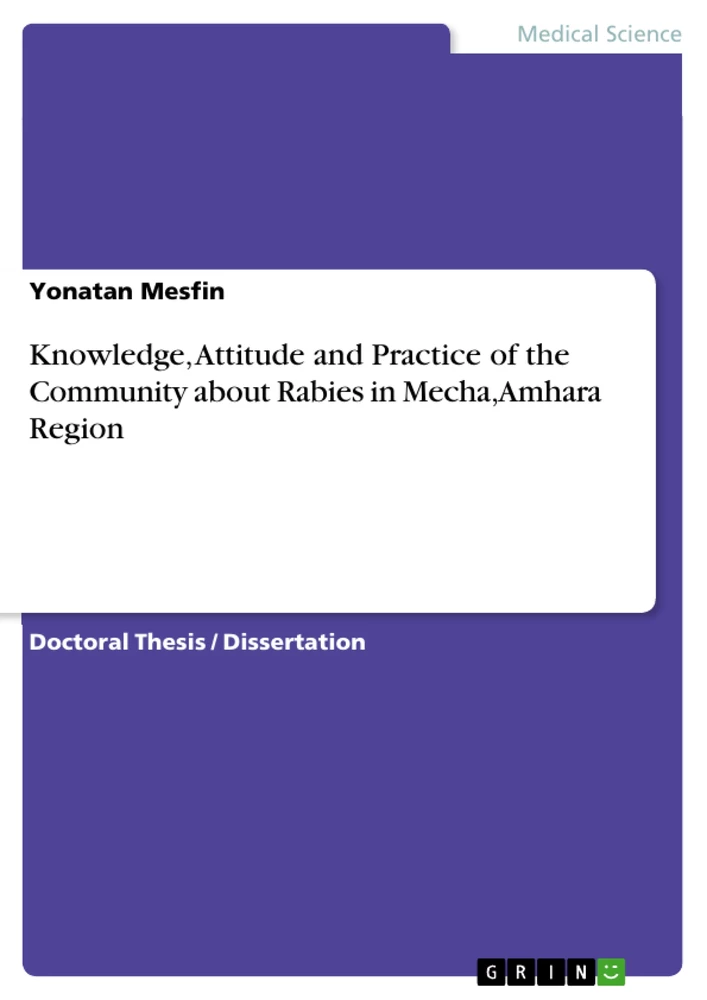
Table of Contents
1. INTRODUCTION
2. LITERATURE REVIEW
2.1. Etiology
2.1.1 Classification
2.1.2 Structure
2.2. Epidemiology
2.2.1. Distribution of rabies
2.2.2. Host Range and Susceptibility
2.3. Pathogenesis
2.4. Clinical findings
2.4.1. Incubation Period
2.4.2. Clinical signs and symptoms
2.5. Diagnosis
2.6. Treatment
2.7. Prevention and control
3. MATERIAL AND METHODS
3.1. Study area
3.2. Study design
3.3. Study Population
3.4. Data collection method
3.5. Sample size determination
3.6. Data management and analysis
4. RESULTS
5. DISCUSION
6. CONCLUSION AND RECOMMENDATIONS
7. REFERENCES
8. ANNEXE
Research Objectives and Key Topics
The primary objective of this study is to evaluate the knowledge, attitudes, and practices (KAP) regarding rabies among the community in Mecha district, Ethiopia, to address the lack of quantitative data and inform effective control strategies.
- Community awareness regarding rabies transmission and its fatal nature.
- Assessment of current practices and attitudes toward post-exposure treatment.
- Evaluation of the influence of socio-demographic factors on community KAP levels.
- Identification of barriers to seeking modern medical treatment for rabies exposure.
- Analysis of the role of traditional practices and their impact on public health interventions.
Excerpt from the Book
2.3. Pathogenesis
Rabies is a central nervous system (CNS) disease that is almost invariably fatal (Metlin, 2008), except for few rare reported cases (Miah et al., 2005). Rabies virus enters the body through wounds or by direct contact with mucosal surfaces. It cannot cross intact skin. It replicates in the bitten muscle and gains access to motor endplates and motor axons to reach the central nervous system. Virions are carried in transport vesicles and travel to the central nervous system exclusively by fast retrograde transport along motor axons, with no uptake by sensory or sympathetic endings. Viruses can also enter motor axons in peripheral nerves directly during a penetrating injury. In some bat variants, viral propagation may also occur via sensory nerves due to skin tropism (WHO, 2013).
The estimated speed of virus migration depends on whether it moves by centripetal retrograde axonal transport or centrifugal spread. In centripetal retrograde axonal transport, migration is fast, with speeds of 5–100 mm/day or even faster, because neuronal populations of the same synaptic order located at various distances, e.g. 10 μm to 2 cm, are infected simultaneously (Ugolini , 2008; Hemachudha, 2013). Conversely, centrifugal spread is slow, probably mediated by passive diffusion rather than active transport (Ugolini, 2011; Hemachudha, 2013).
Summary of Chapters
1. INTRODUCTION: Outlines the historical background of rabies, its global impact as a zoonotic disease, and the specific rationale for conducting the study in the Mecha district of Ethiopia.
2. LITERATURE REVIEW: Examines the etiology, classification, pathogenesis, and clinical progression of rabies, alongside existing diagnostic methods and global control strategies.
3. MATERIAL AND METHODS: Details the cross-sectional, community-based study design, the multistage sampling procedures, and the data collection methodology used to survey 423 households.
4. RESULTS: Presents the findings regarding the socio-demographic characteristics of the participants and their KAP scores, highlighting significant associations between education, age, gender, and rabies awareness.
5. DISCUSION: Compares the study's findings with regional and global research, emphasizing the gaps in awareness and the continued reliance on traditional practices over professional medical care.
6. CONCLUSION AND RECOMMENDATIONS: Summarizes the community's low KAP levels and suggests actionable interventions for the Ministry of Agriculture and health professionals to improve disease prevention.
Keywords
Rabies, Knowledge, Attitude, Practice, Mecha, Ethiopia, Zoonosis, Vaccination, Epidemiology, Community Awareness, Public Health, Dog Management, Traditional Healers.
Frequently Asked Questions
What is the core focus of this research thesis?
The thesis focuses on assessing the level of knowledge, attitudes, and practices (KAP) regarding rabies among the community living in Mecha district, Ethiopia, to understand the current awareness gap and disease perception.
What are the primary themes explored in the study?
The study explores community understanding of rabies causes, modes of transmission, clinical signs in humans and animals, and how residents respond to suspected animal bites.
What is the main objective of this study?
The main objective is to provide quantitative data on community awareness in the study area, as there is a lack of accurate information required to design effective public health control measures.
Which scientific methods were employed to gather the data?
The study used a cross-sectional, community-based quantitative approach, utilizing multistage sampling to select participants for face-to-face interviews using a structured, pre-tested questionnaire.
What content is covered in the main body of the thesis?
The main body covers the theoretical background of rabies, detailed methodologies for the survey, presentation of demographic and awareness data, and a comparative discussion of these results with findings from other studies.
Which keywords best characterize this research?
Key terms include Rabies, Knowledge, Attitude, Practice, Mecha, Ethiopia, Zoonosis, Public Health, and Community Awareness.
How does the educational status of participants influence their rabies knowledge according to the study?
The study found a highly significant association between education and KAP scores, where respondents with higher levels of education (first degree and above) demonstrated better knowledge and awareness than illiterate or primary-educated participants.
What are the implications of the study regarding traditional medicine?
The study highlights a concern that widespread reliance on traditional healers and herbal extracts for treating bite wounds interferes with timely access to life-saving post-exposure prophylaxis (PEP).
Ende der Leseprobe aus 55 Seiten
- nach oben
- Arbeit zitieren
- Dr. Yonatan Mesfin (Autor:in), 2016, Knowledge, Attitude and Practice of the Community about Rabies in Mecha, Amhara Region, München, Page::Imprint:: GRINVerlagOHG, https://www.diplomarbeiten24.de/document/1141266

neugierig - aktuell - relevant
Entdecken Sie hilfreiche Tipps und Tricks rund ums Studium!

Entdecken Sie hilfreiche Tipps und Tricks rund ums Studium!
Ihre Hausarbeit / Abschlussarbeit:

- - Publikation als E-Book und Buch
- - Hohes Honorar auf die Verkäufe
- - Für Sie komplett kostenlos - mit ISBN
- - Es dauert nur 5 Minuten
- - Jede Arbeit findet Leser

- © GRIN Publishing GmbH.
- Alle Inhalte urheberrechtlich geschützt. Kopieren und verbreiten untersagt.
- info@grin.com
- AGB
- Open Publishing
Der GRIN Verlag hat sich seit 1998 auf die Veröffentlichung akademischer eBooks und Bücher spezialisiert. Der GRIN Verlag steht damit als erstes Unternehmen für User Generated Quality Content. Die Verlagsseiten GRIN.com, Hausarbeiten.de und Diplomarbeiten24 bieten für Hochschullehrer, Absolventen und Studenten die ideale Plattform, wissenschaftliche Texte wie Hausarbeiten, Referate, Bachelorarbeiten, Masterarbeiten, Diplomarbeiten, Dissertationen und wissenschaftliche Aufsätze einem breiten Publikum zu präsentieren.
Kostenfreie Veröffentlichung: Hausarbeit, Bachelorarbeit, Diplomarbeit, Dissertation, Masterarbeit, Interpretation oder Referat jetzt veröffentlichen!
Folgen Sie GRIN auf


- GRIN Verlag GmbH
-
- Nymphenburger Str. 86
- 80636
- Munich, Deutschland
- +49 89-550559-0
- +49 89-550559-10
- info@grin.com
-
