
präsentiert von

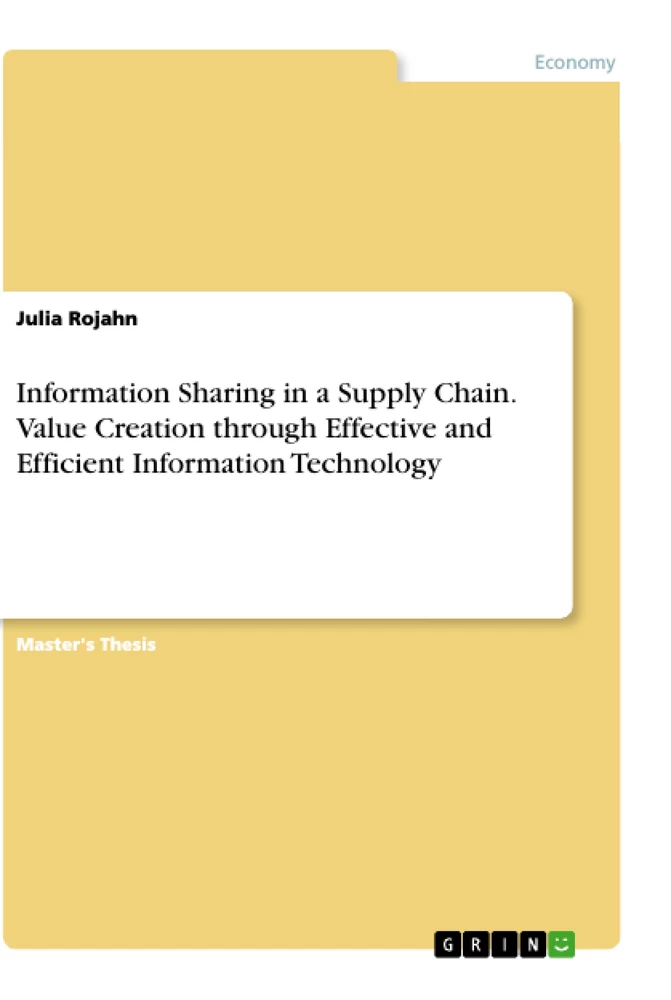
Table of Contents
1. Introduction
1.1 Purpose and research questions
1.2 Design of the study
Choice of theoretical background
Choice of general methodology
Research limitations
1.3. Structure of the report
1.4. Definitions of core terminology
2. Theoretical Framework
2.1 Market oriented view
2.2 Literature Review
3. Empirical design of the study
3.1. Research approaches
3.2. Research strategies
The Case study
Interview
Grounded Theory
Archival research strategy
3.3 Validity and Reliability of empirical data
4. The case study of XY A/S
4.1 General facts about XY A/S
4.2 Supply Chain of XY A/S
5. Descriptive analysis
5.1 Empirical findings
6. Contingency Analysis
6.1 Defining support and primary activities at XY A/S
6.2 Linkages between TD and support activities
7. Discussion
7.1 Further research
7.2 Recommendations for XY A/S
8.Conclusion
Research Objectives and Focus Areas
The primary objective of this thesis is to investigate how information systems (IS) and information technology (IT) can create value for a company within a manufacturing supply chain context. The study explores the effectiveness of IT, identifies necessary system requirements for value creation, and analyzes the internal and external challenges associated with implementing new information systems.
- Analysis of the relationship between IT implementation and value chain (VC) performance.
- Examination of information sharing (IS) practices and their impact on supply chain coordination.
- Identification of barriers to successful IT system integration, such as infrastructure and know-how.
- Development of a contingency framework to link technology development with primary value activities.
Excerpt from the Book
The Case study
The aim of this thesis is to analyze how an information system can create value for a company. This will be analyzed by focusing on whether IT actually has an impact on value creation, how IS is involved, and what risks can arise internally and externally when implementing an information system. In order to achieve this goal, the Danish manufacturing company XY A/S will be analyzed in terms of its current activities regarding IT. By detecting the current situation, issues and possible improvements can be investigated. With the use of the VC model, TD can then be further analyzed by focusing on primary value activities of XY’s business processes. With the help of this analysis, it can be answered whether there is a linkage between TD and primary value adding activities and hence, of and how IT can create value.
Due to the fact that one company will be presented and taken as a basis for this thesis, the methodology of this report is a single-case study. The term case study has multiple definitions and understandings. In accordance to Bromley (1990, p. 302), it is a “systematic inquiry into an event or a set of related events that aims to describe and explain the phenomenon of interest”. Considering Yin (2003, p. 1), “case studies are the preferred strategy when “how” or “why” questions are being posed, when the investigator has little control over events, and when the focus is on a contemporary phenomenon within some real-life context”, such as organizational and managerial processes and international relations. Case studies are in-depth explanations of social behaviors and a contemporary set of events that cannot be controlled by the investigator. Moreover, this type of research methodology can provide an understanding of a complex issue or object, and can further strengthen the topic through previous research (Yin, 1984). It is about “identifying a contemporary phenomenon within its real-life context, which does not clearly evident the boundaries between phenomenon and context, and in which multiple sources are used” (Yin, 1984, p.23).
Summary of Chapters
1. Introduction: Outlines the research context, globalization trends, the necessity of SCM, and defines the core research questions regarding IT and value creation.
2. Theoretical Framework: Establishes the market-oriented view and introduces Michael Porter's Value Chain and Five Forces models as the basis for analysis.
3. Empirical design of the study: Details the research methodology, focusing on the single-case study approach, qualitative interviews, and the application of Grounded Theory.
4. The case study of XY A/S: Provides a profile of the case company, describing its structure, business areas, and existing supply chain processes.
5. Descriptive analysis: Presents the findings from the qualitative interviews, categorized into variables like information quality and system requirements.
6. Contingency Analysis: Analyzes the linkages between Technology Development (TD) and the firm's primary and support value activities.
7. Discussion: Synthesizes findings to address the research questions, reflecting on the impact of IT on firm performance and competitive advantage.
8.Conclusion: Recaps the main study outcomes, confirming that IT creates value when implemented with specific functional requirements and alignment with partner needs.
Keywords
Supply Chain Management, Value Chain Analysis, Information Sharing, Information Technology, Competitive Advantage, Manufacturing Sector, Information Systems, Porter’s Five Forces, Case Study, Qualitative Research, Technology Development, Process Automation, Logistics, Customer Satisfaction, Business Strategy
Frequently Asked Questions
What is the primary focus of this thesis?
The thesis investigates how implementing a new information system within a manufacturing company can contribute to value creation and improve supply chain efficiency.
What are the central thematic fields?
The study centers on Supply Chain Management (SCM), the Value Chain (VC) concept, the role of Information Sharing (IS), and the strategic deployment of Information Technology (IT).
What is the core research question?
The main research question is: "How can Information systems create value for a company?"
Which methodology is employed?
The research uses a qualitative, exploratory single-case study methodology, incorporating semi-structured interviews and an archival literature review.
What does the main body of the work cover?
The main body covers the theoretical background (Porter's models), the empirical design, a detailed case study of the company "XY A/S", and a contingency analysis mapping technology to specific value chain activities.
Which keywords define this work?
Key terms include Supply Chain Management, Information Sharing, Value Chain, IT Implementation, and Competitive Advantage.
How does the author define a "Value Chain"?
The author uses Porter’s definition, describing it as a system of interdependent activities that are divided into primary and support categories to generate profit margin exceeding the costs of creation.
What are the identified challenges for IT implementation?
The study identifies poor IT infrastructure, a lack of know-how among partners, and security/access concerns as the most critical challenges when integrating new information systems.
Why was XY A/S chosen for this case study?
XY A/S was selected as it is a global manufacturing SME facing specific international expansion challenges that require integrated IT solutions for better coordination with customers and suppliers.
Ende der Leseprobe aus 84 Seiten
- nach oben
- Arbeit zitieren
- Julia Rojahn (Autor:in), 2017, Information Sharing in a Supply Chain. Value Creation through Effective and Efficient Information Technology, München, Page::Imprint:: GRINVerlagOHG, https://www.diplomarbeiten24.de/document/1141793

neugierig - aktuell - relevant
Entdecken Sie hilfreiche Tipps und Tricks rund ums Studium!

Entdecken Sie hilfreiche Tipps und Tricks rund ums Studium!
Ihre Hausarbeit / Abschlussarbeit:

- - Publikation als E-Book und Buch
- - Hohes Honorar auf die Verkäufe
- - Für Sie komplett kostenlos - mit ISBN
- - Es dauert nur 5 Minuten
- - Jede Arbeit findet Leser

- © GRIN Publishing GmbH.
- Alle Inhalte urheberrechtlich geschützt. Kopieren und verbreiten untersagt.
- info@grin.com
- AGB
- Open Publishing
Der GRIN Verlag hat sich seit 1998 auf die Veröffentlichung akademischer eBooks und Bücher spezialisiert. Der GRIN Verlag steht damit als erstes Unternehmen für User Generated Quality Content. Die Verlagsseiten GRIN.com, Hausarbeiten.de und Diplomarbeiten24 bieten für Hochschullehrer, Absolventen und Studenten die ideale Plattform, wissenschaftliche Texte wie Hausarbeiten, Referate, Bachelorarbeiten, Masterarbeiten, Diplomarbeiten, Dissertationen und wissenschaftliche Aufsätze einem breiten Publikum zu präsentieren.
Kostenfreie Veröffentlichung: Hausarbeit, Bachelorarbeit, Diplomarbeit, Dissertation, Masterarbeit, Interpretation oder Referat jetzt veröffentlichen!
Folgen Sie GRIN auf


- GRIN Verlag GmbH
-
- Nymphenburger Str. 86
- 80636
- Munich, Deutschland
- +49 89-550559-0
- +49 89-550559-10
- info@grin.com
-
