
präsentiert von

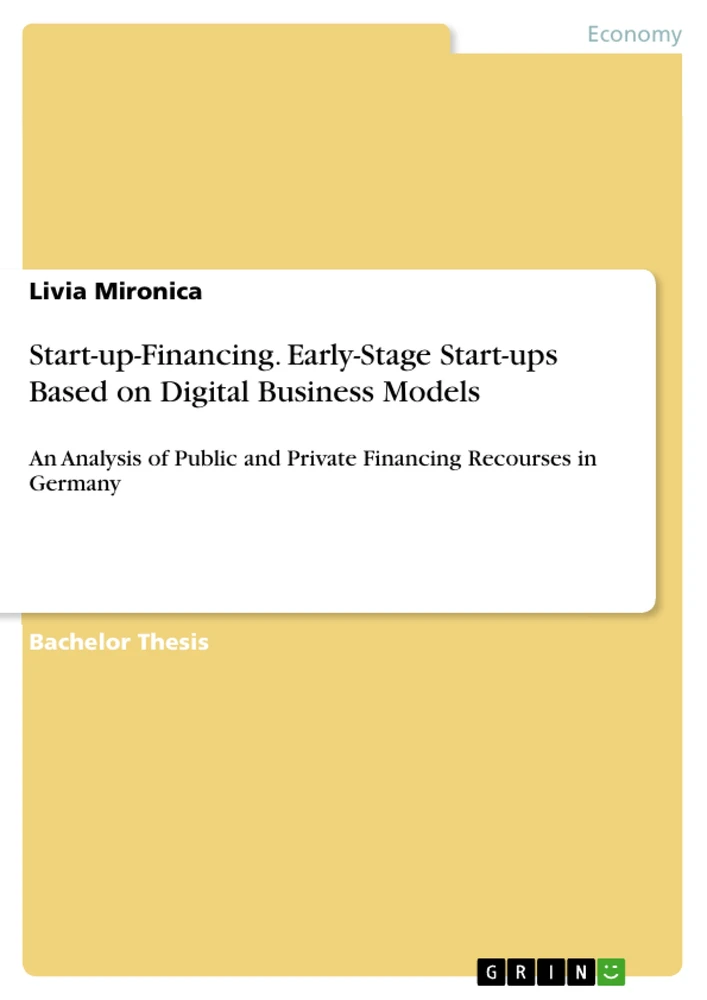
Table of Contents
1. Introduction
1.1 Research Objectives
1.2 Structure and Proceedings
2. Theoretical Basics for Digital Start-ups
2.1 Entrepreneurship vs. E-Entrepreneurship
2.2 Start-up: Definition and Characteristics
2.3 Digital Business Model: E-Business Start-ups
2.4 Financial Barriers for Young Digital Start-ups
3. Public and Private Financing Recourses of Digital Start-ups in Germany
3.1 Early-stage Digital Start-up Financing
3.2 Private Financing Sources
3.2.1 Bootstrapping and FFF
3.2.2 Business Angels
3.2.3 Crowdfunding
3.2.4 Incubators/Accelerators
3.2.5 Venture Capital
3.3 Public financing sources
3.3.1 Incubators/Accelerators
3.3.2 Public Loans
3.3.3 Grants
3.3.4 Governmental Venture Capital
4. Conclusion and Outlook
Research Objectives and Key Themes
This thesis aims to identify and critically evaluate suitable financing programs and investors for each development phase of early-stage digital start-ups in Germany, providing guidance for entrepreneurs in selecting an optimal financing mix.
- Theoretical foundations of E-Entrepreneurship and digital business models.
- Analysis of specific financial barriers faced by young digital ventures.
- Comprehensive assessment of private funding sources (Bootstrapping, Angels, VC, etc.).
- Evaluation of public financing instruments and support programs (Grants, Loans, Incubators).
- Strategic comparison of financing options based on the company life cycle.
Excerpt from the Book
2.2 Start-up: Definition and Characteristics
As mentioned in the previous subsection, the entrepreneur is the key element in starting and developing a start-up. But what exactly is a start-up?
In view of the large number of synonyms used in the literature, there is no uniform definition for the start-up term, so the definition must be precisely delimited in accordance with the framework of this thesis. According to Eisenmann et al. (2012) “Start-ups are new organizations created by entrepreneurs to launch new products.” The organization of a start-up is usually informal and without a clear internal structure, as the main focus is on the time of entry into the market under limited resources. For this work, the general definition of start-ups, according to Deutscher Startup Monitor (2020), is used. The definition names three main characteristics:
Start-ups are younger than ten years,
have a planned employee/ sales growth and/or
are (highly) innovative in their products/services, business models and/or technologies.
Summary of Chapters
1. Introduction: Presents the role of digital start-ups in the German economy and defines the research scope regarding their financing challenges.
2. Theoretical Basics for Digital Start-ups: Establishes definitions for e-entrepreneurship and start-ups, while examining specific financial obstacles unique to digital business models.
3. Public and Private Financing Recourses of Digital Start-ups in Germany: Provides an in-depth analysis of various private (e.g., business angels, venture capital) and public (e.g., grants, public loans) funding sources available to early-stage ventures.
4. Conclusion and Outlook: Summarizes key findings and concludes that a mix of public and private funding is often the most appropriate strategy for early-stage digital ventures.
Keywords
Digital Start-ups, E-Entrepreneurship, Early-stage Financing, Venture Capital, Business Angels, Crowdfunding, Public Loans, Grants, Incubators, Accelerators, Bootstrap Financing, Innovation, Germany, Financial Barriers, Life Cycle Model
Frequently Asked Questions
What is the primary focus of this research paper?
The paper focuses on identifying and assessing the suitability of different public and private financial resources for early-stage digital start-ups in the German market.
What are the central themes discussed in this thesis?
The themes include the differentiation between traditional and digital entrepreneurship, the specific financial barriers digital start-ups encounter, and a detailed breakdown of both private and public funding instruments.
What is the core research question addressed by the author?
The research aims to determine which financing instruments and programs best suit the various financial and development phases of a digital start-up in Germany.
Which scientific methodology does the work employ?
The research is based on an integrated literature review approach to synthesize existing knowledge on financial resources and life cycle theories of start-ups.
What does the main part of the work cover?
The main part (Chapter 3) provides a comprehensive presentation of private and public financing, ranging from personal savings and crowdfunding to governmental venture capital and public loan programs.
Which keywords characterize this publication?
Key terms include E-Entrepreneurship, Digital Start-ups, Venture Capital, Business Angels, Crowdfunding, and various German public funding programs like EXIST and KfW loans.
How do incubators and accelerators differ according to the text?
The text highlights that while both provide support, incubators typically offer facilities and general infrastructure for longer periods (1-5 years), whereas accelerators provide intense, time-limited support (3-6 months) often focused on rapid growth and market entry.
Why is obtaining funding particularly difficult for early-stage digital start-ups?
Start-ups in the digital sector often face high risks, lack traditional loan collateral, and possess intangible assets (know-how) that many traditional financial institutions are hesitant to fund without established market validation.
What is the "house bank principle" in the context of German public loans?
It is the process where start-ups cannot apply for public loans directly but must go through their local commercial bank, which performs a credit assessment before the public bank approves the funding.
What role does the "High-Tech Gründerfonds" (HTGF) play?
The HTGF acts as a major German governmental venture capital fund, providing hybrid investment (public and private) to high-tech digital start-ups to help cover R&D costs in their early stages.
Ende der Leseprobe aus 61 Seiten
- nach oben
- Arbeit zitieren
- Livia Mironica (Autor:in), 2021, Start-up-Financing. Early-Stage Start-ups Based on Digital Business Models, München, Page::Imprint:: GRINVerlagOHG, https://www.diplomarbeiten24.de/document/1142401

neugierig - aktuell - relevant
Entdecken Sie hilfreiche Tipps und Tricks rund ums Studium!

Entdecken Sie hilfreiche Tipps und Tricks rund ums Studium!
Ihre Hausarbeit / Abschlussarbeit:

- - Publikation als E-Book und Buch
- - Hohes Honorar auf die Verkäufe
- - Für Sie komplett kostenlos - mit ISBN
- - Es dauert nur 5 Minuten
- - Jede Arbeit findet Leser

- © GRIN Publishing GmbH.
- Alle Inhalte urheberrechtlich geschützt. Kopieren und verbreiten untersagt.
- info@grin.com
- AGB
- Open Publishing
Der GRIN Verlag hat sich seit 1998 auf die Veröffentlichung akademischer eBooks und Bücher spezialisiert. Der GRIN Verlag steht damit als erstes Unternehmen für User Generated Quality Content. Die Verlagsseiten GRIN.com, Hausarbeiten.de und Diplomarbeiten24 bieten für Hochschullehrer, Absolventen und Studenten die ideale Plattform, wissenschaftliche Texte wie Hausarbeiten, Referate, Bachelorarbeiten, Masterarbeiten, Diplomarbeiten, Dissertationen und wissenschaftliche Aufsätze einem breiten Publikum zu präsentieren.
Kostenfreie Veröffentlichung: Hausarbeit, Bachelorarbeit, Diplomarbeit, Dissertation, Masterarbeit, Interpretation oder Referat jetzt veröffentlichen!
Folgen Sie GRIN auf


- GRIN Verlag GmbH
-
- Nymphenburger Str. 86
- 80636
- Munich, Deutschland
- +49 89-550559-0
- +49 89-550559-10
- info@grin.com
-
