
präsentiert von

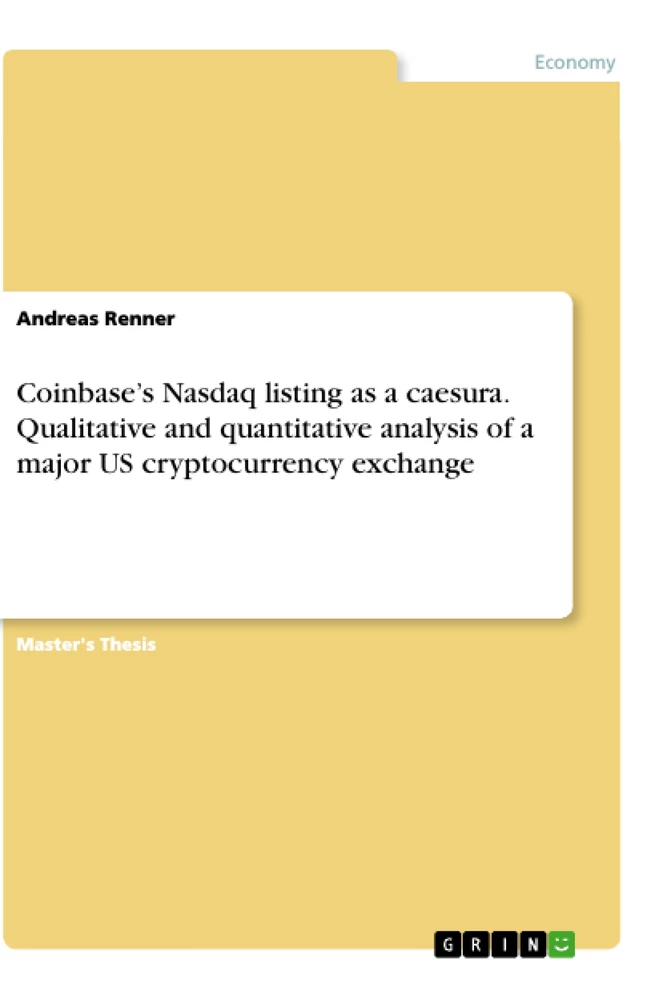
Table of Content
1 Introduction
1.1 Relevance of the topic and purpose of the thesis
1.2 Structure and approach of the thesis
1.3 Terminology
1.3.1 Exchange
1.3.2 Cryptocurrencies, blockchain and cryptocurrency exchanges
2 Methodology
2.1 Research design and strategy
2.2 Research instruments
2.2.1 Qualitative instruments
2.2.2 Quantitative instruments
3 Analysis of Coinbase
3.1 Qualitative findings
3.1.1 Company
3.1.2 Customers
3.1.3 Competitors
3.1.4 Collaborators
3.1.5 Context
3.2 Quantitative findings
4 Discussion and recommendations
4.1 Answers to the research questions
4.2 Recommendations
5 Conclusion
Bibliography
Objectives and Research Focus
This master thesis provides a comprehensive qualitative and quantitative analysis of Coinbase, a major US cryptocurrency exchange, in the context of its historic Nasdaq listing. The study aims to evaluate the company's business model, its competitive positioning, and financial health to provide strategic recommendations for management, potential investors, and market participants, while simultaneously contributing to a better understanding of the evolving cryptocurrency industry.
- Analysis of Coinbase's internal strengths and weaknesses via a Five C's framework.
- Evaluation of the industry environment using SWOT, PESTLE, and Porter's Five Forces.
- Quantitative financial assessment through eleven key ratios compared against traditional exchanges like Nasdaq and ICE.
- Strategic assessment of Coinbase's business model and its dependency on volatile cryptocurrency markets.
- Derivation of actionable recommendations for management and investors.
Excerpt from the Book
3.1.1 Company
Coinbase, founded in 2012 by Brian Armstrong -a former software developer at IBM and Airbnb and an early cryptocurrency adopter-, who is also the current CEO, and Fred Ehrsam -a former foreign exchange trader at Goldman Sachs-, is an online platform that enables customers to buy, sell, transfer, and store digital currencies (Coinbase, n.d.a; Coinbase, n.d.e; CB Information Services, 2018). Particularly, Coinbase offers three distinct services (CB Information Services, 2018; Armstrong, 2017). Firstly, Coinbase offers the Global Digital Asset Exchange called Coinbase Pro, an order book exchange for more advanced, large-volume traders, such as institutional players. The Global Digital Asset Exchange trades determine the mid-market price and provide Coinbase with a secure internal liquidity source. These functions are important for the second service – Coinbase’s brokerage. Coinbase is also operating a brokerage in the form of an exchange for retail investors. These can buy and sell cryptocurrencies at the mid-market price plus a fee. Due to the in-house liquidity source, Coinbase is independent of external liquidity, which reduces the volatility of the underlying cryptocurrencies. Thirdly, Coinbase launched Toshi, a browser for decentralised apps (DApp), in 2017 (Coelho-Prabhu; 2018; CB Information Services, 2018). Toshi then was further developed to become the first wallet that launched crypto-collectables, i.e., nonfungible tokens. In August 2018, Toshi was rebranded and became Coinbase Wallet. Thus, Coinbase is offering wallet, exchange, and merchant tools on one platform. Additionally, through its Application Programming Interface, applications can be built on the Coinbase platform. In October 2020, Coinbase launched an additional product in the US – the Coinbase Card (Coinbase, 2020b). This Visa debit card enables users to spend their cryptocurrencies stored on Coinbase for ATM cash withdrawals as well as both purchases and payments in-store and online.
Summary of Chapters
1 Introduction: Provides the background of the cryptocurrency boom and Coinbase's landmark direct listing on the Nasdaq, establishing the thesis's purpose and research questions.
2 Methodology: Details the exploratory, single case study approach and introduces the qualitative and quantitative frameworks utilized for the analysis.
3 Analysis of Coinbase: Presents the in-depth investigation of Coinbase, integrating qualitative findings through the Five C's, SWOT, PESTLE, and Porter's Five Forces, followed by a quantitative evaluation using financial ratios.
4 Discussion and recommendations: Synthesizes the analysis to answer the primary research questions and offers strategic guidance for investors and industry stakeholders.
5 Conclusion: Summarizes the key findings, confirming Coinbase's pioneering status and outlining the external and internal challenges it faces.
Keywords
Coinbase, Cryptocurrency Exchange, Nasdaq Listing, Blockchain, Financial Analysis, Strategic Management, Five C's Analysis, SWOT Analysis, PESTLE, Porter's Five Forces, Institutional Investors, Financial Ratios, Cryptoeconomy, Market Capitalization, Business Model
Frequently Asked Questions
What is the primary focus of this master thesis?
The thesis focuses on analyzing Coinbase, the first major US cryptocurrency exchange to list on a traditional stock market, to assess its business model, competitive situation, and financial stability following its Nasdaq listing.
What are the core thematic fields covered?
The work covers the evolution of cryptocurrency exchanges, the strategic analysis of Coinbase's platform and service offerings, the impact of the regulatory environment, and the challenges of reliance on transaction revenues.
What is the central research question of the study?
The thesis addresses two primary questions: What is Coinbase's current competitive situation, and what are its competitive advantages, and how can it improve its future positioning?
Which scientific methods were applied in the research?
The author employed a qualitative, holistic case study approach incorporating Five C's, SWOT, PESTLE, and Porter's Five Forces, alongside a quantitative analysis using eleven distinct financial ratios compared with industry benchmarks.
What aspects are addressed in the main body of the paper?
The main body contains a detailed company overview, customer and competitor analysis, the global business context, and a rigorous quantitative financial performance assessment comparing Coinbase to traditional exchanges like ICE and Nasdaq.
Which key terms characterize the thesis?
Key terms include cryptocurrency exchanges, blockchain, direct listing, financial ratios, competitive advantage, market capitalization, and the cryptoeconomy.
How does the author analyze the bargaining power of buyers?
The analysis differentiates between retail users and institutions, concluding that while retail users have limited individual power, their ability to organize as a group can influence Coinbase, while institutional clients hold more power due to trading volume.
What conclusion does the author reach regarding Coinbase's dependence on transaction revenues?
The author identifies this dependence as a fundamental weakness, making the company highly vulnerable to cryptocurrency market volatility and future fee compressions in a maturing industry.
Ende der Leseprobe aus 68 Seiten
- nach oben
- Arbeit zitieren
- Andreas Renner (Autor:in), 2021, Coinbase’s Nasdaq listing as a caesura. Qualitative and quantitative analysis of a major US cryptocurrency exchange, München, Page::Imprint:: GRINVerlagOHG, https://www.diplomarbeiten24.de/document/1144631

neugierig - aktuell - relevant
Entdecken Sie hilfreiche Tipps und Tricks rund ums Studium!

Entdecken Sie hilfreiche Tipps und Tricks rund ums Studium!
Ihre Hausarbeit / Abschlussarbeit:

- - Publikation als E-Book und Buch
- - Hohes Honorar auf die Verkäufe
- - Für Sie komplett kostenlos - mit ISBN
- - Es dauert nur 5 Minuten
- - Jede Arbeit findet Leser

- © GRIN Publishing GmbH.
- Alle Inhalte urheberrechtlich geschützt. Kopieren und verbreiten untersagt.
- info@grin.com
- AGB
- Open Publishing
Der GRIN Verlag hat sich seit 1998 auf die Veröffentlichung akademischer eBooks und Bücher spezialisiert. Der GRIN Verlag steht damit als erstes Unternehmen für User Generated Quality Content. Die Verlagsseiten GRIN.com, Hausarbeiten.de und Diplomarbeiten24 bieten für Hochschullehrer, Absolventen und Studenten die ideale Plattform, wissenschaftliche Texte wie Hausarbeiten, Referate, Bachelorarbeiten, Masterarbeiten, Diplomarbeiten, Dissertationen und wissenschaftliche Aufsätze einem breiten Publikum zu präsentieren.
Kostenfreie Veröffentlichung: Hausarbeit, Bachelorarbeit, Diplomarbeit, Dissertation, Masterarbeit, Interpretation oder Referat jetzt veröffentlichen!
Folgen Sie GRIN auf


- GRIN Verlag GmbH
-
- Nymphenburger Str. 86
- 80636
- Munich, Deutschland
- +49 89-550559-0
- +49 89-550559-10
- info@grin.com
-
