
präsentiert von

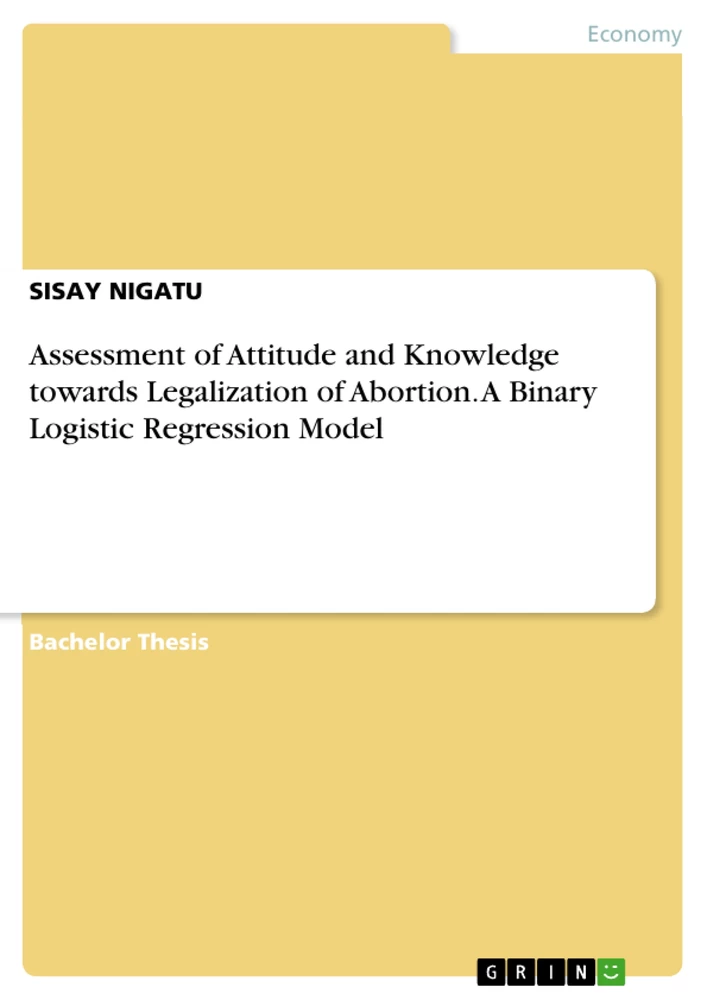
Table of Contents
1. CHAPTER ONE
1.1 INTRODUCTION
2. CHAPTER TWO
2.1 LITERATURE REVIEW
3. CHAPTER THREE
3.1 METHODOLOGY
4. CHAPTER FOUR
4.1 STATISTICAL DATA ANALYSIS
5. CHAPTER FIVE
Research Objectives and Themes
This study aims to assess the knowledge and attitude of undergraduate female Biology students at Addis Ababa University regarding the legalization of abortion, utilizing binary logistic regression to identify key socio-demographic and related determinants.
- Assessment of student knowledge and attitude towards abortion legality.
- Application of binary logistic regression models to identify influencing factors.
- Analysis of socio-demographic variables in the context of unintended pregnancy.
- Evaluation of the impact of reproductive health awareness and education.
Excerpt from the Book
1.1 Background of the Study
Abortion is the termination of a pregnancy by the expulsion of a fetus or embryo from the uterus. An abortion can occur spontaneously due to complications during pregnancy or can be induced. In the context of human pregnancies, an abortion induced to preserve the health of the pregnant. Female is termed as therapeutic abortion, while an abortion induced for any other reason is termed as elective abortion. By convention, induced abortion is usually defined as pregnancy termination prior to 20 weeks (for developed countries) and 28 weeks (for developing countries) gestation or less than 500-gm birth weight; it can be safe or unsafe abortion (1, 19).
In most part of our country Ethiopia, abortion is considered as a taboo, as a result a female who had an induced abortion hose herself and do not seek health service to inspire unless she is in a terminal stage. Abortion has been contributing to the high maternal mortality rate (MMR). The risk groups, (mothers and children) have priority in health service implementation. Worldwide, the Plan to achieve the Millennium Development Goal is focusing on maternal and child health as a primary goal in health program. To achieve the Millennium Development Goal (MDG) of reducing maternal deaths by three-fourths by 2015, particularly in sub-Saharan Africa, like Ethiopia, the issue of abortion has to be systematically addressed (12).
The demand for abortion in this poor and predominantly rural country is rooted in low contraceptive use and high levels of unintended pregnancy. Unsafe abortion not only affects the health of the women, it also affects material and financial resources of health institution. In many developing countries , management complications of usage hospital beads , blood supply ,medications and involves health man power. Indeed, only 14 % of Ethiopian women of reproductive age use contraception and more than 40% of pregnancies are unintended (14).
Summary of Chapters
CHAPTER ONE: Introduces the background of the study regarding abortion in Ethiopia, the problem statement, and the objectives of the research.
CHAPTER TWO: Provides a comprehensive review of existing literature on global and local abortion statistics, determinants, and the associated public health challenges.
CHAPTER THREE: Details the research methodology, including the study area, population, stratified random sampling design, and the logistic regression model used for analysis.
CHAPTER FOUR: Presents the statistical data analysis, including descriptive statistics and the results of Chi-square tests and logistic regression models.
CHAPTER FIVE: Concludes the findings regarding factors affecting student attitudes and knowledge, while offering recommendations for policy makers and health professionals.
Keywords
Abortion, Legalization, Binary Logistic Regression, Addis Ababa University, Female Biology Students, Maternal Mortality, Reproductive Health, Unintended Pregnancy, Contraception, Socio-demographic Variables, Chi-square Test, Public Health, Ethiopia, Attitude, Knowledge.
Frequently Asked Questions
What is the primary focus of this research?
The research focuses on assessing the level of knowledge and the attitude of undergraduate female Biology students at the College of Natural Science, Addis Ababa University, regarding the legalization of abortion.
What are the central themes discussed in this study?
The central themes include the prevalence of induced versus spontaneous abortion, the impact of reproductive health education, socio-economic and demographic determinants, and the public health implications of unsafe abortion in Ethiopia.
What is the core objective of the work?
The primary goal is to determine the factors that significantly influence female students' attitudes and knowledge toward the legalization of abortion using statistical modeling.
Which scientific methodology is applied?
The study employs a quantitative approach using stratified random sampling and inferential statistical methods, specifically Chi-square tests of independence and binary logistic regression models.
What does the main body of the work cover?
The main body covers the theoretical background, a review of global and local literature, detailed methodology for data collection and analysis, and a presentation of empirical findings based on questionnaire responses.
How are the results categorized?
Results are categorized through descriptive analysis, Chi-square tests to determine associations, and logistic regression analysis to identify the most effective variables influencing student attitudes and knowledge.
How do marital status and residence impact the results?
The analysis indicates that marital status and place of residence are significant predictors of both the attitude and knowledge of the female students concerning the legalization of abortion.
What is the significance of the findings regarding mother's education?
The study finds that the educational level of the students' mothers has a significant impact on the students' adequate knowledge regarding the legalization of abortion, though it shows an insignificant effect on their attitudes.
Ende der Leseprobe aus 41 Seiten
- nach oben
- Arbeit zitieren
- SISAY NIGATU (Autor:in), 2021, Assessment of Attitude and Knowledge towards Legalization of Abortion. A Binary Logistic Regression Model, München, Page::Imprint:: GRINVerlagOHG, https://www.diplomarbeiten24.de/document/1146966

neugierig - aktuell - relevant
Entdecken Sie hilfreiche Tipps und Tricks rund ums Studium!

Entdecken Sie hilfreiche Tipps und Tricks rund ums Studium!
Ihre Hausarbeit / Abschlussarbeit:

- - Publikation als E-Book und Buch
- - Hohes Honorar auf die Verkäufe
- - Für Sie komplett kostenlos - mit ISBN
- - Es dauert nur 5 Minuten
- - Jede Arbeit findet Leser

- © GRIN Publishing GmbH.
- Alle Inhalte urheberrechtlich geschützt. Kopieren und verbreiten untersagt.
- info@grin.com
- AGB
- Open Publishing
Der GRIN Verlag hat sich seit 1998 auf die Veröffentlichung akademischer eBooks und Bücher spezialisiert. Der GRIN Verlag steht damit als erstes Unternehmen für User Generated Quality Content. Die Verlagsseiten GRIN.com, Hausarbeiten.de und Diplomarbeiten24 bieten für Hochschullehrer, Absolventen und Studenten die ideale Plattform, wissenschaftliche Texte wie Hausarbeiten, Referate, Bachelorarbeiten, Masterarbeiten, Diplomarbeiten, Dissertationen und wissenschaftliche Aufsätze einem breiten Publikum zu präsentieren.
Kostenfreie Veröffentlichung: Hausarbeit, Bachelorarbeit, Diplomarbeit, Dissertation, Masterarbeit, Interpretation oder Referat jetzt veröffentlichen!
Folgen Sie GRIN auf


- GRIN Verlag GmbH
-
- Nymphenburger Str. 86
- 80636
- Munich, Deutschland
- +49 89-550559-0
- +49 89-550559-10
- info@grin.com
-
