
präsentiert von

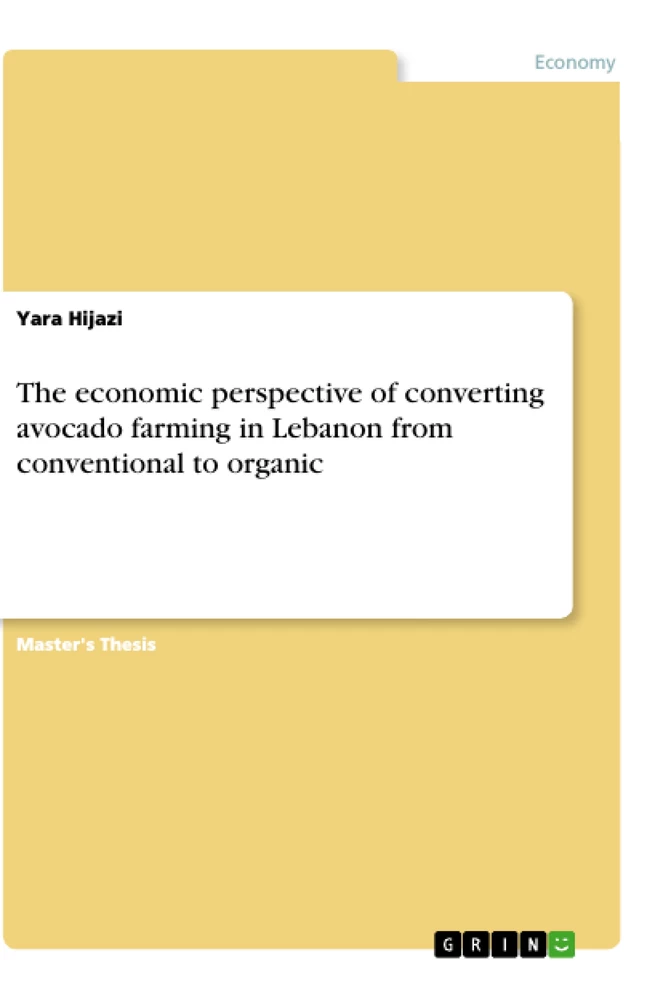
Table of Contents
1. Introduction
2. Theoretical Background and Literature Review
2.1. Current Economic Crisis in Lebanon
2.2. Avocado Farming
2.2.1. Lebanon
2.3. Current Avocado Market in Lebanon: Chain Actors
2.3.1. International Avocado Market
2.3.2. Europe as a Potential market for Lebanon
2.4. Organic Farming
2.4.1. Definitions
2.4.2. Benefits and Opportunities of Organic Farming
2.4.3. Challenges
2.4.4. Converting to Organic Farming Debate
2.4.5. Organic Certification in Lebanon
2.4.6. Organic Market in Lebanon
2.5. Global organic market
2.6. The Lebanese Value Chain of Fruits and its Potential for Europe
2.7. Research Questions
3. Materials and Methods
3.1. Qualitative Research Methods
3.1.1. Quantitative versus Qualitative
3.1.2. Data Collection Method: Interviews and Case Studies
3.2. Analysis: SWOT
3.3. Procedure
3.3.1. Respondents’ Backgrounds
3.3.2. Price per kg
4. Results
4.1. Export
4.1.1. Exporting to Europe in 2021
4.1.2. Transition Period and Certification
4.2. Cost Analysis: Non-Organic Chemicals Used and Labor
5. Discussion
5.1. Costs of Converting to Organic Farming
5.2. Comparison with Avocado Farming in Mexico
5.3. Additional Aspects of Organic Avocado Farming
5.4. Social, Ethical, and Environmental Aspects
5.5. Alternatives
5.6. Limitations
6. Conclusion
7. Bibliography
8. Appendix: Interview Questions
Objectives and Research Themes
This master's thesis examines the economic feasibility of converting avocado farming in Lebanon from conventional to organic methods amidst the country's severe financial crisis. The research aims to determine if organic certification can provide a sustainable income for farmers, specifically through potential export opportunities to European markets, while identifying the primary barriers and alternatives for local growers.
- The impact of the Lebanese economic crisis on agricultural operational costs and profitability.
- Barriers to adopting organic farming practices and obtaining certification in a developing economy.
- Market potential and export strategies for Lebanese avocados within the European union.
- The effectiveness of internationally funded agricultural development projects.
- The role of cooperatives and associations in supporting small-scale farmers.
Excerpt from the Book
2.2.1.1. Environmental Requirements
In order to better understand the considerations needed for developing avocado production in Lebanon in the future, this section introduces the environmental requirements of avocado in terms of soil, climate, and water needs and management. The avocado tree is an evergreen tree with a height of 10-15 m that is originally from Mexico (Duarte et al., 2017). Its shape varies according to the type and reproduction methods. The fruit is green in color at the early stages and then develops a dark, shiny hue in the ripening stage. The trees planted with seeds (not grafted) grow straight and perpendicular due to the firm control of the upper part. The avocado root system, like any other plant, is highly dependent on soil, climate, and agricultural performance. Deep, sandy, moderately homogeneous, well-drained soils help extend the roots deeper. The soil moisture, in turn, is strongly affected by the climate (Hijazi, 2016). The roots are superficial in areas where the soil surface is wet during the year, especially if the water drainage is weak. The land appropriate for planting avocados should be clear of any disease, should have a good water leakage, be 1.5 m deep, and display a pH between five and seven. The trees should be planted three meters apart from each other (Hijazi, 2016). As for the climate, Hijazi (2016) stated that it determines the appropriate time to start planting avocado trees. The climate also allows the mass of roots to be removed and transplanted at any time of the year if the irrigation system is effective and monitored. In the Mediterranean climate, the intensity of the winter is the main factor affecting the timing of planting, especially in areas exposed to the risk of frost. If the expected temperature is very low, it is preferable to postpone the planting until the spring. Moreover, avocados require abundant light and are preferably planted in sunlight-flooded areas with around 2000 hours annually.
Summary of Chapters
1. Introduction: Outlines the significance of the agriculture sector in Lebanon and introduces the shift toward avocado farming as a potential economic alternative.
2. Theoretical Background and Literature Review: Provides context on the economic crisis in Lebanon, examines avocado farming requirements, and reviews existing literature on organic farming practices and certification.
3. Materials and Methods: Describes the qualitative research approach, including semi-structured interviews with ten avocado farmers and the application of SWOT analysis.
4. Results: Presents findings from interviews regarding current farm practices, export destinations, and farmers' perceptions of organic conversion and certification costs.
5. Discussion: Analyzes the economic feasibility of conversion, comparing costs with other organic crops and exploring the socio-economic and environmental challenges faced by farmers.
6. Conclusion: Synthesizes the research findings, noting that while organic farming has potential, current economic instability makes it a high-risk endeavor, suggesting export of non-certified produce as a temporary alternative.
Keywords
Avocado farming, Lebanon, organic agriculture, economic crisis, agricultural export, farm certification, sustainable development, SWOT analysis, livelihood, market demand, rural economics, international funding, crop management, food security, small-scale farming.
Frequently Asked Questions
What is the core focus of this research?
The work investigates whether converting avocado farms from conventional to organic practices in Lebanon can improve the economic situation of local farmers during the country's ongoing financial crisis.
What are the central thematic areas?
Key themes include the impact of Lebanon's currency devaluation on farm costs, the technical and financial hurdles of organic certification, and the potential for exporting to competitive European markets.
What is the primary research question?
The study asks if converting to organic farming helps alleviate the economic hardships of Lebanese avocado farmers, what obstacles prevent this transition, and what alternative strategies exist.
Which scientific methods were applied?
The author employed a qualitative research design, conducting semi-structured interviews with ten avocado growers, supplemented by a SWOT analysis to evaluate project planning and organizational performance.
What does the main body cover?
It details the environmental and economic requirements for avocado production, the history of international development projects in Lebanon, the specifics of organic certification, and a comparative discussion on production costs.
Which keywords best characterize this work?
Avocado farming, Lebanon, organic agriculture, economic crisis, agricultural export, farm certification, sustainable development, and SWOT analysis.
How does the economic crisis specifically affect avocado farmers?
Farmers face inflated costs for imported materials and machinery (paid in USD) while selling their produce locally in a depreciated currency (LBP), forcing them to seek export markets for better revenue.
What is the conclusion regarding organic conversion?
The author concludes that while organic farming is ecologically positive, the current financial instability, high cost of certification, and lack of long-term support make full conversion difficult for most farmers at this time.
What role does the Global G.A.P. project play?
It serves as a recommended interim strategy, allowing farmers to export produce to Europe by adhering to Integrated Pest Management (IPM) standards, which are more manageable than immediate, full organic conversion.
Ende der Leseprobe aus 67 Seiten
- nach oben
- Arbeit zitieren
- Yara Hijazi (Autor:in), 2021, The economic perspective of converting avocado farming in Lebanon from conventional to organic, München, Page::Imprint:: GRINVerlagOHG, https://www.diplomarbeiten24.de/document/1153594

neugierig - aktuell - relevant
Entdecken Sie hilfreiche Tipps und Tricks rund ums Studium!

Entdecken Sie hilfreiche Tipps und Tricks rund ums Studium!
Ihre Hausarbeit / Abschlussarbeit:

- - Publikation als E-Book und Buch
- - Hohes Honorar auf die Verkäufe
- - Für Sie komplett kostenlos - mit ISBN
- - Es dauert nur 5 Minuten
- - Jede Arbeit findet Leser

- © GRIN Publishing GmbH.
- Alle Inhalte urheberrechtlich geschützt. Kopieren und verbreiten untersagt.
- info@grin.com
- AGB
- Open Publishing
Der GRIN Verlag hat sich seit 1998 auf die Veröffentlichung akademischer eBooks und Bücher spezialisiert. Der GRIN Verlag steht damit als erstes Unternehmen für User Generated Quality Content. Die Verlagsseiten GRIN.com, Hausarbeiten.de und Diplomarbeiten24 bieten für Hochschullehrer, Absolventen und Studenten die ideale Plattform, wissenschaftliche Texte wie Hausarbeiten, Referate, Bachelorarbeiten, Masterarbeiten, Diplomarbeiten, Dissertationen und wissenschaftliche Aufsätze einem breiten Publikum zu präsentieren.
Kostenfreie Veröffentlichung: Hausarbeit, Bachelorarbeit, Diplomarbeit, Dissertation, Masterarbeit, Interpretation oder Referat jetzt veröffentlichen!
Folgen Sie GRIN auf


- GRIN Verlag GmbH
-
- Nymphenburger Str. 86
- 80636
- Munich, Deutschland
- +49 89-550559-0
- +49 89-550559-10
- info@grin.com
-
