
präsentiert von

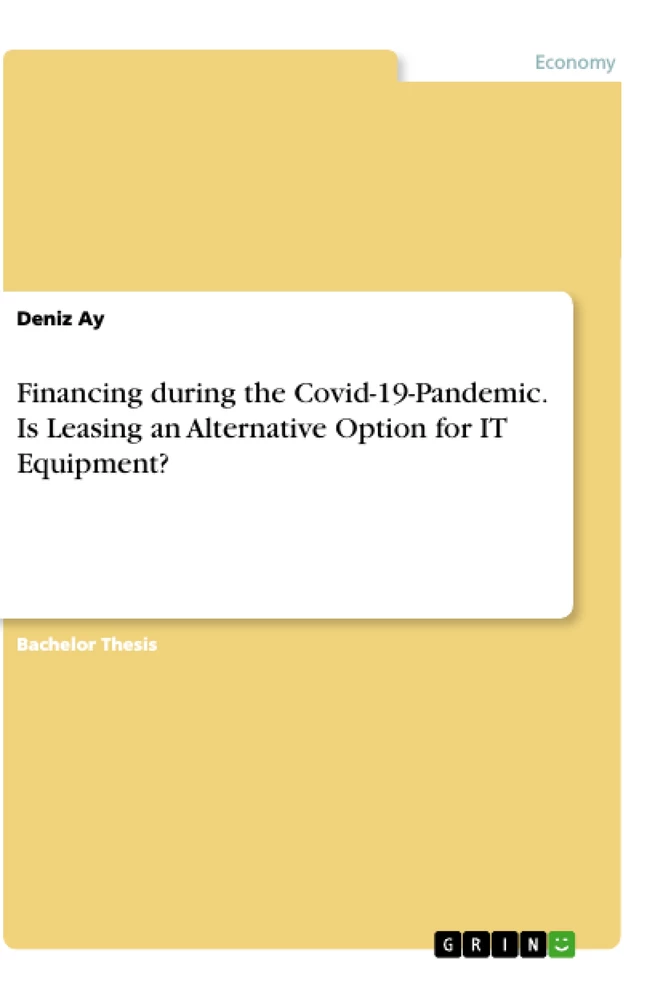
Table of Contents
1 Introduction
2 Fundamentals of Leasing
2.1 Basics and Terms
2.2 Subsectors of Leasing
2.2.1 Leasing object
2.2.2 Leasing Contract
2.2.3 Contractual Partner
2.3 Leasing effects
2.3.1 Effects of leasing on liquidity
2.3.2 Balance sheet effects
2.3.3 Tax effects
2.4 Alternative financing options and comparison to leasing
2.4.1 Financing basics
2.4.2 Internal Financing
2.4.3 External Financing
2.4.4 Leasing compared to other financing options
3 Changed economic situation during the Corona pandemic
3.1 Coronavirus an introduction
3.2 Impact on the German economy
3.3 Measures taken by companies
3.4 Impact on the leasing industry
4 Empirical approach
4.1 Data Evaluation
4.2 Results of the survey
5 Conclusion and Outlook
Research Objectives and Key Topics
The thesis examines the relevance of leasing as a financing alternative for IT equipment during the Corona pandemic, focusing on whether it served as an appropriate instrument for companies facing economic instability and the sudden need for digital infrastructure. The research explores the theoretical foundations of leasing, the economic changes triggered by the pandemic, and validates these insights through expert interviews.
- The mechanics of leasing, including liquidity, balance sheet, and tax effects.
- A comparison between leasing and alternative internal/external financing options.
- The economic impact of the Corona pandemic on the German corporate landscape.
- The role of digitization as a corporate response to the pandemic crisis.
- An empirical analysis of expert opinions on leasing’s importance during the pandemic.
Excerpt from the Book
1 Introduction
The Corona pandemic, which broke out in 2020, has endangered not only the health of many people but also the economic stability in Germany; many companies have become economically unstable as a result of the pandemic, as shown by the 4.8% drop in gross domestic product (GDP) in Germany (Statista, 2021). As a result, the federal government called for an economic shutdown to protect the population from the increasing number of Corona infections (Knauth and Krafczyk, 2020: 677).
The result was a massive drop in sales in many sectors like aviation and tourism. In addition, the German government's Corona Occupational Health and Safety Ordinance stipulates that employers are obliged to offer home offices, provided there are no operational reasons to the contrary (Presse- und Informationsamt der Bundesregierung, 2021). Therefore, the necessary IT equipment for the employees was usually unavailable and had to be procured. This is in direct contrast to the lack of liquidity of the companies due to the multiple slumps in sales. This resulted in resorting to alternative financing options, such as leasing.
Leasing originated in the USA and has developed from a sales promotion tool for manufacturers and dealers to a natural form of financing for the respective buyer. The first German leasing company was founded in 1962. Initially, leasing as a form of funding was difficult to establish and developed in two different directions: direct leasing with an independent leasing company as a contact and sales leasing, in which the dealer also takes on the role of the leasing company as an intermediary (Pahlke, 2013: 1).
Summary of Chapters
1 Introduction: Introduces the economic challenges posed by the Corona pandemic in Germany and outlines the research objective regarding leasing as a financing alternative.
2 Fundamentals of Leasing: Explains the basic definitions, subsectors, and economic effects of leasing, alongside a comparison to other internal and external financing instruments.
3 Changed economic situation during the Corona pandemic: Details the economic shifts, including GDP decline and the sudden push for digitization, as well as the pandemic's impact on the leasing industry.
4 Empirical approach: Outlines the qualitative research methodology, including the expert interview process, and presents the analyzed results categorized by leasing effects and future outlooks.
5 Conclusion and Outlook: Provides a final synthesis of the findings, confirming that leasing gained significant relevance as a flexible financing tool during the pandemic.
Keywords
Leasing, IT equipment, Corona pandemic, corporate finance, liquidity effect, balance sheet, tax impact, digitization, external financing, internal financing, economic stability, expert interviews, flexibility, investment, Germany.
Frequently Asked Questions
What is the core focus of this thesis?
The thesis investigates the role of leasing as an alternative financing option for IT equipment for German companies during the financial challenges of the Corona pandemic.
What are the primary thematic areas covered?
It covers leasing fundamentals, comparative financing options, the economic impacts of the pandemic, and qualitative data from experts in the leasing industry.
What is the primary research question?
The research asks whether leasing gained relevance as a financing alternative during the Corona pandemic and whether it proved to be an appropriate financing type for companies.
Which scientific method is employed?
The work utilizes a qualitative empirical approach, specifically conducting semi-standardized expert interviews with account managers and a customer to evaluate the research questions.
What topics are discussed in the main part?
The main part analyzes the mechanics of leasing (liquidity/tax/balance sheet), compares it to traditional credit and self-financing, and reviews the economic impact of the pandemic and digitization on the industry.
Which keywords best characterize this work?
Key terms include Leasing, IT equipment, Corona pandemic, liquidity, corporate finance, and digitization.
How does leasing affect a company's liquidity during a crisis?
Leasing preserves liquidity by allowing companies to avoid a high initial capital outflow for purchasing assets, as the lessor assumes the purchase price, enabling the company to use funds for other vital business areas.
What effect does the pandemic have on the future of IT equipment leasing?
Experts anticipate a positive future for IT leasing, driven by the ongoing need for modern digital infrastructure, the necessity for home office solutions, and the increasing preference of companies for flexible usage concepts over asset ownership.
Ende der Leseprobe aus 128 Seiten
- nach oben
- Arbeit zitieren
- Deniz Ay (Autor:in), 2021, Financing during the Covid-19-Pandemic. Is Leasing an Alternative Option for IT Equipment?, München, Page::Imprint:: GRINVerlagOHG, https://www.diplomarbeiten24.de/document/1154540

neugierig - aktuell - relevant
Entdecken Sie hilfreiche Tipps und Tricks rund ums Studium!

Entdecken Sie hilfreiche Tipps und Tricks rund ums Studium!
Ihre Hausarbeit / Abschlussarbeit:

- - Publikation als E-Book und Buch
- - Hohes Honorar auf die Verkäufe
- - Für Sie komplett kostenlos - mit ISBN
- - Es dauert nur 5 Minuten
- - Jede Arbeit findet Leser

- © GRIN Publishing GmbH.
- Alle Inhalte urheberrechtlich geschützt. Kopieren und verbreiten untersagt.
- info@grin.com
- AGB
- Open Publishing
Der GRIN Verlag hat sich seit 1998 auf die Veröffentlichung akademischer eBooks und Bücher spezialisiert. Der GRIN Verlag steht damit als erstes Unternehmen für User Generated Quality Content. Die Verlagsseiten GRIN.com, Hausarbeiten.de und Diplomarbeiten24 bieten für Hochschullehrer, Absolventen und Studenten die ideale Plattform, wissenschaftliche Texte wie Hausarbeiten, Referate, Bachelorarbeiten, Masterarbeiten, Diplomarbeiten, Dissertationen und wissenschaftliche Aufsätze einem breiten Publikum zu präsentieren.
Kostenfreie Veröffentlichung: Hausarbeit, Bachelorarbeit, Diplomarbeit, Dissertation, Masterarbeit, Interpretation oder Referat jetzt veröffentlichen!
Folgen Sie GRIN auf


- GRIN Verlag GmbH
-
- Nymphenburger Str. 86
- 80636
- Munich, Deutschland
- +49 89-550559-0
- +49 89-550559-10
- info@grin.com
-
