
präsentiert von

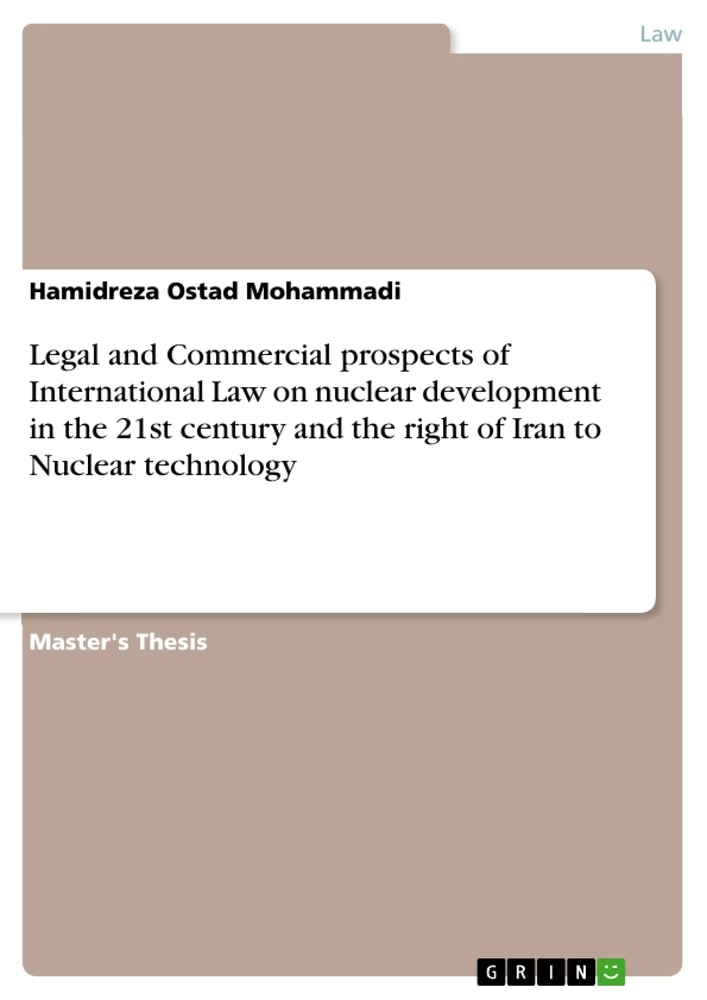
Table of Contents
1. CHAPTER 1: INTRODUCTION
1.1 Overview
1.2 Why is nuclear development so vital tob e recognised and regulated by International Law
1.3 Aims and Objectives
2. CHAPTER 2: CREATION OF NUCLEAR RELATED ORGANISATIONS AND TREATIES
2.1 A brief history of the development of the nuclear technology
2.2 International Atomic Energy Agency (IAEA)
2.3 Creation of Nuclear Non-Proliferation Treaty (NPT)
2.4 Treaty establishing the European Atomic Energy Community (“EURATOM”)
3. CHAPTER 3: INTERNATIONAL LAW ON THE NUCLEAR TRADE AND DEVELOPMENT
3.1 International transport law regarding the International Nuclear trade Regulations
3.2 Nuclear trade and the competition law
3.3 Other International Instruments and Civil Law Contracts
4. CHAPTER 4: NUCLEAR TECHNOLOGY AND THE DEVELOPING COUNTRIES
4.1 Nuclear energy affects on the developing countries’ economy
4.2 Nuclear Trade and the right to development
4.3 Contribution of the WTO in Nuclear trade and development (Article XXI of GATT)
5. CHAPTER 5: THE RIGHT OF IRAN TO NUCLEAR TECHNOLOGY
5.1 Summary
5.2 Case review
5.3 Iran’s right to nuclear technology under Article IV of Non-Proliferation Treaty (NPT)
5.4 The right of Iran to nuclear technology under the Universal Declaration of Human Rights
5.5 Politics overriding Iran’s right to nuclear technology
5.6 Security Council Sanctions against Iran
5.7 Case Resolution
6. CHAPTER 6: CONCLUSION
Research Objectives and Core Themes
This thesis examines the legal, commercial, and human rights frameworks governing international nuclear development and trade. It critically analyzes the role of international organizations like the IAEA and WTO, evaluates the limitations of the Non-Proliferation Treaty (NPT), and investigates the specific challenges faced by developing countries. Furthermore, it explores the legitimacy of international sanctions and the rights of sovereign states, specifically Iran, to access nuclear technology for peaceful civilian purposes.
- The intersection of international law, nuclear energy, and global trade.
- The effectiveness and inherent biases of current non-proliferation regimes.
- The impact of technological monopolies on developing nations' economic rights.
- An in-depth legal case analysis of Iran's nuclear program and the subsequent diplomatic disputes.
Book Excerpt
5.2 Case review
Iran's interest in nuclear technology dates back to the U.S. Atoms for Peace programme. In the 1950s, the Shah initiated Iran's nuclear research programme and developed an ambitious plan to produce 23,000MW from nuclear power by the end of the century. Early progress was not steady, and the nuclear programme was stalled by the Islamic revolution in 1979, then the eight-year war with Iraq through most of the 1980s. The programme was revived later in the decade, when Iran’s strategic and economical interests began to start the nuclear programme. The international community and the International Atomic Energy Agency (IAEA) have increased their inspection of Iran's activities over the last several years. The most controversial developments were announced in 2002-03, during which time Iran admitted to having construction plans for two enrichment facilities, a heavy water production plant, a fuel fabrication plant, and undertaken research into conversion and enrichment activities. On 19 August 2003, Iran began testing a ten-machine cascade at the Pilot Fuel Enrichment Plant at Natanz with uranium hexafluoride (UF6). (After announcing on 21 October 2003 that it would cooperate with the IAEA, Iran signed the Additional Protocol to the NPT on 18 December.)
In February 2003 Mohamed ElBaradei travelled to Iran with a team of inspectors to investigate Iran's nuclear programme. In November 2003 Dr. ElBaradei reported to the Board of Governors that Iran had repeatedly and over an extended period failed to meet with its safeguards obligations, including by failing to declare its uranium enrichment programme. Although he stated that there was no evidence that Iran was pursuing nuclear weapons, he added that he was still not in a position to conclude that there are no undeclared nuclear materials or activities in Iran. On 18 December 2003 Iran signed the Additional Protocol at the IAEA headquarters in Vienna, and pledged to act in accordance with its provisions pending completion of ratification of the protocol. Iran also pledged to suspend its plutonium reprocessing and uranium enrichment-related activities, in response to a diplomatic initiative by France, Germany and the UK. However, Iran ended its suspension and ended implementation of the Additional Protocol on 1 August 2005.
Summary of Chapters
CHAPTER 1: INTRODUCTION: This chapter introduces the transition to nuclear energy as a global imperative and outlines the paper's focus on creating a fairer international legal framework for nuclear technology.
CHAPTER 2: CREATION OF NUCLEAR RELATED ORGANISATIONS AND TREATIES: The chapter explores the history of nuclear organizations and treaties like the NPT and EURATOM, emphasizing their roles as regulators and providers of legal frameworks.
CHAPTER 3: INTERNATIONAL LAW ON THE NUCLEAR TRADE AND DEVELOPMENT: This section analyzes the intersection of international trade, transport laws, and competition regulations regarding the global supply of nuclear materials.
CHAPTER 4: NUCLEAR TECHNOLOGY AND THE DEVELOPING COUNTRIES: This chapter discusses the energy needs of developing nations and the technological barriers imposed by dominant nuclear states.
CHAPTER 5: THE RIGHT OF IRAN TO NUCLEAR TECHNOLOGY: A deep dive into the legal and political controversy surrounding Iran's nuclear program, analyzing NPT obligations and the legality of international sanctions.
CHAPTER 6: CONCLUSION: The final chapter summarizes the necessity for more transparent, equitable nuclear regulations and emphasizes the need for adapting regimes to balance non-proliferation with peaceful technological development.
Keywords
Nuclear Law, International Trade, Non-Proliferation Treaty, IAEA, EURATOM, Iran Nuclear Program, Uranium Enrichment, Human Rights, Economic Development, Nuclear Energy, Sanctions, WTO, Peaceful Use, Technology Transfer, Global Security.
Frequently Asked Questions
What is the fundamental subject of this publication?
The work explores the legal and commercial complexities surrounding the international trade and development of nuclear technology, with a specific focus on the rights of nations under international law.
What are the primary themes discussed?
The themes include the history of nuclear governance, the role of international organizations like the IAEA, the legal rights of developing nations, and the political dimensions of nuclear non-proliferation.
What is the central research question?
The author seeks to address how a universal and fairer legal framework can be introduced for the use, development, and trade of nuclear materials while addressing the shortcomings of current international legal instruments.
Which scientific or legal methods are employed?
The paper utilizes a legal analysis of existing treaties (such as the NPT and EURATOM), organizational statutes, and international trade law, complemented by a specific case study of Iran's nuclear program.
What topics are covered in the main body?
The main body examines the history of nuclear organization, international competition law, the economic impact on developing countries, and the diplomatic conflict involving Iran, including UN Security Council sanctions.
How would you characterize the keywords of this work?
The work is characterized by terms linking international law, trade regulation, nuclear proliferation, and sovereign energy rights.
What is the author's stance on the role of the IAEA in Iran's case?
The author suggests that if the IAEA were provided with more resources and Iran with more cooperative opportunities, the current diplomatic impasse could be resolved to foster global confidence.
How does the author view the EURATOM treaty in a broader context?
The author views EURATOM as a potential model for a fair, regional distribution of nuclear fuel, suggesting that its structure could inspire future IAEA policy-making for a more balanced global approach.
Ende der Leseprobe aus 78 Seiten
- nach oben
- Arbeit zitieren
- LLM Hamidreza Ostad Mohammadi (Autor:in), 2007, Legal and Commercial prospects of International Law on nuclear development in the 21st century and the right of Iran to Nuclear technology, München, Page::Imprint:: GRINVerlagOHG, https://www.diplomarbeiten24.de/document/115765

neugierig - aktuell - relevant
Entdecken Sie hilfreiche Tipps und Tricks rund ums Studium!

Entdecken Sie hilfreiche Tipps und Tricks rund ums Studium!
Ihre Hausarbeit / Abschlussarbeit:

- - Publikation als E-Book und Buch
- - Hohes Honorar auf die Verkäufe
- - Für Sie komplett kostenlos - mit ISBN
- - Es dauert nur 5 Minuten
- - Jede Arbeit findet Leser

- © GRIN Publishing GmbH.
- Alle Inhalte urheberrechtlich geschützt. Kopieren und verbreiten untersagt.
- info@grin.com
- AGB
- Open Publishing
Der GRIN Verlag hat sich seit 1998 auf die Veröffentlichung akademischer eBooks und Bücher spezialisiert. Der GRIN Verlag steht damit als erstes Unternehmen für User Generated Quality Content. Die Verlagsseiten GRIN.com, Hausarbeiten.de und Diplomarbeiten24 bieten für Hochschullehrer, Absolventen und Studenten die ideale Plattform, wissenschaftliche Texte wie Hausarbeiten, Referate, Bachelorarbeiten, Masterarbeiten, Diplomarbeiten, Dissertationen und wissenschaftliche Aufsätze einem breiten Publikum zu präsentieren.
Kostenfreie Veröffentlichung: Hausarbeit, Bachelorarbeit, Diplomarbeit, Dissertation, Masterarbeit, Interpretation oder Referat jetzt veröffentlichen!
Folgen Sie GRIN auf


- GRIN Verlag GmbH
-
- Nymphenburger Str. 86
- 80636
- Munich, Deutschland
- +49 89-550559-0
- +49 89-550559-10
- info@grin.com
-
