
präsentiert von

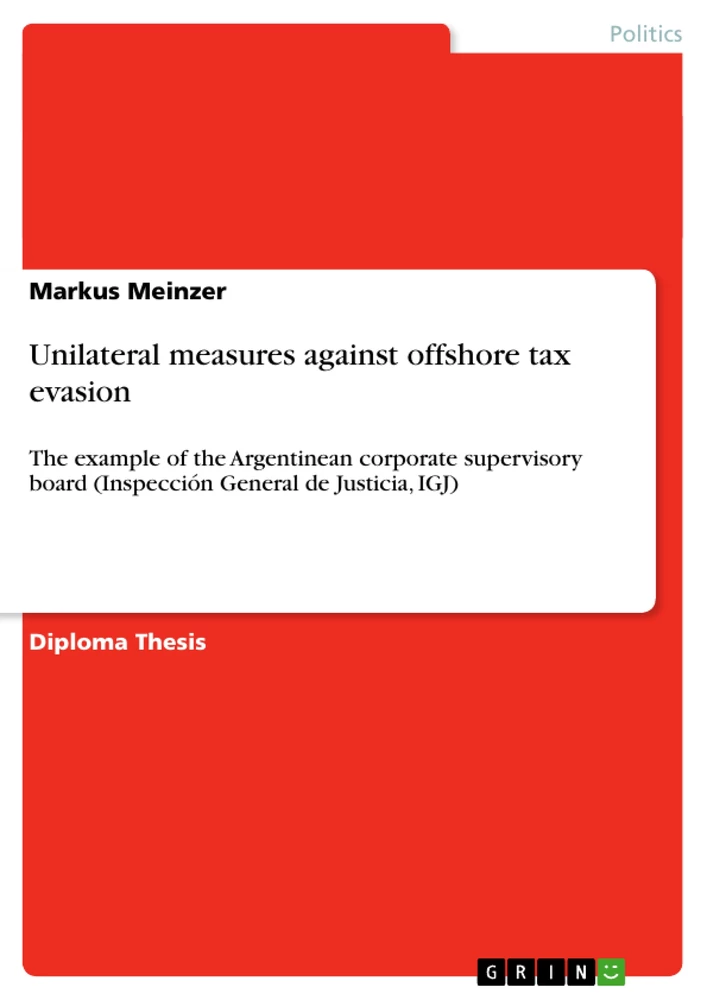
Table of Contents
1 Introduction
2 Theoretical background, research subject and methodology
2.1 Definitions of key concepts
2.1.1 Offshore
2.1.2 Tax evasion
2.1.3 Offshore tax evasion
2.1.4 Offshore financial centre (OFC) and tax haven
2.1.5 Offshore (shell) company
2.2 Theoretical Background and Relevance
2.3 Research Question and Hypotheses
2.4 Delimitation
2.5 Epistemological background and Methodology
2.6 Sources and Formality
2.7 Field research: qualitative and quantitative methods
3 Corporate Law, Institutions and Policy
3.1 Judicial Context: Corporate Law on the federal level
3.2 Institutional Framework: Implementation on the provincial level
3.3 Offshore Corporate Policy: IGJ-General Resolutions 2003-2005
3.3.1 IGJ-RG 7/03 – Centrepiece: Real Economic Activity Criteria
3.3.2 IGJ-RG 8/03 – End to Actos Aislados Provision
3.3.3 IGJ-RG 12/2003 – Defining and Supporting Adecuación
3.3.4 IGJ-RG 22/2004 – Exemption of Investment Vehicles
3.3.5 IGJ-RG 2/05 – Severing of Real Economic Activity Criteria
3.3.6 Resolution IGJ-RG 3/05 – Identification of Shareholders
3.3.7 IGJ-RG 7/05 – Integration and Reordering
3.4 Summary: Two layers and two criteria interplaying in implementation practice
4 Analysis and Test of Hypothesis 1
4.1 Qualitative Analysis
4.2 QuantitativeAnalysis
5 Hypothesis 2: widening the perspective
5.1 Offshore tax evasion: framework of analysis
5.2 Bottlenecks in the puzzle: Access to foreign currencies
5.3 The Argentinean Tax-System: Law and Judiciary
5.4 Mechanisms of illicit trans-border capital flows in Argentina
5.4.1 Enabling Entities
5.4.2 Enabling (accounting and/or tax) Devices
5.5 Thoughts on quantitative assessments
6 Conclusions
Research Objectives and Key Themes
The research aims to investigate the normative-judicial scope and factual impact of the regulatory measures implemented by the Argentinean Corporate Supervisory Board (IGJ) between 2003 and 2005 to counteract offshore tax evasion. The study explores whether these unilateral measures by a developing country can effectively alter the behavior of agents utilizing offshore financial structures.
- Regulatory measures of the IGJ (2003-2005) against offshore shell companies.
- The link between offshore structures and cross-border tax evasion by wealthy individuals.
- The effectiveness of administrative implementation and regulatory compliance in Argentina.
- The role of foreign exchange access and tax law as bottlenecks for offshore evasion.
- Institutional challenges in maintaining a central corporate register.
Excerpt from the book
2.1.1 Offshore
To begin with, the term ”offshore” might be confusing since it evokes the imagery of open sea and drilling platforms and thus refers to a real, palpable geographical location. In this sense, this imagery is misleading because offshore for our purposes corresponds to a purely artificial, judicial space instead (Palan 2003: 19). This is even more emphasized if its aspect given by International Law is pronounced, which deems the open seas as being beyond the sovereign space of single nation states.
To make long story short, offshore refers here to a space legally created and supported by nation-states which at the same time is freed and explicitly exempt from regulatory and indeed sovereign control. For such a thing to exist, two elements are necessary: Firstly, a state providing laws, whether deliberately or accidentally, which withdraw or reduce effective regulation and/or taxation over international economic activities taking place in or being rooted through its jurisdiction. Secondly, the principle of exclusive sovereignty which is bound to a territory and prescribes that no other state or force is allowed to intervene in affairs taking place on the former’s territory (Palan 1998: 25-28; 2003: 19-20). Thus, the unregulated and/or untaxed realm of the former state is becoming offshore, allowing international economic activity - and therefore activities which affect third states or parties - to take place therein under the protection of the institution of sovereignty.
Summary of Chapters
1 Introduction: Provides an overview of the rise of tax havens and the challenge they pose to developing countries, while outlining the thesis' focus on the Argentinean regulatory approach.
2 Theoretical background, research subject and methodology: Defines key concepts such as "offshore" and "tax evasion," outlines the theoretical framework regarding international development, and details the qualitative and quantitative research methodology used.
3 Corporate Law, Institutions and Policy: Examines the legal context of the IGJ, describes the chronologically implemented general resolutions (2003-2005), and summarizes the two-layered policy framework.
4 Analysis and Test of Hypothesis 1: Presents the qualitative and quantitative findings regarding whether IGJ measures altered the behavior of agents using offshore companies, concluding the hypothesis does not hold true.
5 Hypothesis 2: widening the perspective: Explores whether offshore evaders shifted to more indirect methods following the restrictions on shell companies, and discusses bottlenecks like foreign currency access.
6 Conclusions: Synthesizes the findings, confirming that the Argentinean ban on offshore shell companies was comprehensive, and provides a generic outlook on the sustainability of such measures.
Keywords
Offshore, Tax Evasion, Argentina, IGJ, Corporate Law, Shell Companies, Tax Havens, Capital Flight, Regulation, Implementation, Adecuación, Tax Policy, Fiscal Autonomy, Money Laundering, Transparency
Frequently Asked Questions
What is the core focus of this thesis?
The work focuses on the regulatory measures introduced by the Argentinean corporate supervisory body (IGJ) between 2003 and 2005 aimed at banning offshore shell companies to counteract cross-border tax evasion.
What are the central thematic areas?
The core themes include international tax evasion, the use of offshore shell companies by wealthy individuals, the institutional effectiveness of the IGJ, and the broader context of tax policy in developing nations.
What is the primary research question?
The research asks what the normative-judicial scope and the factual impact of the IGJ’s policy were, and whether these measures effectively successfully countered offshore tax evasion in the Argentinean context.
Which methodology is employed?
The thesis adopts an explorative case study approach, combining qualitative analysis (interviews with 27 experts) and quantitative analysis of corporate registration data from the Buenos Aires registry.
What is addressed in the main chapters?
The main chapters cover the theoretical framework and definitions, the detailed legal and institutional context of the IGJ resolutions, the analysis of the two hypotheses regarding the impact on evader behavior, and the mechanisms of illicit capital flows.
Which keywords best characterize the research?
Relevant keywords include Offshore, Tax Evasion, Argentina, IGJ, Corporate Law, Shell Companies, Tax Havens, Capital Flight, and Fiscal Autonomy.
How does the "Real Economic Activity" criterion work?
The criterion requires foreign companies to prove that they are not just facades but are conducting substantial commercial activity in their place of incorporation, shifting the burden of proof to the company to justify their legal status.
What is "adecuación"?
Adecuación is the administrative process required by the IGJ for foreign companies that fail to meet real economic activity criteria, forcing them to adopt the legal form of an Argentinean company, thereby subjecting them to local jurisdiction and oversight.
Ende der Leseprobe aus 143 Seiten
- nach oben
- Arbeit zitieren
- Markus Meinzer (Autor:in), 2008, Unilateral measures against offshore tax evasion, München, Page::Imprint:: GRINVerlagOHG, https://www.diplomarbeiten24.de/document/115900

neugierig - aktuell - relevant
Entdecken Sie hilfreiche Tipps und Tricks rund ums Studium!

Entdecken Sie hilfreiche Tipps und Tricks rund ums Studium!
Ihre Hausarbeit / Abschlussarbeit:

- - Publikation als E-Book und Buch
- - Hohes Honorar auf die Verkäufe
- - Für Sie komplett kostenlos - mit ISBN
- - Es dauert nur 5 Minuten
- - Jede Arbeit findet Leser

- © GRIN Publishing GmbH.
- Alle Inhalte urheberrechtlich geschützt. Kopieren und verbreiten untersagt.
- info@grin.com
- AGB
- Open Publishing
Der GRIN Verlag hat sich seit 1998 auf die Veröffentlichung akademischer eBooks und Bücher spezialisiert. Der GRIN Verlag steht damit als erstes Unternehmen für User Generated Quality Content. Die Verlagsseiten GRIN.com, Hausarbeiten.de und Diplomarbeiten24 bieten für Hochschullehrer, Absolventen und Studenten die ideale Plattform, wissenschaftliche Texte wie Hausarbeiten, Referate, Bachelorarbeiten, Masterarbeiten, Diplomarbeiten, Dissertationen und wissenschaftliche Aufsätze einem breiten Publikum zu präsentieren.
Kostenfreie Veröffentlichung: Hausarbeit, Bachelorarbeit, Diplomarbeit, Dissertation, Masterarbeit, Interpretation oder Referat jetzt veröffentlichen!
Folgen Sie GRIN auf


- GRIN Verlag GmbH
-
- Nymphenburger Str. 86
- 80636
- Munich, Deutschland
- +49 89-550559-0
- +49 89-550559-10
- info@grin.com
-
