
präsentiert von

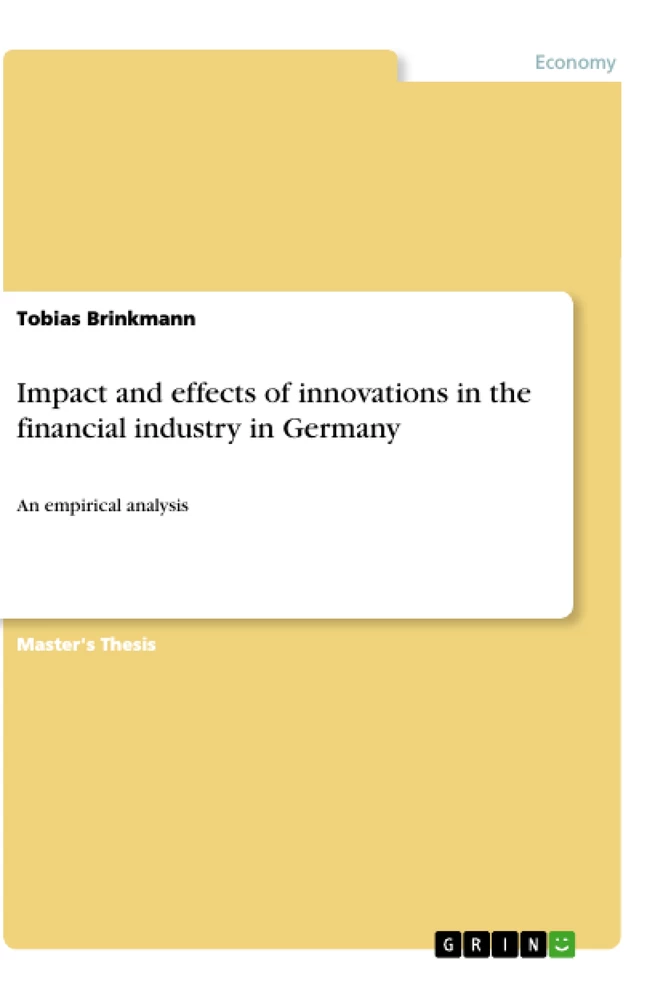
Table of Contents
1 Introduction
1.1 Abstract
1.2 Research Method and Questions
1.3 Research Approach and Limitations of the Study
2 Literature Review
2.1 Definition of Banking
2.2 The German Banking System
2.3 Types of Banks
2.4 Definition of FinTech and background
2.5 Modern and open banking
3 Methodology
3.1 Research methodology and justification of approach
3.2 Data collection and analysis
3.3 Technique of data collection, verification, and limitations
3.4 Philosophy of the research
4 Theoretical Framework
4.1 Definition and Management of Innovation
4.2 Innovation Culture and Strategy
4.2 The innovation process and framework requirements
4.4 Fintech Business Models
4.4.1 Crowdfunding, -investing and -lending
4.4.2 Credit, Factoring and Payments
4.4.3 Investment and banking
4.4.4. Robo-Advice and Associated Services
4.5 Impact and effects of regulatory and environmental changes on FinTechs
4.6 Comparison of FinTech and Banking Business Models
5 Research Study
5.1 Conceptual Framework
5.2 Study Design and Questions
5.3 Key findings of collaborations between FinTechs and banks
5.3.1 Hypothesis 1: Banks facilitate the market entry of FinTech start-ups
5.3.2 Hypothesis 2: A) FinTech start-ups with high financial funds apply for proper banking licenses rather than initializing own collaborations and B) banks increase FinTech's profits
5.3.3 Hypothesis 3: Incumbents facilitate FinTech start-ups the development of new products and services
5.4 Enablers of cooperation between FinTech and market incumbents
5.4.1 Summary of key results
5.4.2 Practical Example: Design Thinking as instrument to foster innovation in banking
6 Conclusion
6.1 Critical Acclaim
6.2 Outlook and future research
Research Objectives and Key Topics
This thesis examines the impact of innovative FinTech start-ups on the German financial industry, focusing on the collaborative dynamics between these new market entrants and traditional banking incumbents. The primary research goal is to investigate how the innovative strengths of FinTechs can be utilized through strategic collaborations to foster digital transformation while addressing regulatory and structural challenges.
- The evolution of the German banking system in the face of digitalization.
- Classification and assessment of diverse FinTech business models (e.g., crowdfunding, payments, robo-advice).
- Critical analysis of innovation management and the "open innovation" paradigm in financial services.
- Evaluation of key success factors and drivers for successful bank-FinTech partnerships.
- The influence of regulatory frameworks and environmental changes on the FinTech market growth.
Excerpt from the Book
4.2 Innovation Culture and Strategy
Commonly, the innovation culture is closely linked to the corporate strategy. In that matter, Hauschild (2004) observes that both innovation strategy and culture are critical determinants for the competitive strengths of a company. However, Jacobs and Snijders (2008) partly criticize Hauschild’s perception as rather theoretical assumptions. While Corsten et al. (2006) observe that the corporate culture defines the organization’s norms and values, Hauschild (2004) suggests that the corporate culture has a tremendous impact on the long-term motivation, enthusiasm, and performance of employees. Moreover, Corsten et al. (2006) confirm that observation and highlight that the corporate culture illustrates the sum of norms and values an organization has. Conclusively, the willingness for innovations represents an independent determinant as part of the corporate culture (Jacobs and Snijders, 2008). While Jacobs and Snijders (2008) conclude that successful innovations require a corporate atmosphere in which employees are highly encouraged to contribute to the thinking out of the box process, Corsten et al. (2006) and Hauschildt (2004) identify five key characteristics of successful innovative organizations.
First, system openness relating to the corporate environment through intense exchange of internal and external data is required and the willingness to enter a dialogue and to accept new ideas and change. Second, freedom is needed granting corporate employees enough creative room and freedom, e. g. for the development of their ideas. Third, an open style of information and communication is crucial hence innovative organizations tend to have a more informal style of information and communication, to external stakeholders and independent from hierarchy levels enhancing the innovative spirit. Fourth, conflict awareness and risk tolerance are crucial elements of successful innovative organizations since constructive conflicts usually foster creativity and the development of innovations is often accompanied by failures and drawbacks. As a result, Corsten et al. (2006) emphasize that innovative companies encourage their employees to work constructively and to tolerate mistakes as part of the innovation process. Fifth, human resources development should foster innovative thinking of employees to enhance the entrepreneurial atmosphere.
Summary of Chapters
1 Introduction: Provides an overview of the digital transformation in the German financial sector and defines the research scope regarding FinTech start-ups.
2 Literature Review: Discusses the fundamentals of banking, the German banking structure, and the emergence of FinTech as a driver of change.
3 Methodology: Details the qualitative research approach, including semi-structured interviews and data triangulation used to validate the findings.
4 Theoretical Framework: Explores innovation management, corporate innovation culture, and specific FinTech business models within the regulatory environment.
5 Research Study: Presents the conceptual framework and empirical findings concerning the collaboration between traditional banks and FinTechs.
6 Conclusion: Synthesizes the results and offers a prospective outlook on the future integration of FinTech innovations within traditional banking infrastructures.
Keywords
FinTech, Germany, Banking Industry, Digitalization, Innovation Management, Open Innovation, Financial Intermediaries, Collaboration, Business Models, Regulatory Framework, Crowdfunding, Robo-Advice, Asset Management, Financial Crisis, Market Incumbents
Frequently Asked Questions
What is the core subject of this thesis?
The thesis investigates the impact and effects of FinTech innovations on the German financial industry, specifically analyzing the evolving relationship between traditional banks and start-ups.
What are the primary thematic areas covered?
The work covers banking definitions, the German banking system, FinTech market segmentation, innovation management theories, and the regulatory environment affecting financial services.
What is the central research question?
The research seeks to determine how FinTech start-ups and traditional banks can successfully collaborate to leverage innovation while navigating regulatory constraints and changing customer behaviors.
Which scientific methods are utilized?
The study employs a qualitative research approach, primarily using a literature review combined with semi-structured interviews of industry executives to validate research hypotheses.
What topics are discussed in the main body?
The main body examines various innovation theories, detailed business models of FinTech companies, and empirical findings regarding how incumbents facilitate market entry for start-ups.
What are the characterizing keywords?
Key terms include FinTech, Innovation Management, German Banking System, Open Innovation, Business Models, and Regulatory Framework.
How does the "open innovation" paradigm apply to banks?
It encourages banks to look beyond internal R&D by integrating external technologies and knowledge from FinTech partners to accelerate digital transformation.
Why are regulatory hurdles a significant factor for FinTechs in Germany?
Regulatory requirements, such as obtaining a banking license, are resource-intensive and time-consuming, forcing many start-ups to seek collaborations with established licensed banks.
Ende der Leseprobe aus 94 Seiten
- nach oben
- Arbeit zitieren
- Master of Arts Tobias Brinkmann (Autor:in), 2021, Impact and effects of innovations in the financial industry in Germany, München, Page::Imprint:: GRINVerlagOHG, https://www.diplomarbeiten24.de/document/1165296

neugierig - aktuell - relevant
Entdecken Sie hilfreiche Tipps und Tricks rund ums Studium!

Entdecken Sie hilfreiche Tipps und Tricks rund ums Studium!
Ihre Hausarbeit / Abschlussarbeit:

- - Publikation als E-Book und Buch
- - Hohes Honorar auf die Verkäufe
- - Für Sie komplett kostenlos - mit ISBN
- - Es dauert nur 5 Minuten
- - Jede Arbeit findet Leser

- © GRIN Publishing GmbH.
- Alle Inhalte urheberrechtlich geschützt. Kopieren und verbreiten untersagt.
- info@grin.com
- AGB
- Open Publishing
Der GRIN Verlag hat sich seit 1998 auf die Veröffentlichung akademischer eBooks und Bücher spezialisiert. Der GRIN Verlag steht damit als erstes Unternehmen für User Generated Quality Content. Die Verlagsseiten GRIN.com, Hausarbeiten.de und Diplomarbeiten24 bieten für Hochschullehrer, Absolventen und Studenten die ideale Plattform, wissenschaftliche Texte wie Hausarbeiten, Referate, Bachelorarbeiten, Masterarbeiten, Diplomarbeiten, Dissertationen und wissenschaftliche Aufsätze einem breiten Publikum zu präsentieren.
Kostenfreie Veröffentlichung: Hausarbeit, Bachelorarbeit, Diplomarbeit, Dissertation, Masterarbeit, Interpretation oder Referat jetzt veröffentlichen!
Folgen Sie GRIN auf


- GRIN Verlag GmbH
-
- Nymphenburger Str. 86
- 80636
- Munich, Deutschland
- +49 89-550559-0
- +49 89-550559-10
- info@grin.com
-
