
präsentiert von

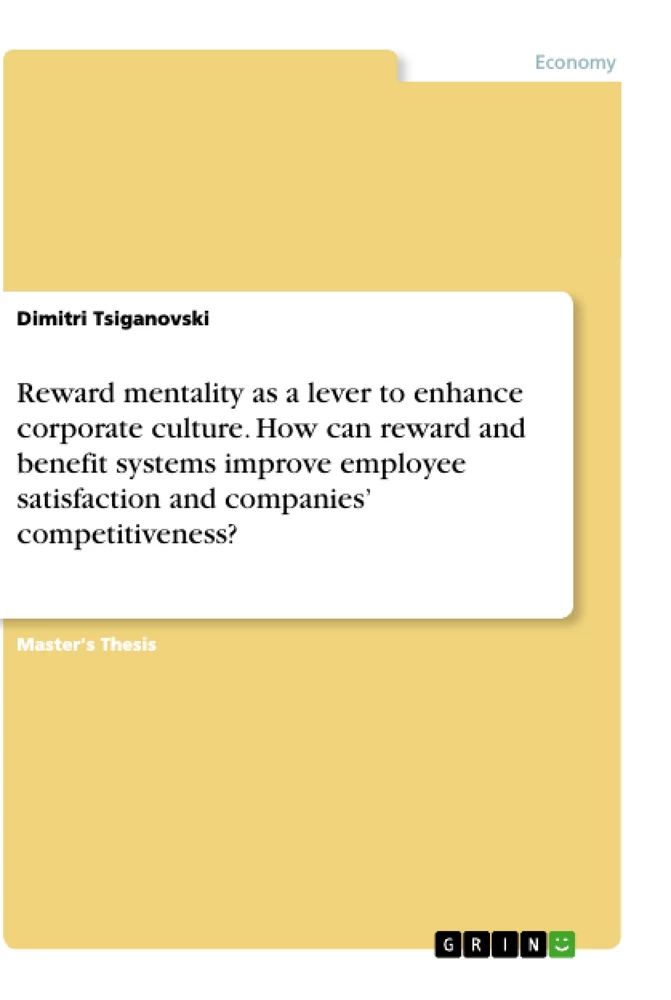
Table of Contents
1 Introduction
1.1 Problem definition
1.2 Aim
1.3 Research Question
1.4 Research Objectives
1.5 Dissertation structure
2 Literature review
2.1 Introduction
2.2 Rewards as drivers for motivation at work
2.3 Importance of reward systems for employees
2.4 Relationship between rewards and a successful Corporate Culture
2.5 Different reward systems
2.5.1 Individualistic rewards
2.5.2 Cooperative rewards
2.5.3 Monetary rewards and benefits
2.5.4 Non-monetary rewards and benefits
2.6 Impacts of reward and benefit systems on employee satisfaction
2.6.1 Psychological and emotional effects
2.6.2 Positive and negative effects of extrinsic rewards
2.6.3 Positive and negative effects of intrinsic motivation
2.7 Innovative mind-set: Rewards as influencers of innovative thinking
2.8 Rewards as decisive factors for long-term competitiveness
2.9 Summary of findings
3 Methodology
3.1 Research philosophy
3.2 Data collection methods
3.2.1 Primary data: Semi-structured interview
3.3 Sampling techniques
3.4 Ethical considerations
3.5 Methodological limitations
4 Data analysis
4.1 Introduction
4.2 Primary data
4.2.1 Qualitative data analysis and discussion with links to literature
4.3 Summary and discussion of key findings
5 Conclusion and Recommendations
5.1 Conclusion
5.2 Recommendations
5.3 Limitations of the overall research
Research Objectives and Key Topics
The primary aim of this research is to analyze how Evergreen Marine can optimize its existing reward and benefit systems to enhance employee satisfaction, long-term competitiveness, and an innovative mind-set within its German offices, using qualitative data to bridge the gap between literature and practice.
- The correlation between effective reward mentalities and corporate success.
- Distinctions between individualistic and cooperative reward structures.
- The impact of monetary versus non-monetary rewards on employee motivation.
- Barriers to innovative thinking caused by hierarchical structures.
- Strategic recommendations for implementing a balanced reward model.
Excerpt from the Book
1.1 Problem definition
In order to explore and analyse how a company can effectively and successfully use a well-thought-out reward and benefit system to intensify and improve its competitiveness, satisfaction among its employees and their innovative mind-set at work for the long-term, the Taiwanese globally operating shipping company ‘Evergreen Marine Corporation’ was chosen as the main partner to discuss the dissertation’s relevant aspects.
In certain industries as the shipping industry, there is a very strong demand of staying competitive (Lee et al., 2014) to provide an excellent service to its customers, to increase its market share and its financial power, international growth and employee satisfaction as elements of long-term competitiveness. Hence, the pressure to stay competitive and still strongly present. Being in such a competitive environment, shipping companies focus on their main competitive advantage, namely the employees as they are one of the main driving forces for a company’s corporate culture and success. As the shipping industry is a highly competitive area, the satisfaction of employees becomes even more important, as especially high-qualified employees are always comparing opportunities on the labour market if they are not satisfied with their current employer (Bhattacharya, 2015).
While working in the Sales Department for an Evergreen office in Germany, the pressure to maintain or improve Evergreen’s competitiveness has been noticeable on a frequent basis. Such employees in Sales regularly have to fulfil a given KPI, acquire new clients, keep their professionalism in critical situations to stakeholders and close long-term contracts to maximise the company’s success. However, after closing deals and improving the company’s success, the instinctive desire to get quickly noticeable, transparent and individualised rewards for great work results, such as sales commission on every closed business deal, often becomes prevailing, as it values and stimulates employee satisfaction and motivation to continue such working which is not uncommon in sales environments. An absence of such reward mentality or the lack of knowledge on how to individualise rewards on certain employees might often result in opposite effects as less motivation or less interesting in innovative thinking, lower performance and feeling of working without ‘getting something back’.
Summary of Chapters
1 Introduction: This chapter introduces the research context, focusing on the correlation between reward systems, employee satisfaction, and organizational competitiveness at Evergreen Marine.
2 Literature review: This section provides a theoretical framework by examining various reward types and their psychological effects on motivation and innovation.
3 Methodology: The author details the use of qualitative, semi-structured interviews and an interpretive philosophy to gather subjective data from employees.
4 Data analysis: This chapter presents the primary findings from the interviews, organized into themes such as job satisfaction, reward effectiveness, and areas for improvement.
5 Conclusion and Recommendations: The final chapter synthesizes the findings and proposes practical strategies, such as implementing a performance-measuring scorecard and increasing autonomy.
Keywords
Reward systems, Employee satisfaction, Corporate culture, Shipping industry, Evergreen Marine, Intrinsic motivation, Extrinsic rewards, Long-term competitiveness, Innovative mind-set, Qualitative research, Performance-based pay, Organizational commitment, Human resources, Career development, Strategic management.
Frequently Asked Questions
What is the core focus of this master thesis?
The thesis focuses on analyzing the current reward mentality at Evergreen Marine and exploring how to improve these systems to better support employee satisfaction and long-term business competitiveness.
Which thematic fields are central to the study?
The central themes include the effectiveness of monetary and non-monetary rewards, the influence of leadership on motivation, the role of corporate culture, and the promotion of an innovative mind-set.
What is the primary research goal?
The goal is to provide strategic recommendations that enable Evergreen Marine to optimize its reward structures to boost employee engagement and performance.
Which scientific methodology was applied?
The researcher employed a qualitative research approach, specifically utilizing semi-structured interviews with 14 full-time employees across different hierarchical levels and departments in Germany.
What is covered in the main body of the work?
The main body covers a comprehensive literature review, the methodological framework, a detailed analysis of primary data collected through interviews, and a discussion of key thematic findings.
Which keywords best characterize this research?
The work is characterized by terms such as reward systems, corporate culture, intrinsic and extrinsic motivation, employee satisfaction, and organizational competitiveness.
How does the shipping industry's competitiveness affect rewards?
The high competitiveness of the shipping sector pressures companies to treat employees as their main competitive advantage, making effective reward systems essential for retaining skilled staff.
Why did the researcher choose the 'Evergreen Marine' case study?
The researcher, being a former employee in the Sales Department, identified specific challenges regarding reward transparency and hierarchical constraints, which provided a practical and research-worthy basis for analysis.
What is the role of the 'Balanced Scorecard' in the recommendations?
It is recommended as a performance-measuring tool to provide clear goals and increase transparency, though the author emphasizes it must be carefully tailored to individual departmental tasks.
How do generational differences impact the study’s results?
The findings indicate that younger employees (Generation Y) place a higher value on monetary rewards for financial security compared to older generations, which influences their overall job satisfaction.
Ende der Leseprobe aus 81 Seiten
- nach oben
- Arbeit zitieren
- Dimitri Tsiganovski (Autor:in), 2021, Reward mentality as a lever to enhance corporate culture. How can reward and benefit systems improve employee satisfaction and companies’ competitiveness?, München, Page::Imprint:: GRINVerlagOHG, https://www.diplomarbeiten24.de/document/1167690

neugierig - aktuell - relevant
Entdecken Sie hilfreiche Tipps und Tricks rund ums Studium!

Entdecken Sie hilfreiche Tipps und Tricks rund ums Studium!
Ihre Hausarbeit / Abschlussarbeit:

- - Publikation als E-Book und Buch
- - Hohes Honorar auf die Verkäufe
- - Für Sie komplett kostenlos - mit ISBN
- - Es dauert nur 5 Minuten
- - Jede Arbeit findet Leser

- © GRIN Publishing GmbH.
- Alle Inhalte urheberrechtlich geschützt. Kopieren und verbreiten untersagt.
- info@grin.com
- AGB
- Open Publishing
Der GRIN Verlag hat sich seit 1998 auf die Veröffentlichung akademischer eBooks und Bücher spezialisiert. Der GRIN Verlag steht damit als erstes Unternehmen für User Generated Quality Content. Die Verlagsseiten GRIN.com, Hausarbeiten.de und Diplomarbeiten24 bieten für Hochschullehrer, Absolventen und Studenten die ideale Plattform, wissenschaftliche Texte wie Hausarbeiten, Referate, Bachelorarbeiten, Masterarbeiten, Diplomarbeiten, Dissertationen und wissenschaftliche Aufsätze einem breiten Publikum zu präsentieren.
Kostenfreie Veröffentlichung: Hausarbeit, Bachelorarbeit, Diplomarbeit, Dissertation, Masterarbeit, Interpretation oder Referat jetzt veröffentlichen!
Folgen Sie GRIN auf


- GRIN Verlag GmbH
-
- Nymphenburger Str. 86
- 80636
- Munich, Deutschland
- +49 89-550559-0
- +49 89-550559-10
- info@grin.com
-
