
präsentiert von

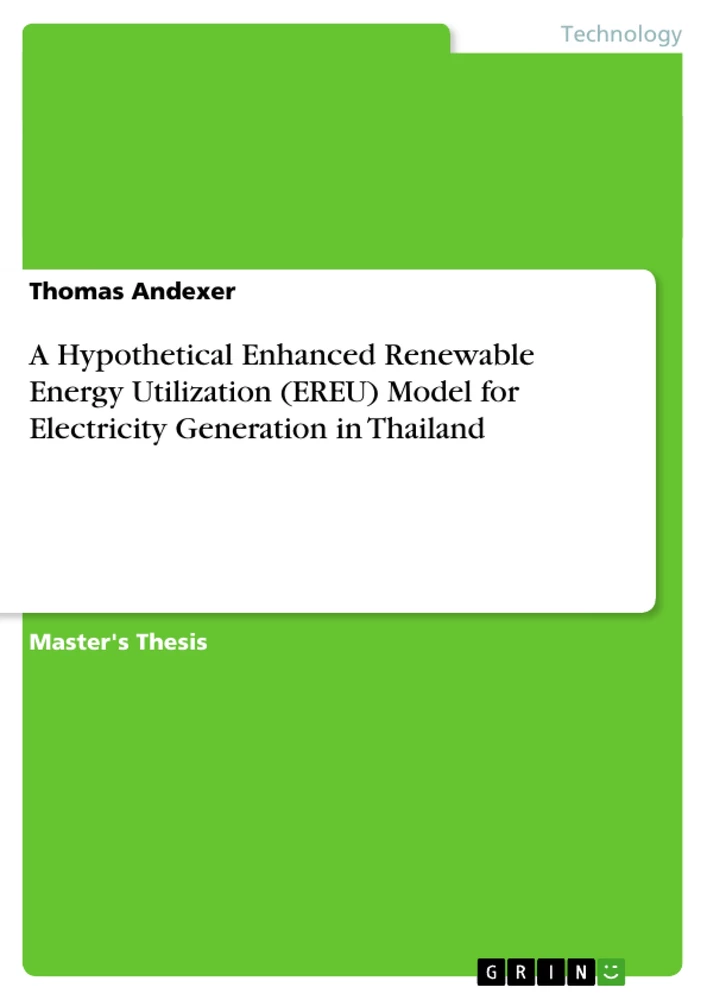
Table of Contents
1. Introduction
1. Background Information and Statement of the Problem
2. Research Objectives
3. Scope and Boundaries
4. The Research Question
5. The Significance of this Thesis
6. Operationalization of the Terminology
7. The Thesis Structure
2. Review of Literature
1. The Definition of Renewable Energy
1.1 Focus: Renewable Energy for Electricity Generation
2. Thailand - Country Overview
2.1 Digression: Economic Development 1997 - 2007
3. The Electricity Industry and Electricity Consumption in Thailand
3.1 Thailand’s Electricity Supply Industry (ESI)
3.2 Electricity Consumption Development 1990 - 2006
4. Renewable Energy for Electricity Generation in Thailand
4.1 The Beginning of Energy Conservation and Renewable Energy Promotion (1992 - 2000)
4.2 The Reform of the SPP Program, VSPP Legislation and Enforcement of Renewable Energy Promotion (2000 - 2004)
4.3 The Energy Policy and Development Plan and the Upgrade of the VSPP Regulation (2005 - 2007)
4.4 Current Data and Statistics
4.5 Recent Development: Latest Events in the Year 2007
5. Summary, Forecast and Conclusion
5.1 The Importance of Renewable Energy for Electricity Generation in the Kingdom of Thailand
6. Pre-Assessment of an Enhanced Renewable Energy Utilization Model
6.1 Need Assessment: Abolition of Barriers to Enhance RE Utilization
6.2 Conceptual Framework
3. Research Methodology
1. Expert Interview Survey: Research Design
1.1 Introduction
1.2 Research Type and Participants
2. Research Instruments
2.1 Population and Sampling Methodology
2.2 Data Gathering: The Questionnaire and Interview Procedure
4. Data Analysis and Synthesis
1. The Interviewee Profiles
2. Restructuring Thailand’s ESI
3. Creation of Enhanced RE Support Mechanisms
4. Removal of Major Barriers against RE Development
5. Strategic Planning and Thailand’s Future Energy Portfolio
6. Compliance to International Goals and Targets
5. The Hypothetical Enhanced Renewable Energy Utilization (EREU) Model and Strategic Implications
1. Introduction
2. Restructuring of Thailand’s ESI and Regulatory/Administrative Measures
2.1 Establishment of an Independent Regulation Authority (IRA)
2.2 Liberalization and Decentralization
2.3 EGAT Restructuring and other Amendment Measures
2.4 The Further Development of the SPP and VSPP Program
2.5 Conclusion: EREU Module 1
3. Enhanced RE Support Mechanisms and Incentive Measures
3.1 Enhanced Quota Mechanism: Update of the RPS
3.2 Bidding Mechanism
3.3 Enhanced Tariff Mechanism: Establishment of a Comprehensive Feed-in Support Scheme for RE
3.4 Production Tax Credits: Creation of Tax- and Investment Incentives
3.5 Conclusion: EREU Module 2
4. Removal of Major Barriers against RE Development and Information Measures
4.1 Provision of Enhanced Financing Options for RE Projects
4.2 Establish Enhanced Local Workforce Training and Expertise
4.3 Increase Consumer Awareness Towards RE Utilization
4.4 Foster Community and Stakeholder Participation in RE Decisions and Projects
4.5 Conclusion: EREU Module 3
5. Strategic Planning for Enhanced RE Utilization and Technology-Specific Measures
5.1 Reform the Power Development Macro Planning Process
5.2 Realistically Plan with Renewable Alternatives
5.3 Consider Technology-Specific Measures
5.4 Conclusion: EREU Module 4
6. International Goals and Monitoring Measures
6.1 Ratification and Compliance to International Goals
6.2 Take the Consequences from the Result of the 2011-Target
6.3 Conclusion: EREU Module 5
7. The Enhanced Renewable Energy Utilization (EREU) Model
7.1 Expert Verification
8. Strategic Implications
6. Discussion and Recommendation
1. Closing Discussion
2. Final Recommendation
Objectives and Topics
This thesis aims to develop a strategic framework, known as the Enhanced Renewable Energy Utilization (EREU) model, to address Thailand’s growing electricity demand while reducing reliance on imported fossil fuels and mitigating environmental impacts. The primary research question investigates the factors influencing renewable energy (RE) importance in Thailand and determines which strategic model is necessary to enhance its utilization.
- Current electricity industry structure in Thailand and its reliance on centralized power generation.
- Barriers to adopting renewable energy technologies, including policy, economic, and technical challenges.
- Strategic policy measures such as independent regulation, enhanced feed-in tariffs, and community-level participation.
- The impact of international climate commitments and carbon credit mechanisms on renewable energy feasibility.
- A roadmap for decentralized electricity supply and sustainable energy policy in Thailand.
Excerpt from the book
4.4.3 An Underlining Case study
An exhibiting example for the VSPP program are the pig farms of SPM Feedmill Company in Ratchaburi province, 100 kilometers west of Bangkok. SPM’s management has decided to invest more than 40 million THB to install biogas power plants at two pig farms and a feed mill (Joint Graduate School of Energy and Environment (JGSEE), 2006). The project has received more than eleven million THB of subsidy payment (ENCON Fund) and was commissioned in September 2003, along with the Clean Development Mechanism (CDM) program framework (UNFCCC & Royal Danish Embassy, 2005). The fairly simple technology takes advantage of pig manure, which is decomposed to create huge amounts of methane (AD). In the next step, modified truck engines and induction generators burn the biogas to generate electricity, whereas the biogas digesters have a total electricity capacity of around 500 kW, from which 150 kW are sold to PEA (Greacen C., 2007). These innovative projects have helped SPM to reduce its monthly electricity bill to a third of previous level and, including the feed mill, the firm is saving up to three million THB annually. The villagers are happy as well, because there are no more environmental problems with wastewater, air pollution (bad smell) and flies.
Summary of Chapters
Chapter 1: Introduction: Outlines the background, research objectives, and the scope of the study regarding renewable energy in Thailand.
Chapter 2: Review of Literature: Analyzes the historical development, status of electricity supply, and challenges of renewable energy utilization in Thailand.
Chapter 3: Research Methodology: Explains the exploratory research design and the expert interview survey approach used to gather qualitative data.
Chapter 4: Data Analysis and Synthesis: Provides an objective summary of the expert interview results and identifies key commonalities and discrepancies.
Chapter 5: The Hypothetical Enhanced Renewable Energy Utilization (EREU) Model and Strategic Implications: Develops the core strategic model and outlines implementation measures based on expert input.
Chapter 6: Discussion and Recommendation: Concludes the research by providing final recommendations for policy planning and future implementation of the EREU model.
Keywords
Renewable Energy, Electricity Generation, Thailand, EREU Model, Energy Policy, Decentralization, Feed-in Tariffs, CDM, Biomass, Biogas, Power Development Plan, Sustainability, Energy Security, Expert Interview, Market Liberalization.
Frequently Asked Questions
What is the core focus of this research?
The research focuses on analyzing the barriers to renewable energy adoption in Thailand and developing a hypothetical strategic model (EREU) to enhance its utilization for grid-connected electricity generation.
What are the primary thematic areas covered?
The work covers electricity market restructuring, the establishment of regulatory bodies, support mechanisms like feed-in tariffs, removal of technical and economic barriers, and the role of community participation.
What is the main goal of the EREU model?
The primary goal is to provide a comprehensive strategic guideline that shifts Thailand toward a more decentralized, sustainable, and diversified electricity supply by leveraging its indigenous renewable energy resources.
Which methodology was employed?
The study uses a two-fold approach: comprehensive secondary research on past and current developments, followed by an exploratory primary research project involving in-depth interviews with seven recognized field experts.
What does the main body of the thesis address?
The main body examines the structural challenges of the Thai Electricity Supply Industry (ESI), evaluates existing policy programs like SPP/VSPP, and develops five distinct modules for the EREU model to support long-term energy transition.
Which keywords best characterize this work?
The research is defined by terms such as Renewable Energy, Electricity Generation, Thailand, EREU Model, Energy Policy, Decentralization, Feed-in Tariffs, and Clean Development Mechanism (CDM).
How does the research view the role of the Electricity Generating Authority of Thailand (EGAT)?
The experts generally perceive EGAT’s dominant position as a monopoly that restricts competition and hampers the integration of decentralized renewable energy sources.
What specific potential does the research identify for biogas projects?
The research uses the case study of SPM Feedmill Company to demonstrate that biogas projects can be economically viable, significantly reduce operating costs for farms, and mitigate local environmental issues like pollution and odor.
What is the expert consensus on the 2011 renewable energy target?
Most experts express significant doubt about Thailand’s ability to reach the 2011 target due to low current tariff adder rates, slow regulatory progress, and the short remaining time frame.
Ende der Leseprobe aus 213 Seiten
- nach oben
- Arbeit zitieren
- Dipl.Ing.(FH) MSc. Thomas Andexer (Autor:in), 2008, A Hypothetical Enhanced Renewable Energy Utilization (EREU) Model for Electricity Generation in Thailand, München, Page::Imprint:: GRINVerlagOHG, https://www.diplomarbeiten24.de/document/117280

neugierig - aktuell - relevant
Entdecken Sie hilfreiche Tipps und Tricks rund ums Studium!

Entdecken Sie hilfreiche Tipps und Tricks rund ums Studium!
Ihre Hausarbeit / Abschlussarbeit:

- - Publikation als E-Book und Buch
- - Hohes Honorar auf die Verkäufe
- - Für Sie komplett kostenlos - mit ISBN
- - Es dauert nur 5 Minuten
- - Jede Arbeit findet Leser

- © GRIN Publishing GmbH.
- Alle Inhalte urheberrechtlich geschützt. Kopieren und verbreiten untersagt.
- info@grin.com
- AGB
- Open Publishing
Der GRIN Verlag hat sich seit 1998 auf die Veröffentlichung akademischer eBooks und Bücher spezialisiert. Der GRIN Verlag steht damit als erstes Unternehmen für User Generated Quality Content. Die Verlagsseiten GRIN.com, Hausarbeiten.de und Diplomarbeiten24 bieten für Hochschullehrer, Absolventen und Studenten die ideale Plattform, wissenschaftliche Texte wie Hausarbeiten, Referate, Bachelorarbeiten, Masterarbeiten, Diplomarbeiten, Dissertationen und wissenschaftliche Aufsätze einem breiten Publikum zu präsentieren.
Kostenfreie Veröffentlichung: Hausarbeit, Bachelorarbeit, Diplomarbeit, Dissertation, Masterarbeit, Interpretation oder Referat jetzt veröffentlichen!
Folgen Sie GRIN auf


- GRIN Verlag GmbH
-
- Nymphenburger Str. 86
- 80636
- Munich, Deutschland
- +49 89-550559-0
- +49 89-550559-10
- info@grin.com
-
