
präsentiert von

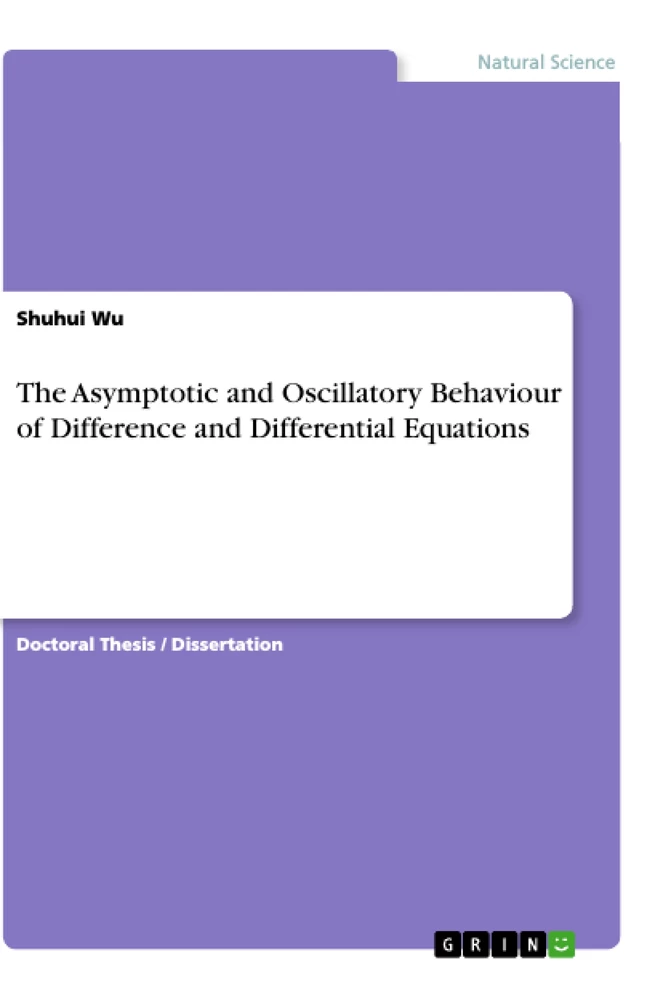
Table of Contents
1 INTRODUCTION
1.1 TERMINOLOGY
1.2 PRELIMINARIES
1.3 BACKGROUND AND HISTORY REVIEW
1.4 MOTIVATION FOR THE THESIS
1.5 OUTLINE OF THE THESIS
2 STABILITY OF DIFFERENTIAL EQUATIONS
2.1 INTRODUCTION
2.2 MAIN RESULT
2.3 THE PROOF
2.4 CONCLUSION
3 OSCILLATION OF NONLINEAR NEUTRAL DIFFERENTIAL EQUATIONS
3.1 INTRODUCTION
3.2 MAIN RESULTS WHEN δ = +1
3.3 EXAMPLES FOR (3.2.2)
3.4 MAIN RESULTS WHEN δ = −1
3.5 EXAMPLES FOR (3.4.14)
3.6 CONCLUSION
4 EVEN ORDER DIFFERENCE EQUATIONS
4.1 INTRODUCTION
4.2 PRELIMINARIES
4.3 SECOND ORDER EQUATION (4.1.1)
4.3.1 OSCILLATION CRITERIA
4.3.2 EXAMPLES
4.3.3 SOME LEMMAS
4.3.4 PROOF OF THEOREMS
4.4 FOURTH ORDER EQUATION (4.1.1)
4.4.1 RELATED LEMMAS
4.4.2 MAIN RESULTS
4.4.3 EXAMPLES
4.5 HIGHER EVEN ORDER EQUATION (4.1.1)
4.5.1 RELATED LEMMAS
4.5.2 MAIN RESULTS
4.5.3 EXAMPLES
4.6 CONCLUSION
5 ODD ORDER DIFFERENCE EQUATIONS
5.1 INTRODUCTION
5.2 PRELIMINARIES
5.3 THIRD ORDER EQUATION (4.1.1)
5.3.1 RELATED LEMMAS
5.3.2 MAIN RESULTS
5.3.3 EXAMPLES
5.4 HIGHER ODD ORDER EQUATION (4.1.1)
5.4.1 RELATED LEMMAS
5.4.2 MAIN RESULTS
5.4.3 EXAMPLES
5.5 CONCLUSION AND SUMMARY
6 HIGHER ORDER NONLINEAR DIFFERENCE EQUATIONS
6.1 INTRODUCTION
6.2 RELATED LEMMAS
6.3 MAIN RESULTS
6.4 EXAMPLES
6.5 CONCLUSION
7 CONCLUSION
Research Objectives and Core Topics
This thesis aims to investigate the asymptotic and oscillatory behavior of solutions for various classes of differential and difference equations, providing theoretical criteria in higher dimensions where explicit solutions are often unavailable.
- Stability of non-autonomous Lotka-Volterra systems.
- Oscillation criteria for second-order nonlinear neutral differential equations.
- Oscillatory behavior of higher-order nonlinear neutral difference equations with continuous variables.
- Application of Riccati transformation techniques to establish stability and oscillation results.
- Comparative study between even and odd order difference equation behaviors.
Excerpt from the Book
3.2 MAIN RESULTS WHEN δ = +1
In this section, we consider equation (3.1.1) with δ = +1. We rewrite equation (3.1.1) as (a(t)(x(t) + p(t)x(t − τ )))' + f(t, x(t − σ)) − g(t, x(t − ρ)) = 0. (3.2.2)
Four oscillatory criteria will be presented here for equation (3.2.2) to be bounded oscillatory, almost oscillatory and bounded almost oscillatory, respectively.
Theorem 3.2.1 Suppose conditions (H1), (H2) and (H4) hold, q(t) > r(t), r(t) is bounded and σ ≥ ρ. Then (3.2.2) is bounded oscillatory.
Proof Let x(t) be a bounded non-oscillatory solution. Suppose x(t) is an eventually positive solution. Then there exists a t2 ≥ t1 such that x(t) > 0 and x(t − λ) > 0 for t ≥ t2. Let z(t) = a(t)(x(t) + p(t)x(t − τ )) − ∫(t-ρ to t-σ) r(s)x(s)ds. (3.2.3)
Summary of Chapters
1 INTRODUCTION: Outlines the fundamental terminology, basic notations, and the motivation for investigating the qualitative behavior of differential and difference equations.
2 STABILITY OF DIFFERENTIAL EQUATIONS: Investigates the nonautonomous Lotka-Volterra population model, establishing conditions for global stability and the extinction of species.
3 OSCILLATION OF NONLINEAR NEUTRAL DIFFERENTIAL EQUATIONS: Derives criteria for bounded, almost, and bounded-almost oscillation for second-order neutral differential equations.
4 EVEN ORDER DIFFERENCE EQUATIONS: Analyzes the oscillatory behavior of even-order nonlinear neutral difference equations using integral transformations and Riccati techniques.
5 ODD ORDER DIFFERENCE EQUATIONS: Investigates odd-order equations, contrasting their oscillatory properties with those of even-order systems.
6 HIGHER ORDER NONLINEAR DIFFERENCE EQUATIONS: Focuses on more general even-order difference equations, utilizing generalized Riccati techniques to achieve oscillation criteria.
7 CONCLUSION: Summarizes the thesis findings and suggests potential future research directions for higher-order and more general nonautonomous equations.
Keywords
Differential Equations, Difference Equations, Asymptotic Behavior, Oscillatory Behavior, Neutral Equations, Stability, Lotka-Volterra Systems, Riccati Transformation, Nonlinear Dynamics, Oscillation Criteria, Nonlinear Neutral Term, Bounded Solutions, Non-autonomous Systems
Frequently Asked Questions
What is the primary focus of this thesis?
The thesis investigates the qualitative properties, specifically the asymptotic and oscillatory behavior, of solutions to various differential and difference equations, often involving neutral terms and time delays.
What types of equations are analyzed?
The work covers first-order non-autonomous differential systems, second-order nonlinear neutral differential equations, and higher-order nonlinear neutral difference equations.
What is the core research goal?
The goal is to establish theoretical criteria for oscillation and stability in mathematical models, particularly where explicit solutions cannot be formulated.
Which mathematical methods are utilized?
The author primarily employs Riccati transformations, integral transformations, and iteration methods to convert complex equations into tractable forms or inequalities.
What is the distinction between Chapter 4 and Chapter 5?
Chapter 4 focuses on even-order nonlinear neutral difference equations, while Chapter 5 addresses odd-order equations, which require different analytical approaches due to varying behaviors.
How is the stability of population models addressed?
Stability is assessed using the nonautonomous Lotka-Volterra system, where conditions are derived for a global attractor to exist, leading to the extinction of specific species.
What significance do the examples play?
The examples provided at the end of each section serve to demonstrate the practical application and validity of the established oscillation criteria in specific, solvable cases.
Why are neutral terms significant?
Neutral terms involve derivatives of functional history, making the oscillation analysis significantly more complex than standard delay differential equations.
Ende der Leseprobe aus 193 Seiten
- nach oben
- Arbeit zitieren
- Shuhui Wu (Autor:in), 2009, The Asymptotic and Oscillatory Behaviour of Difference and Differential Equations, München, Page::Imprint:: GRINVerlagOHG, https://www.diplomarbeiten24.de/document/1176159

neugierig - aktuell - relevant
Entdecken Sie hilfreiche Tipps und Tricks rund ums Studium!

Entdecken Sie hilfreiche Tipps und Tricks rund ums Studium!
Ihre Hausarbeit / Abschlussarbeit:

- - Publikation als E-Book und Buch
- - Hohes Honorar auf die Verkäufe
- - Für Sie komplett kostenlos - mit ISBN
- - Es dauert nur 5 Minuten
- - Jede Arbeit findet Leser

- © GRIN Publishing GmbH.
- Alle Inhalte urheberrechtlich geschützt. Kopieren und verbreiten untersagt.
- info@grin.com
- AGB
- Open Publishing
Der GRIN Verlag hat sich seit 1998 auf die Veröffentlichung akademischer eBooks und Bücher spezialisiert. Der GRIN Verlag steht damit als erstes Unternehmen für User Generated Quality Content. Die Verlagsseiten GRIN.com, Hausarbeiten.de und Diplomarbeiten24 bieten für Hochschullehrer, Absolventen und Studenten die ideale Plattform, wissenschaftliche Texte wie Hausarbeiten, Referate, Bachelorarbeiten, Masterarbeiten, Diplomarbeiten, Dissertationen und wissenschaftliche Aufsätze einem breiten Publikum zu präsentieren.
Kostenfreie Veröffentlichung: Hausarbeit, Bachelorarbeit, Diplomarbeit, Dissertation, Masterarbeit, Interpretation oder Referat jetzt veröffentlichen!
Folgen Sie GRIN auf


- GRIN Verlag GmbH
-
- Nymphenburger Str. 86
- 80636
- Munich, Deutschland
- +49 89-550559-0
- +49 89-550559-10
- info@grin.com
-
