
präsentiert von

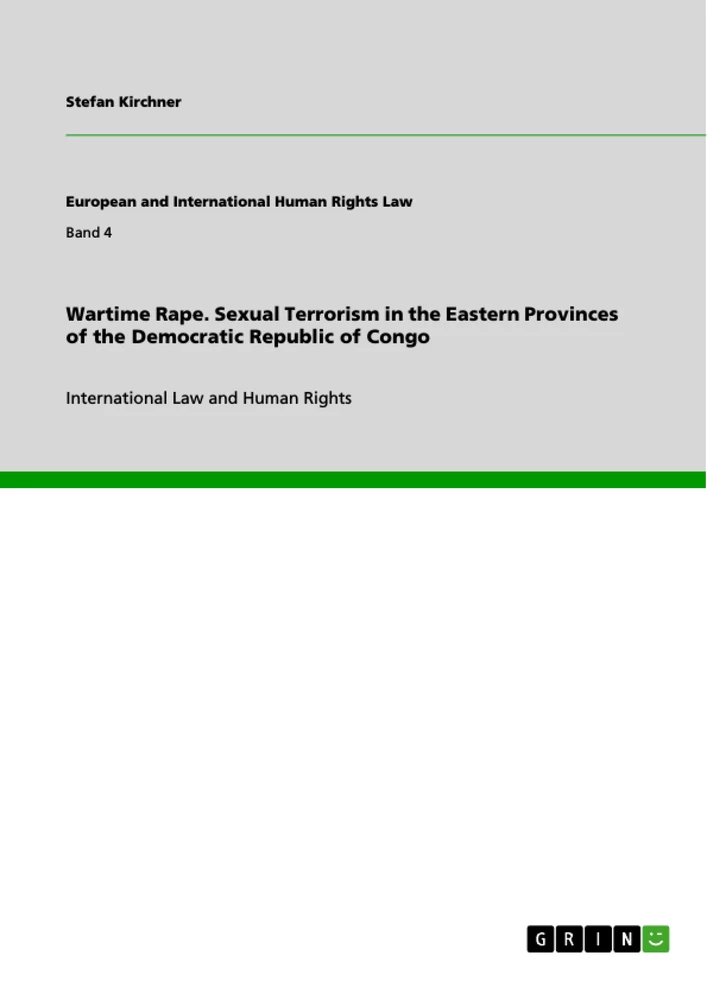
Table of Contents
Preface
Abstract
Outline
Chapter I – Background
Chapter II – Women’s Rights under International Law
Chapter III – Denial of Justice in the DRC
Chapter IV – A Role for the International Criminal Court
Chapter V – Conclusions and Outlook
Objectives and Topics
The primary objective of this work is to analyze the multidimensional crisis of systematic sexual violence in the Eastern Democratic Republic of Congo (DRC) and to evaluate the effectiveness of national and international legal mechanisms in providing justice for victims of these atrocities. The research examines how conflict-related sexual violence serves as a weapon of war and genocide, while identifying the legal, social, and structural barriers that prevent survivors from accessing justice.
- The role of sexual violence as a systematic weapon in the Eastern DRC conflict.
- Medical and psychological consequences for victims, including the prevalence of fistula and HIV/AIDS.
- Social stigmatization and the traditional legal status of women as obstacles to justice.
- The adequacy of international humanitarian and human rights law in addressing these crimes.
- The potential and limitations of the International Criminal Court in providing accountability.
Excerpt from the Book
3. Social Consequences
The gravity of the situation is highlighted by a UN report on the situation of children in Ituri, North- and South-Kivu, dated 28 June 2007: “Despite all of the initiatives undertaken to counter sexual violence and the adoption of two national laws on sexual violence on 20 July 2006, the number of sexual abuses remains extremely high. Sexual violence has occurred virtually unabated, in a climate of impunity and judicial dysfunction. Although the reported rate of sexual violence remains high, such incidents are under-reported and accurate statistics are difficult to obtain because of a number of factors, including the fear of ostracism and retribution which prevents survivors from coming forward; the prohibitive distance and lack of access to medical care owing to the prevailing security situation in some areas; a lack of faith in the judicial system; and the local tendency of amicable settlement, whereby the perpetrator pays the victim an agreed upon sum.
[Between June 2006 and May 2007], 12,867 survivors of sexual violence were identified by United Nations Children’s Fund (UNICEF) partners in the eastern region of the Democratic Republic of the Congo. Of those survivors, 4,222 were children (3,740 girls and 482 boys). Children represent an alarming one third of survivors of sexual violence. Of 100 survivors in Ituri, 43 were children (of whom approximately 18 per cent were boys). Of the aforementioned 4,222 children, information on the perpetrators is available in only 690 cases; in 29 cases, the perpetrators were members of [the Armed Forces of the D.R.C.] or [Congolese National Police] (4.2 per cent); in 458 cases, they were from armed groups (66 per cent); and in 203 cases, they were civilians (29 per cent).”
In some villages, two thirds of all women are thought to have been raped but until recently remaining silent was all that stood between the women and complete disgrace in the eyes of their families and communities. Often the problem runs deeper than the wounds which are visible.
Summary of Chapters
Chapter I – Background: This chapter introduces the catastrophic scale of violence in the Eastern DRC, detailing how systematic rape is employed as a tool of war, and highlighting the severe, long-term physical and medical injuries inflicted upon women and children.
Chapter II – Women’s Rights under International Law: This section contrasts the fundamental protections mandated by international human rights and humanitarian law with the reality of widespread violations occurring in the DRC.
Chapter III – Denial of Justice in the DRC: This chapter analyzes the failure of the Congolese judicial system, addressing how legislative shortcomings and traditional societal norms effectively bar rape survivors from legal recourse.
Chapter IV – A Role for the International Criminal Court: This chapter evaluates the ICC's potential to intervene and address the systematic nature of these crimes, while acknowledging its limitations as a supplementary judicial body.
Chapter V – Conclusions and Outlook: This final chapter argues that real change requires a fundamental transformation in the status of women in Congolese society, driven by a new culture of respect, rather than relying solely on top-down legal solutions.
Keywords
Wartime Rape, Sexual Terrorism, Democratic Republic of Congo, International Humanitarian Law, Human Rights, International Criminal Court, Gender-based Violence, Systematic Rape, Impunity, Post-Conflict Justice, Rape-induced Fistulae, Women's Rights, Genocide, Armed Conflict, Sexual Slavery.
Frequently Asked Questions
What is the core focus of this work?
The work examines the systematic use of sexual violence as a weapon of war in the Eastern Democratic Republic of Congo and the resulting crisis of impunity for these crimes.
What are the central thematic areas?
The book covers the intersection of war crimes, the medical consequences for survivors, the failure of the domestic legal system, and the role of international law and international criminal justice.
What is the primary research question?
The research investigates why sexual violence remains pervasive in the DRC and whether current national and international legal instruments are capable of providing justice and preventing future atrocities.
Which scientific methods are utilized?
The author employs a legal-analytical approach, examining international treaties, case law from international tribunals (such as ICTR and ICTY), and empirical reports from humanitarian organizations like Human Rights Watch and MSF.
What topics are discussed in the main body?
The main body treats the background of the conflict, the breach of international human rights and humanitarian norms, the specific obstacles to justice within the Congolese legal system, and the symbolic and practical role of the ICC.
How would you describe this work using keywords?
This work is characterized by terms such as sexual terrorism, international law, impunity, conflict-related sexual violence, and gender-based human rights violations.
How does the DRC's domestic law impede justice for rape victims?
A significant legal barrier identified is Article 448 of the Congolese family code, which requires a married woman to obtain her husband's permission before she can initiate legal proceedings in court.
What role does the international community play in this crisis?
The international community is involved through the presence of UN missions and the potential for the International Criminal Court to prosecute perpetrators, although the book emphasizes that these measures have yet to fundamentally alter the reality for victims on the ground.
Ende der Leseprobe aus 262 Seiten
- nach oben
- Arbeit zitieren
- Rechtsanwalt Stefan Kirchner (Autor:in), 2008, Wartime Rape. Sexual Terrorism in the Eastern Provinces of the Democratic Republic of Congo, München, Page::Imprint:: GRINVerlagOHG, https://www.diplomarbeiten24.de/document/118118

neugierig - aktuell - relevant
Entdecken Sie hilfreiche Tipps und Tricks rund ums Studium!

Entdecken Sie hilfreiche Tipps und Tricks rund ums Studium!
Ihre Hausarbeit / Abschlussarbeit:

- - Publikation als E-Book und Buch
- - Hohes Honorar auf die Verkäufe
- - Für Sie komplett kostenlos - mit ISBN
- - Es dauert nur 5 Minuten
- - Jede Arbeit findet Leser

- © GRIN Publishing GmbH.
- Alle Inhalte urheberrechtlich geschützt. Kopieren und verbreiten untersagt.
- info@grin.com
- AGB
- Open Publishing
Der GRIN Verlag hat sich seit 1998 auf die Veröffentlichung akademischer eBooks und Bücher spezialisiert. Der GRIN Verlag steht damit als erstes Unternehmen für User Generated Quality Content. Die Verlagsseiten GRIN.com, Hausarbeiten.de und Diplomarbeiten24 bieten für Hochschullehrer, Absolventen und Studenten die ideale Plattform, wissenschaftliche Texte wie Hausarbeiten, Referate, Bachelorarbeiten, Masterarbeiten, Diplomarbeiten, Dissertationen und wissenschaftliche Aufsätze einem breiten Publikum zu präsentieren.
Kostenfreie Veröffentlichung: Hausarbeit, Bachelorarbeit, Diplomarbeit, Dissertation, Masterarbeit, Interpretation oder Referat jetzt veröffentlichen!
Folgen Sie GRIN auf


- GRIN Verlag GmbH
-
- Nymphenburger Str. 86
- 80636
- Munich, Deutschland
- +49 89-550559-0
- +49 89-550559-10
- info@grin.com
-
