
präsentiert von

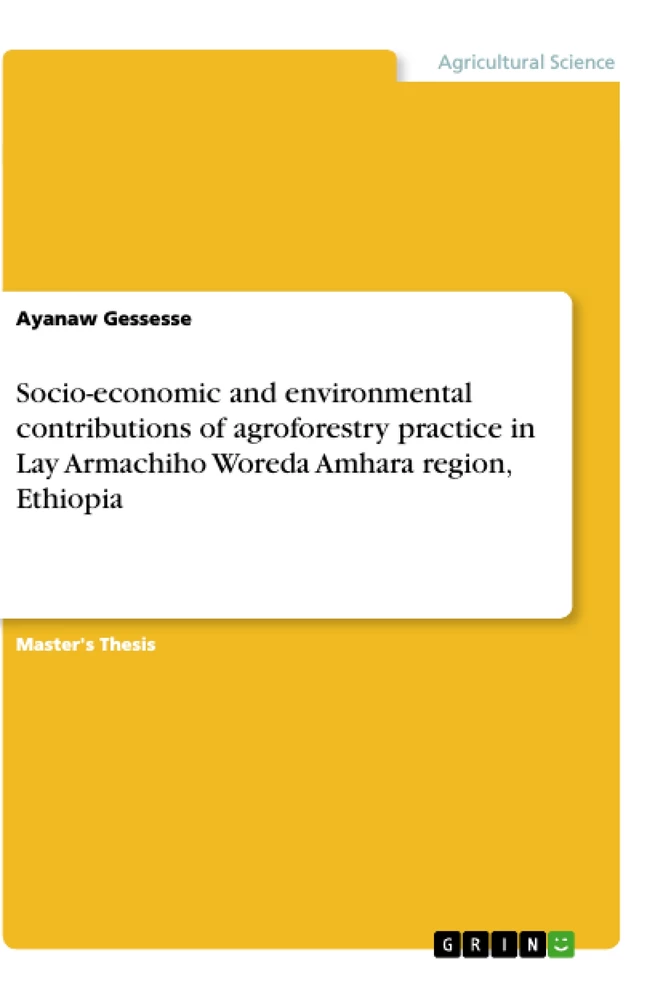
Table of Contents
1. INTRODUCTION
1.1 BACKGROUND OF THE STUDY
1.2 STATEMENTS OF THE PROBLEM
1.3 OBJECTIVES OF THE STUDY
1.3.1 General objective
1.3.2 Specific objectives
1.4 RESEARCH QUESTIONS
1.5 SCOPE OF THE STUDY
1.6 SIGNIFICANCE OF STUDY
1.7 ORGANIZATION OF THE PAPER
2. LITERATURE REVIEW
2.1 DEFINITIONS AND CONCEPTS
2.1.1 Agroforestry
2.1.2 Agroforestry practice
2.1.3 Agroforestry systems
2.2 MAJOR TYPES OF THE AGROFORESTRY PRACTICE
2.2.1 Alley cropping
2.2.2 Home gardens
2.2.3 Windbreaks/Shelterbelts
2.2.4 Forest Farming
2.2.5 Boundary Planting
2.2.6 Live fences
2.2.7 Multipurpose Woody Hedgerows
2.2.8 Trees on rangelands-Silvopastoral
2.3 THEORETICAL LITERATURE
2.3.1 History of agroforestry
2.3.2 Advantages of agroforestry
2.3.3 Functions of trees in agroforestry
2.4 EMPIRICAL LITERATURE
2.4.1 Environmental contributions of agroforestry practice
2.4.2 Social contributions of agroforestry practice
2.4.3 Economical contributions of agroforestry practice
2.5 CONCEPTUAL FRAME WORK
3. MATERIALS AND METHODS
3.1 DESCRIPTION OF STUDY AREA
3.1.1 Location
3.1.2 Topography
3.1.3 Climate
3.1.4 Soil characteristic
3.1.5 Population
3.1.6 Economic activities
3.2 RESEARCH METHODOLOGY
3.3 SOURCES OF DATA
3.3.1 Primary data source
3.3.2 Secondary data source
3.4 SAMPLING TECHNIQUE AND SAMPLE SIZE
3.5 METHODS OF DATA COLLECTION
3.5.1 Questionnaires survey
3.5.2 Ground survey
3.5.3 Focus group discussion
3.5.4 Key informant interview
3.5.5 Observation
3.6 METHODS OF DATA ANALYSIS
3.7 RESEARCH METHOD SUMMARY
4. RESULT AND DISCUSSION
4.1 SOCIO-DEMOGRAPHIC CHARACTERISTICS OF RESPONDENTS
4.2 AGROFORESTRY PRACTICES AND ITS CONTRIBUTION FOR PLANT SPECIES DIVERSITY
4.3 Trees shrubs and livestock’s production
4.4 CONTRIBUTIONS OF AGROFORESTRY PRACTICE TO REDUCE BURDENS OF WOMEN & CHILDREN
4.5 CONTRIBUTIONS OF AGROFORESTRY PRACTICE FOR AVERAGE ANNUAL NET INCOME
5. CONCLUSION AND RECOMMENDATION
5.1 CONCLUSION
5.2 RECOMMENDATIONS
Research Objectives and Themes
This study aims to assess the environmental and socioeconomic contributions of agroforestry practices in Lay Armachiho Woreda, Ethiopia, specifically focusing on how these practices influence local biodiversity, household labor burdens, and economic productivity.
- Analysis of agroforestry's impact on plant species diversity in agricultural landscapes.
- Evaluation of how agroforestry practices reduce the labor burden for women and children regarding fuel energy collection.
- Assessment of the net income contributions of agroforestry compared to non-agroforestry practices.
- Examination of socioeconomic and demographic factors affecting the adoption of agroforestry systems.
- Identification of potential policy and governance options to promote sustainable agroforestry.
Excerpt from the Book
Agroforestry practice
Agroforestry practices (AFP) vary in their composition, structure, and function, depending on the biophysical, ecological, social, economic, and cultural situation under which they occur(O. Jemal, 2018).
Agroforestry systems were intensively managed to maintain their productive and protective functions through cultivation, fertilization, irrigation, pruning, and thinning. Ideally, components are structurally and functionally combined and energetically managed to optimize the positive biophysical interactions between them. In some systems, for example, the trees are regularly coppiced (severely cut back), and the cuttings are applied as mulch to the soil. Such management not only encourages new tree growth but also augments the light levels reaching shaded crops, reduces weeds, and helps to preserve soil moisture (Gold, 2018).
Summary of Chapters
CHAPTER ONE: This chapter introduces the study, covering the background, problem statement, research objectives, and the significance of investigating agroforestry in the study area.
CHAPTER TWO: This section provides a comprehensive literature review, detailing definitions, types of agroforestry practices, and the theoretical and empirical evidence supporting the environmental, social, and economic benefits of these systems.
CHAPTER THREE: This chapter describes the study area, methodology, data collection instruments (questionnaires, interviews, and ground surveys), and the sampling techniques used to gather information from the targeted households.
CHAPTER FOUR: This chapter presents the research results and discussions, including the socioeconomic profiles of respondents and the specific findings regarding species diversity, fuel energy collection, and net income.
CHAPTER FIVE: This concluding chapter summarizes the key findings of the research and provides evidence-based recommendations for stakeholders and policymakers to promote sustainable agroforestry practices.
Keywords
Agroforestry, Lay Armachiho Woreda, Ethiopia, Plant Species Diversity, Shannon Diversity Index, Simpson Diversity Index, Fuel Energy Collection, Net Present Value, Net Income, Socioeconomic Contribution, Smallholder Farmers, Sustainable Land Use, Rural Livelihoods, Environmental Stewardship.
Frequently Asked Questions
What is the core focus of this research?
The research focuses on evaluating the environmental and socioeconomic impacts of agroforestry practices in Lay Armachiho Woreda, specifically looking at species diversity, household labor efficiency, and household income generation.
What are the primary thematic areas covered?
The main themes include plant species diversity measurement, gender-disaggregated labor burdens for fuel collection, economic performance (NPV/BCR) of agroforestry versus mono-cropping, and sociodemographic drivers of agroforestry adoption.
What is the primary objective of this study?
The primary objective is to quantitatively and qualitatively assess how agroforestry contributes to the environment (plant diversity) and society (reducing women's and children's workload) and the economy (net income) in the specific region of Lay Armachiho.
Which scientific methods are utilized in this work?
The study employs a cross-sectional survey design using quantitative tools like the Shannon and Simpson diversity indices, descriptive statistics, and T-tests, alongside qualitative methods like focus group discussions and key informant interviews.
What does the main body of the work cover?
The main body covers the theoretical foundations of agroforestry, a detailed description of the study area's topography and population, the methodology, and a thorough discussion of findings related to species richness and net financial returns from agroforestry plots.
Which keywords best characterize this work?
Key terms include Agroforestry, Plant Species Diversity, Net Present Value (NPV), Fuel Energy Collection, Smallholder Farmers, and Rural Livelihood Improvement.
How does agroforestry affect women and children in the study area?
The study finds that agroforestry significantly reduces the distance and time required for fuel energy collection, thereby alleviating the labor burden primarily borne by women and children compared to those relying on natural forest sources.
What is the economic significance of the findings?
The findings indicate that agroforestry practices yield significantly higher net annual income compared to non-agroforestry (mono-cropping) practices, supported by higher Benefit-Cost Ratios.
Ende der Leseprobe aus 70 Seiten
- nach oben
- Arbeit zitieren
- Ayanaw Gessesse (Autor:in), 2019, Socio-economic and environmental contributions of agroforestry practice in Lay Armachiho Woreda Amhara region, Ethiopia, München, Page::Imprint:: GRINVerlagOHG, https://www.diplomarbeiten24.de/document/1183381

neugierig - aktuell - relevant
Entdecken Sie hilfreiche Tipps und Tricks rund ums Studium!

Entdecken Sie hilfreiche Tipps und Tricks rund ums Studium!
Ihre Hausarbeit / Abschlussarbeit:

- - Publikation als E-Book und Buch
- - Hohes Honorar auf die Verkäufe
- - Für Sie komplett kostenlos - mit ISBN
- - Es dauert nur 5 Minuten
- - Jede Arbeit findet Leser

- © GRIN Publishing GmbH.
- Alle Inhalte urheberrechtlich geschützt. Kopieren und verbreiten untersagt.
- info@grin.com
- AGB
- Open Publishing
Der GRIN Verlag hat sich seit 1998 auf die Veröffentlichung akademischer eBooks und Bücher spezialisiert. Der GRIN Verlag steht damit als erstes Unternehmen für User Generated Quality Content. Die Verlagsseiten GRIN.com, Hausarbeiten.de und Diplomarbeiten24 bieten für Hochschullehrer, Absolventen und Studenten die ideale Plattform, wissenschaftliche Texte wie Hausarbeiten, Referate, Bachelorarbeiten, Masterarbeiten, Diplomarbeiten, Dissertationen und wissenschaftliche Aufsätze einem breiten Publikum zu präsentieren.
Kostenfreie Veröffentlichung: Hausarbeit, Bachelorarbeit, Diplomarbeit, Dissertation, Masterarbeit, Interpretation oder Referat jetzt veröffentlichen!
Folgen Sie GRIN auf


- GRIN Verlag GmbH
-
- Nymphenburger Str. 86
- 80636
- Munich, Deutschland
- +49 89-550559-0
- +49 89-550559-10
- info@grin.com
-
