
präsentiert von

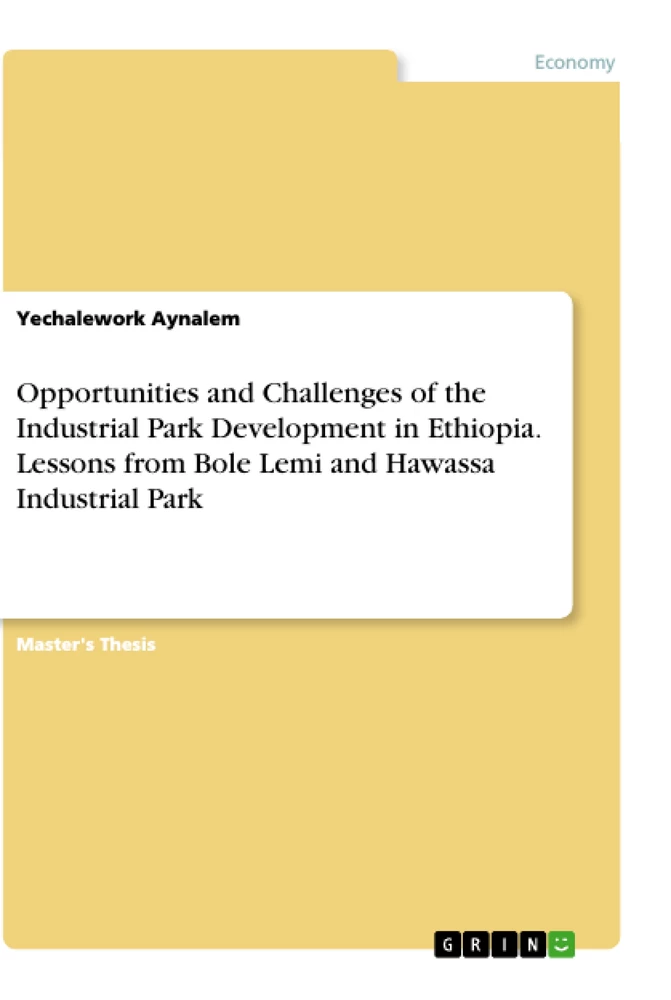
Table of Contents
CHAPTER ONE
INTRODUCTIONS
1.1. Background of the Study
1.2. Statement of the Problem
1.3. Objectives of the Study
1.4. Significance of the Study
1.5. Scope of the Study
1.6. Limitation of the Study
1.7. Definition of Terms
1.8. Organization of the Thesis
CHAPTER TWO
REVIEW OF RELATED LITERATURE
2.1. Definitions and Concepts of Industrial Park
2.1.1. Benefits of IPs
2.1.2. Evolution of Industrial Park Development: Global Scenario
2.1.3. Industrial Park Development in Ethiopia
2.2. Theoretical Framework
2.3. Empirical Literature
CHAPTER THREE
RESEARCH METHODOLOGY
3.1. Research Approach and Design
3.2. The Study Sample
3.3. Data Sources and Data Collection Tools
3.3.1. Document Review
3.3.2. Key Informant Interview (KII)
3.3.3. Focus Group Discussion (FGD)
3.4. Data Analysis Procedure
CHAPTER FOUR
RESULT AND DISCUSSION
4.1. Introduction
4.2. The Experience of IDP in Africa
4.3. Description of Studied IPs in Ethiopia
4.3.1. Bole Lemi Industrial Park
4.3.2. Hawassa Industrial Park
4.4. Opportunities of Industrial Park Development in Ethiopia
4.4.1. Government and Employees Related Opportunities
4.5. Challenges of IPD in Ethiopia
4.5.1. Theoretical and Practical Challenges
4.6. Lessons Learned From and To Ethiopia
4.6.1. What other Countries Can Learn from Ethiopia?
4.6.2. What Ethiopia Can Learn From other Countries?
CHAPTER FIVE
CONCLUSION AND RECOMMENDATION
5.1. Conclusion
5.2. Recommendations
Research Objectives and Thematic Focus
The main objective of this study is to explore the experiences of industrial park developments in African countries, with a primary focus on identifying the main opportunities and challenges, and drawing lessons from and to Ethiopia. The research aims to assess how industrial parks contribute to economic transformation and to provide recommendations for improving the performance of these facilities in Ethiopia.
- Review of industrial park development practices in selected African countries.
- Assessment of opportunities for industrial park development in Ethiopia.
- Identification of theoretical and practical challenges in Ethiopian industrial parks.
- Analysis of linkages between industrial parks and the local economy, including technology and skill transfer.
- Derivation of key lessons for policy improvement and sustainable development in Ethiopia.
Excerpt from the Book
1.1. Background of the Study
Industrial park development has been an important topic of development thinking after WWII. At times, it has been celebrated, challenged, and even discredited, but it has never been absent from the successive intellectual and policy debates on economic change (Farole, 2011). Today, after decades of intellectual debate, there is wide consensus among economists that industrialization is the single most important driver of structural change. The two concepts are indeed closely linked in that: (a) structural transformation is the phenomenon whereby a society’s resources are moved from the sectors where they yield little economic benefits to those where the payoffs are the highest—and (b) this occurs through industrialization (Prihodko et al., 2007). Indeed, prosperity is achieved in any country only when a country’s resources (human, natural, and capital) are shifted from subsistence and informal activities into high-productivity activities (Pakdeenurit & Suthikarnnarunai, 2014).
Industrial parks (IPs) or Export Processing Zones (EPZs) normally are established with the aim of achieving one or more of the following four policy objectives including to attract foreign direct investment (FDI), to serve as “pressure valves” to alleviate large-scale unemployment, in support of a wider economic reform strategy and as experimental laboratories for the application of new policies and approaches (FIAS, 2008). In achieving these objectives, industrial parks have had a mixed record of success. Anecdotal evidence turns up many examples of investments in zone infrastructure resulting in “white elephants,” or parks that largely have resulted in an industry taking advantage of tax breaks without producing substantial employment or export earnings. Empirical studies show that many industrial parks (IPs) or Special Economic Zones (SEZs) have been successful in generating exports and employment, and come out marginally positive in cost-benefit assessments (Jayanthakumaran 2003; Mongé-Gonzalez et al., 2005). Many economists, however, still view industrial parks as a second- or even third-best solution to competitiveness, whose success is restricted to specific conditions over a limited time frame (Newman & Page, 2017). Concerns also have been raised that industrial parks, by and large, have failed to extend benefits outside their enclaves or to contribute to upgrading of skills and the production base (Zeng, 2015).
Summary of Chapters
CHAPTER ONE: This introductory chapter outlines the background and problem statement regarding industrial park development, sets the objectives and significance of the study, and defines the scope and limitations.
CHAPTER TWO: The review of related literature provides definitions and concepts of industrial parks, explores their evolution globally, and details the theoretical frameworks and empirical studies relevant to the topic.
CHAPTER THREE: This chapter describes the research methodology, including the approach and design, the selection of the study sample, and the specific data sources and collection tools utilized.
CHAPTER FOUR: The result and discussion section covers the experience of industrial park development in Africa, describes the studied parks in Ethiopia, and analyzes the opportunities and challenges faced, including lessons learned.
CHAPTER FIVE: The final chapter presents the conclusion of the research and provides specific recommendations for stakeholders involved in industrial park development in Ethiopia.
Keywords
Industrial park, opportunities, challenges, foreign direct investment, employment, technology and skill transfer, Ethiopia, structural transformation, manufacturing sector, economic zones, infrastructure, policy framework, export earnings, industrialization, local economy.
Frequently Asked Questions
What is the primary goal of this research?
The primary goal is to examine the experiences of industrial park development in selected African countries to identify opportunities, challenges, and lessons that can be applied to improve industrial parks in Ethiopia.
What are the main thematic areas covered?
The study covers the definition and global evolution of industrial parks, comparative experiences in Africa, and a detailed analysis of the opportunities and challenges within Ethiopia’s industrial park sector.
What research methodology was employed?
The research used a qualitative approach, employing a combination of descriptive and exploratory research designs. Data were gathered through document reviews, key informant interviews, and focus group discussions.
What are the identified opportunities in Ethiopia's industrial parks?
Key opportunities include the inflow of foreign direct investment (FDI), job creation, technology and skill transfer, and the generation of fiscal revenue and foreign exchange earnings.
What are the major challenges facing the sector in Ethiopia?
Challenges include high labor turnover, inadequate infrastructure and trade logistics, poor linkages with the local economy, shortages of raw materials, and institutional coordination gaps.
Which specific industrial parks were studied?
The case study analysis focused on the Bole Lemi and Hawassa Industrial Parks in Ethiopia.
How does Ethiopia's current performance compare with its regional peers?
While Ethiopia has attracted significant FDI, the research indicates that compared to countries like Mauritius or others in the region, the actual impact on the local economy remains constrained by the lack of deep integration and raw material supply chain issues.
What role does the local community play in the findings?
The study highlights socio-economic issues such as the displacement of farmers due to land acquisition for industrial parks and the limited improvement in the living standards of relocated households.
Are there recommendations for the Ethiopian government?
Yes, recommendations include revising labor laws, improving infrastructure coordination, strengthening industry-university linkages, and fostering a sustainable industrial culture rather than relying solely on fiscal incentives.
Ende der Leseprobe aus 116 Seiten
- nach oben
- Arbeit zitieren
- Yechalework Aynalem (Autor:in), 2019, Opportunities and Challenges of the Industrial Park Development in Ethiopia. Lessons from Bole Lemi and Hawassa Industrial Park, München, Page::Imprint:: GRINVerlagOHG, https://www.diplomarbeiten24.de/document/1183656

neugierig - aktuell - relevant
Entdecken Sie hilfreiche Tipps und Tricks rund ums Studium!

Entdecken Sie hilfreiche Tipps und Tricks rund ums Studium!
Ihre Hausarbeit / Abschlussarbeit:

- - Publikation als E-Book und Buch
- - Hohes Honorar auf die Verkäufe
- - Für Sie komplett kostenlos - mit ISBN
- - Es dauert nur 5 Minuten
- - Jede Arbeit findet Leser

- © GRIN Publishing GmbH.
- Alle Inhalte urheberrechtlich geschützt. Kopieren und verbreiten untersagt.
- info@grin.com
- AGB
- Open Publishing
Der GRIN Verlag hat sich seit 1998 auf die Veröffentlichung akademischer eBooks und Bücher spezialisiert. Der GRIN Verlag steht damit als erstes Unternehmen für User Generated Quality Content. Die Verlagsseiten GRIN.com, Hausarbeiten.de und Diplomarbeiten24 bieten für Hochschullehrer, Absolventen und Studenten die ideale Plattform, wissenschaftliche Texte wie Hausarbeiten, Referate, Bachelorarbeiten, Masterarbeiten, Diplomarbeiten, Dissertationen und wissenschaftliche Aufsätze einem breiten Publikum zu präsentieren.
Kostenfreie Veröffentlichung: Hausarbeit, Bachelorarbeit, Diplomarbeit, Dissertation, Masterarbeit, Interpretation oder Referat jetzt veröffentlichen!
Folgen Sie GRIN auf


- GRIN Verlag GmbH
-
- Nymphenburger Str. 86
- 80636
- Munich, Deutschland
- +49 89-550559-0
- +49 89-550559-10
- info@grin.com
-
