
präsentiert von

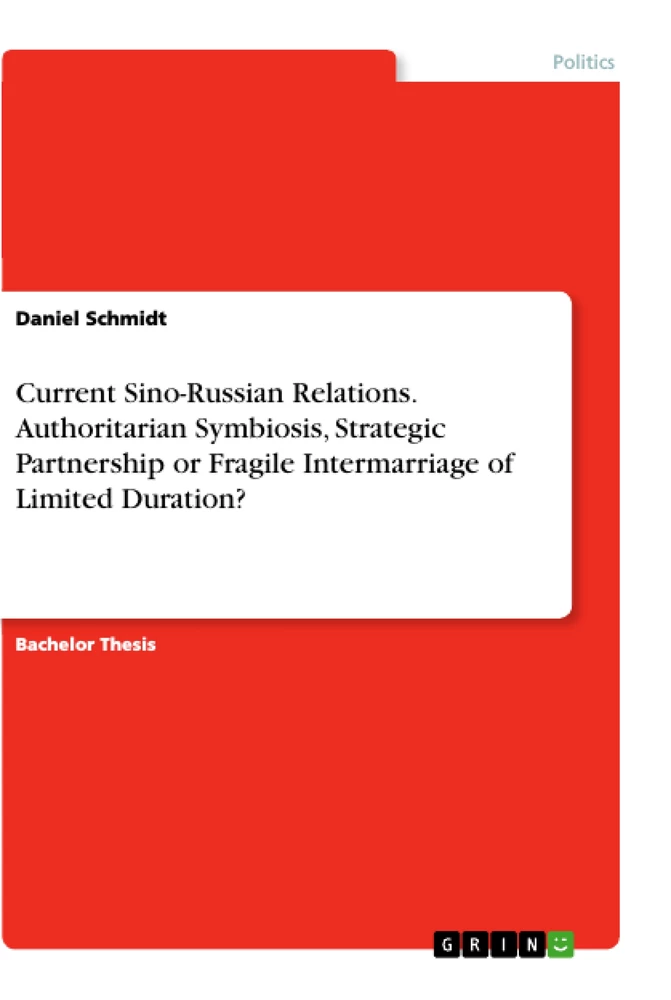
Table of contents
1 Introduction
2 Structure
3 Historical context of Sino-Russian relations
4 Contemporary Statements
5 Literature Review
5.1 Evaluation
6 Methodology
7 Quantitative analysis
7.1 Sino-Russian UNSC and UNGA voting patterns
7.1.1 Sino-Russian voting patterns at the UNSC
7.1.2 Sino-Russian voting patterns at the UNGA
7.1.3 Conclusion
7.2 Trade related bilateral analysis
7.2.1 General bilateral trade levels
7.2.2 Specific bilateral trade levels
7.2.3 Energy trade in particular
7.2.4 Arms trade in particular
7.2.5 Conclusion
7.3 Benchmarks of Russia and China’s asymmetric developments
7.3.1 Gross domestic product
7.3.2 Population
7.3.3 Defense spending
7.3.4 Defense spending as percentage of GDP
7.3.5 Conclusion
8 Qualitative analysis
8.1 China and Russia within the Shanghai Cooperation Organization
8.1.1 The Shanghai Cooperation Organization’s foundation
8.1.2 Ideological core
8.1.3 The drivers of regional integration
8.1.4 The institutional setup
8.1.5 Russia and China’s agenda within the SCO
8.1.6 Conclusion
8.2 The Eurasian Economic Union and the Silk Road Economic Belt
8.2.1 The concepts of SREB and the EAEU
8.2.2 Silk Road Economic Belt
8.2.3 Fields of cooperation
8.2.4 Conclusion
8.3 BRICS and the New Development Bank within the Sino-Russian axis
8.3.1 The concept of BRICS
8.3.2 The design of the BRICS New Development Bank and the Contingent Reserve Arrangement
8.3.3 Implications for the Sino-Russian partnership
8.3.4 Conclusion
9 Final assessment and conclusion
10 List of references
Research Objectives and Themes
This thesis examines the quality and long-term sustainability of the contemporary Sino-Russian relationship, investigating whether it functions as a beneficial "authoritarian symbiosis," a strategic partnership, or a fragile, short-term intermarriage. By employing a two-tracked methodology, it assesses whether the official rhetoric of a deep strategic partnership is supported by empirical evidence in voting patterns, bilateral trade, and institutional cooperation.
- Quantitative analysis of United Nations voting behaviors (UNSC and UNGA) as a measure of political convergence.
- Evaluation of bilateral trade levels, including the specific role of energy and arms exports.
- Analysis of power-indicating benchmarks (GDP, population, and defense spending) to identify growing asymmetries.
- Qualitative assessment of multilateral cooperation through the SCO, the EAEU-SREB nexus, and BRICS financial institutions.
Excerpt from the Book
3 Historical context of Sino-Russian relations
To begin with, it should be remembered that until the late 16th century the tangible predecessing entities of modern-day Russia almost exclusively evolved on the very eastern part of continental Europe (Kollmann, 2017, pp. 55-61). Thus, although sharing nowadays a common border of 4.259 km in length (Krüger, 1999, p. 171), one should not forget that the vast majority of Russians live in the country’s European part. Hence, the distance from Moscow to Paris is less than half the distance of the 5.795 km between Moscow and Beijing. Therefore, when attempting to analyze the current state of Sino-Russian relations, the need to investigate the course of history of the two countries’ relation becomes urgent.
When Russia stretched out to the Urals in the 16th century and crossed it in 1582, its remarkable conquest for Siberia had been set in motion (Chen, 1966, p.12-16). In a swift undertaking Russia had managed until 1656 to reach the Bering Strait (ibid., p. 16) and expanded into Manchuria’s northern spurs (ibid., pp. 40), where Russia deliberately laid its borders next to Chinese territory for the first time in history (ibid., pp. 20-21); thereby triggering the formative Sino-Russian border dispute right from the start, which was set to prolong until 2008 (Blanchard and Shipeng, 2008). Interestingly though, the first of Russia’s several attempts to establish and expand diplomatic contacts do date back a couple of decades earlier than their prime direct encounters in Manchuria (Chen, 1966, pp. 35-38; Christian, 2018, p. 180; Witzenrath, 2007, p. 48). Russia’s main drivers where twofold: first, that of extracting general intelligence about China (Chen, 1966, p. 24-25); and second, to find relieve through new profitable trade channels in times of Europe’s mercantilism (ibid., p. 106; p. 118). Nevertheless, having been largely an endeavor of a dominantly one-sided stimuli – and paired with ongoing cultural challenges – Sino-Russian relations developed rather stringy during the 17th century, as Chen confirms.
Summary of Chapters
1 Introduction: Introduces the research topic and defines the value-axis ranging from authoritarian symbiosis to fragile intermarriage.
2 Structure: Outlines the historical and methodological approach, including the planned quantitative and qualitative analytical steps.
3 Historical context of Sino-Russian relations: Examines the long-term historical development of border issues and diplomatic interactions from the 16th century to the modern era.
4 Contemporary Statements: Analyzes the official state-sponsored media rhetoric, noting a persistent trend of hyperbolic praise regarding bilateral ties.
5 Literature Review: Categorizes existing academic debate into three groups: optimists, skeptics, and the nuanced "in-between" school.
6 Methodology: Explains the quantitative and qualitative variables, including the analytical framework for measuring success in the relationship.
7 Quantitative analysis: Presents data on UN voting patterns, trade volumes, and macroeconomic indicators, demonstrating a significant shift in power balance.
8 Qualitative analysis: Examines case studies of institutional cooperation within the SCO, EAEU/SREB, and BRICS financial mechanisms.
9 Final assessment and conclusion: Synthesizes all findings, arguing that the relationship is likely heading toward a long-term fragile state due to structural power imbalances.
Keywords
China, Russia, Sino-Russian relations, United Nations voting, bilateral trade, power indicators, asymmetric relationship, SCO, EAEU, BRI, BRICS, NDB, international order, geopolitical rivalry, foreign policy.
Frequently Asked Questions
What is the main subject of this thesis?
The thesis investigates the actual quality and durability of contemporary relations between China and Russia, challenging the official narrative of a seamless, deep, and long-lasting strategic partnership.
What are the central themes of the research?
The core themes include political alignment (voting behaviors), bilateral economic interdependence, institutional cooperation in regional bodies, and the impact of growing power asymmetries.
What is the primary research question?
The research asks how the Sino-Russian relationship should be classified on a spectrum ranging from an "authoritarian symbiosis" to a "fragile intermarriage," given the discrepancies between official rhetoric and empirical evidence.
What scientific methods are utilized?
The author uses a two-tracked approach: quantitative analysis of UNSC/UNGA voting data and trade statistics, alongside qualitative case studies of regional organizations like the SCO, EAEU, and BRICS institutions.
What topics does the main body cover?
The main body covers historical context, literature review, methodology, a deep quantitative analysis of voting and trade, and specific qualitative assessments of military and economic institutional frameworks.
Which keywords best characterize this work?
The work is characterized by terms such as Sino-Russian relations, strategic partnership, power asymmetry, UN voting behavior, trade dependence, SCO, and BRICS institutions.
How has the voting correlation between Russia and China changed since 2001?
The thesis demonstrates that voting convergence at both the UNSC and UNGA increased significantly after 2001, effectively placing the two countries on par with established Western alliance voting blocks.
What does the thesis conclude about the arms trade?
The arms trade serves as a "litmus test" that reveals underlying mistrust; while Russia restricts high-end technology to prevent creating a future competitor, it simultaneously arms China's regional rivals, such as Vietnam and India.
Does the author consider the relationship to be symbiotic?
No. The author concludes that the relationship is increasingly asymmetric and does not meet the requirements of a positive-sum symbiosis, instead leaning toward a strategic partnership that faces long-term degradation.
Ende der Leseprobe aus 107 Seiten
- nach oben
- Arbeit zitieren
- Daniel Schmidt (Autor:in), 2019, Current Sino-Russian Relations. Authoritarian Symbiosis, Strategic Partnership or Fragile Intermarriage of Limited Duration?, München, Page::Imprint:: GRINVerlagOHG, https://www.diplomarbeiten24.de/document/1184845

neugierig - aktuell - relevant
Entdecken Sie hilfreiche Tipps und Tricks rund ums Studium!

Entdecken Sie hilfreiche Tipps und Tricks rund ums Studium!
Ihre Hausarbeit / Abschlussarbeit:

- - Publikation als E-Book und Buch
- - Hohes Honorar auf die Verkäufe
- - Für Sie komplett kostenlos - mit ISBN
- - Es dauert nur 5 Minuten
- - Jede Arbeit findet Leser

- © GRIN Publishing GmbH.
- Alle Inhalte urheberrechtlich geschützt. Kopieren und verbreiten untersagt.
- info@grin.com
- AGB
- Open Publishing
Der GRIN Verlag hat sich seit 1998 auf die Veröffentlichung akademischer eBooks und Bücher spezialisiert. Der GRIN Verlag steht damit als erstes Unternehmen für User Generated Quality Content. Die Verlagsseiten GRIN.com, Hausarbeiten.de und Diplomarbeiten24 bieten für Hochschullehrer, Absolventen und Studenten die ideale Plattform, wissenschaftliche Texte wie Hausarbeiten, Referate, Bachelorarbeiten, Masterarbeiten, Diplomarbeiten, Dissertationen und wissenschaftliche Aufsätze einem breiten Publikum zu präsentieren.
Kostenfreie Veröffentlichung: Hausarbeit, Bachelorarbeit, Diplomarbeit, Dissertation, Masterarbeit, Interpretation oder Referat jetzt veröffentlichen!
Folgen Sie GRIN auf


- GRIN Verlag GmbH
-
- Nymphenburger Str. 86
- 80636
- Munich, Deutschland
- +49 89-550559-0
- +49 89-550559-10
- info@grin.com
-
