
präsentiert von

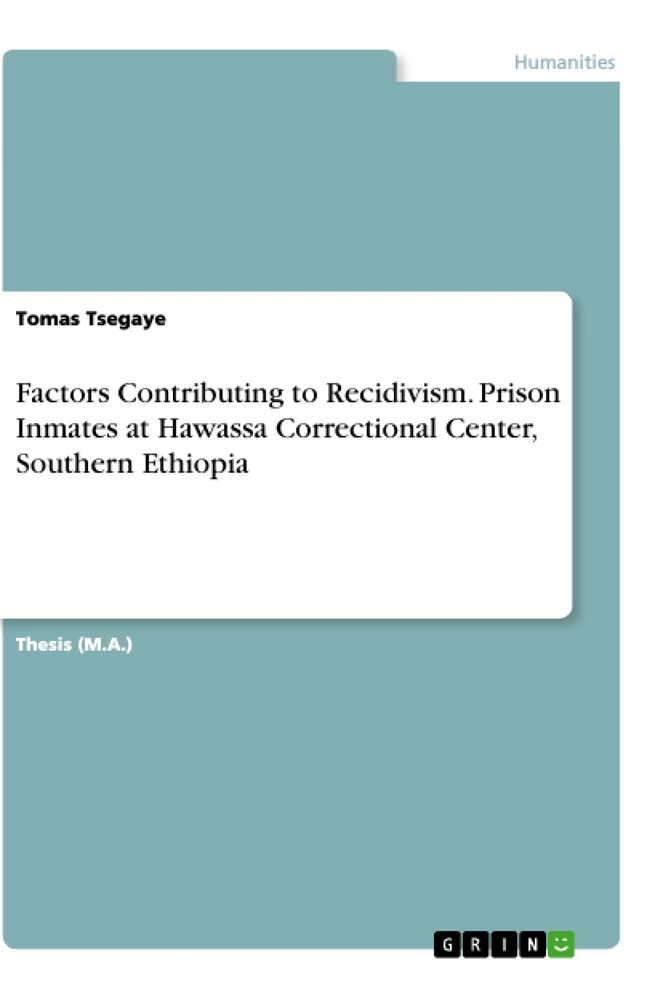
Table of Contents
1. Introduction
1.1 Background of the Study
1.2 Statement of the Problem
1.3 Objectives of the Study
1.3.1 General Objective
1.3.2 Specific Objectives
1.4 Significance of the Study
1.5 Scope of the Study
1.6 Limitations of the Study
1.7 Challenges in Conducting the Study
1.8 Organization of the Paper
2. Review of Related Literature
2.1 Basic Concepts
2.1.1 Correctional Institution
2.1.2 Prison
2.1.3 Recidivism
2.2 Empirical Findings on Factors Contributing to Recidivism
2.2.1 Individual or Personal Level Factors
2.2.2 Institutional Factors
2.2.3 Socio-Economic Factors
2.3 Recidivism, Legal Frameworks and Prison Conditions of Ethiopia
2.3.1 Legal Frameworks and Prison Conditions of Ethiopia
2.3.2 Factors Contributing to Recidivism in Ethiopia
2.4 Theoretical Framework
2.4.1 Differential Association Theory of Edwin Sutherland
2.4.2 Labeling Theory
2.4.3 Strain Theories
2.4.4 Subculture Theory
2.5 Summary of the Empirical and Theoretical Literature
2.6 Conceptual Framework
3. Research Methodology
3.1 Description of the Study Area
3.2 Research Design
3.3 Research Approach
3.4 Sources of Data
3.5 Methods of Data Collection
3.5.1 Survey Method
3.5.2 Key Informant Interview (KII)
3.5.3 Individual Interviews
3.5.4 Case Study
3.6 Procedures of Data Collection
3.7 Method of Data Analysis
3.8 Methodological Triangulation
3.9 Validity and Reliability
3.10 Ethical Considerations
4. Result and Discussion
4.1 Background Information of the Respondents and Informants
4.2 Personal Factors
4.3 Socio-economic Factors
4.4 Institutional Factors
4.5 Discussion
4.5.1 Personal Factors that Contribute to Recidivism
4.5.2 Socio-economic Factors that Contribute to Recidivism
4.5.3 Institutional Factors that Contribute to Recidivism
5. Summary of Findings, Conclusion and Recommendation
5.1 Summary of Findings
5.2 Conclusion
5.3 Recommendations
Research Objectives and Thematic Focus
The primary objective of this research is to identify the multifaceted factors that contribute to recidivism among prison inmates at the Hawassa Correctional Center in Southern Ethiopia. By employing a mixed-methods approach, the study seeks to answer how personal backgrounds, socio-economic circumstances, and institutional practices influence the likelihood of reoffending.
- Analysis of personal factors including age, gender, education, and substance abuse patterns.
- Evaluation of socio-economic drivers such as family support systems, peer pressure, and unemployment.
- Investigation of institutional factors like prison conditions, overcrowding, and rehabilitation efficacy.
- Assessment of the role of social stigmatization and community attitudes toward ex-offenders.
- Formulation of recommendations to improve correctional policies and prisoner reintegration strategies.
Excerpt from the Book
Alcohol and Drug Use
According to the data collected through semi-structured interview, case study and key informant interview, alcohol and drug use upturn the likelihood of reoffending.
One semi-structured interview participant point out,
To tell the truth, I have a history of drinking alcohol. I started drinking alcohol when I was 15 years old just for enjoyment, but I became addicted to it, consequently, I always clashed with people so one day I was imprisoned. After I was released from prison, I continued drinking alcohol, and then once again I was too drunk and raped our neighbor girl, however, at the moment I wasn’t mindful about what I am doing, so finally, I find myself in this prison again (recidivist).
Furthermore, one case study participant, recidivist, aged 29, narrated his experience as follow,
I grew up in Hawassa near what is commonly called Gebeya. I am an Orthodox Christian. I am married and I have children. I was drinking alcohol, just like a sociable drink after work. But my wife always clashed with me due to my drinking. Consequently, my marriage broke up. After my marriage broke up, I drank daily. And I was always getting in trouble with the police being drunk. My family ignored me due to my drinking. One day, I was over-intoxicated and fought with my family. Thus, I was imprisoned for three months. Due to my imprisonment, I lost my job. So, to free up myself from anxiety and my problems, I continued alcohol usage. Plus, I was exposed to smoking and chewing chat. Not only these due to alcohol usage I was exposed to gambling. As a result, I lost all my business. So to fulfill my demands of alcohol and drugs; I participated in unlawful activities like stealing. Consequently, now I am here. In general, alcohol and drug use exposed me to today's life situation.
Summary of Chapters
CHAPTER ONE: INTRODUCTION: This chapter provides the research background, defines the problem statement, establishes the study's objectives, and outlines the significance, scope, and limitations of the investigation into recidivism.
CHAPTER TWO: REVIEW OF RELATED LITERATURE: This chapter synthesizes empirical and theoretical literature, covering basic concepts, factors contributing to recidivism, and relevant sociological theories such as Differential Association and Labeling theory.
CHAPTER THREE: RESEARCH METHODOLOGY: This chapter details the study area, the mixed-methods research design, data collection instruments (surveys, interviews, case studies), and the ethical considerations taken during the research process.
CHAPTER FOUR: RESULT AND DISCUSSION: This chapter presents the data findings, categorized by personal, socio-economic, and institutional factors, and discusses how these results correlate with existing theoretical and empirical knowledge.
CHAPTER FIVE: SUMMARY OF FINDINGS, CONCLUSION AND RECOMMENDATION: This final chapter consolidates the study's results, offers conclusions regarding the drivers of recidivism, and proposes policy and intervention-based recommendations for stakeholders.
Keywords
Prison, Recidivism, Rehabilitation, Reoffending, Socio-economic, Personal Factors, Institutional Factors, Ethiopia, Hawassa, Crime Prevention, Social Reintegration, Stigmatization, Substance Abuse, Criminology, Offender Reentry
Frequently Asked Questions
What is the core subject of this research?
The research explores the underlying factors that lead to recidivism—the tendency of a convicted criminal to reoffend—specifically focusing on the population at the Hawassa Correctional Center in Ethiopia.
What are the primary thematic areas investigated?
The study examines three main categories: personal factors (e.g., age, education), socio-economic drivers (e.g., lack of family support, unemployment), and institutional factors (e.g., prison conditions, lack of rehabilitation).
What is the primary objective of this study?
The main objective is to identify and analyze the specific factors contributing to recidivism to help policymakers and correctional agencies develop more effective crime reduction and social reintegration programs.
Which scientific methodology was applied?
The researcher utilized a mixed-methods, cross-sectional design, collecting quantitative survey data from 80 recidivists and qualitative data through key informant interviews, semi-structured interviews, and case studies.
What does the main body of the research address?
The main body focuses on presenting and discussing the empirical findings, validating them against existing sociological theories like Sutherland's Differential Association, Labeling theory, and Strain theory.
Which keywords characterize this work?
Key terms include Prison, Recidivism, Rehabilitation, Reoffending, Socio-economic, Offender Reentry, Stigmatization, and Social Reintegration.
How does overcrowding affect rehabilitation at the Hawassa Correctional Center?
According to the findings, overcrowding hinders effective rehabilitation by creating a prison subculture where inmates exchange criminal strategies, suffer from poor living conditions, and lack adequate supervision, ultimately hardening their criminal behavior.
What impact does society's attitude have on released inmates?
The study reveals that societal stigmatization and labeling lead to social exclusion, making it difficult for ex-offenders to find employment or housing, which often drives them back into criminal activities for survival.
What role does alcohol and drug abuse play in reoffending?
Substance abuse is identified as both a direct contributor to aggressive or reckless behavior and an indirect financial pressure, as addicts often turn to illegal activities like theft to fund their dependency.
Ende der Leseprobe aus 98 Seiten
- nach oben
- Arbeit zitieren
- Tomas Tsegaye (Autor:in), 2022, Factors Contributing to Recidivism. Prison Inmates at Hawassa Correctional Center, Southern Ethiopia, München, Page::Imprint:: GRINVerlagOHG, https://www.diplomarbeiten24.de/document/1188038

neugierig - aktuell - relevant
Entdecken Sie hilfreiche Tipps und Tricks rund ums Studium!

Entdecken Sie hilfreiche Tipps und Tricks rund ums Studium!
Ihre Hausarbeit / Abschlussarbeit:

- - Publikation als E-Book und Buch
- - Hohes Honorar auf die Verkäufe
- - Für Sie komplett kostenlos - mit ISBN
- - Es dauert nur 5 Minuten
- - Jede Arbeit findet Leser

- © GRIN Publishing GmbH.
- Alle Inhalte urheberrechtlich geschützt. Kopieren und verbreiten untersagt.
- info@grin.com
- AGB
- Open Publishing
Der GRIN Verlag hat sich seit 1998 auf die Veröffentlichung akademischer eBooks und Bücher spezialisiert. Der GRIN Verlag steht damit als erstes Unternehmen für User Generated Quality Content. Die Verlagsseiten GRIN.com, Hausarbeiten.de und Diplomarbeiten24 bieten für Hochschullehrer, Absolventen und Studenten die ideale Plattform, wissenschaftliche Texte wie Hausarbeiten, Referate, Bachelorarbeiten, Masterarbeiten, Diplomarbeiten, Dissertationen und wissenschaftliche Aufsätze einem breiten Publikum zu präsentieren.
Kostenfreie Veröffentlichung: Hausarbeit, Bachelorarbeit, Diplomarbeit, Dissertation, Masterarbeit, Interpretation oder Referat jetzt veröffentlichen!
Folgen Sie GRIN auf


- GRIN Verlag GmbH
-
- Nymphenburger Str. 86
- 80636
- Munich, Deutschland
- +49 89-550559-0
- +49 89-550559-10
- info@grin.com
-
