
präsentiert von

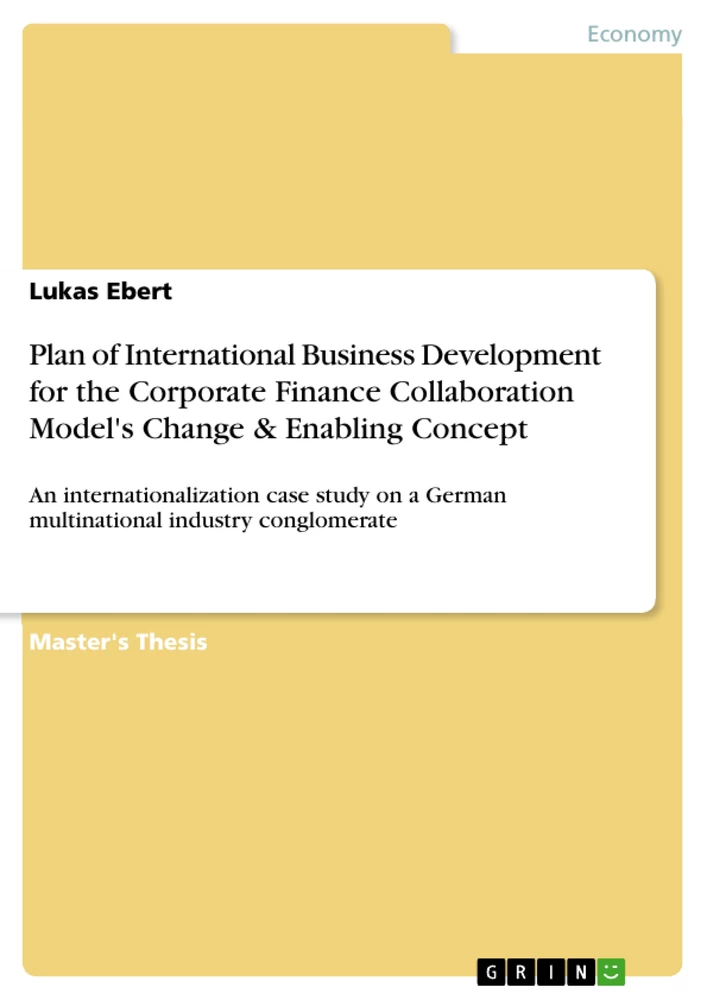
Table of Contents
1 Introduction
1.1 Embedment in the overall context
1.2 Scope of application
1.3 Definition of problems and respective goals
1.4 Structural approach of the paper
2 Literature review and theoretical background
2.1 Internationalization and other key terminology
2.2 Necessity for and modelling of Change Management
2.3 Influence of corporate and national cultures
3 Analysis and generation of insights
3.1 Environment and the origin of the project
3.2 Stakeholder and risk assessment
3.3 Internal competitive situation and customer requirements
3.4 Study of target regions
4 Strategy development and evaluation
4.1 Derivation of options
4.2 Evaluation and implementation
5 Critical review of the approach
6 Conclusion
6.1 Summary and realization of objectives
6.2 Resumé and outlook
Objectives and Topics
The primary objective of this thesis is to develop a sustainable internationalization strategy for the "CF Collaboration Model – Change & Enabling Concept" (CMCEC), a project focused on optimizing accounting processes. The research addresses the challenge of transforming a national organizational structure into a multinational community, specifically focusing on the role of "process owners." The central research goal is to design a framework that ensures effective cooperation, standardization, and change management across diverse global regions.
- Internationalization strategies for corporate accounting processes
- Change management approaches in organizational transformations
- Impact of national and corporate cultures on global project implementation
- Strategic analysis using SWOT and DESTEP frameworks
- Performance quantification using the "Return on Change" (RoC) model
Excerpt from the Book
1.1 Embedment in the overall context
„Globalization has changed us into a company that searches the world, not just to sell or to source, but to find intellectual capital - the world's best talents and greatest ideas.“ (Welch, 2001 as quoted in The Globalist, 2001)
This quote by General Electric’s CEO Jack Welch vividly illustrates two important aspects: On one hand, how the megatrend of globalization has been influencing and is still shaping private as well as corporate life and on the other hand how this “inevitable wave of the future (…) is frequently confused with internationalization, but is in fact something totally different.” (Daly, 1999, p. 31). For this reason, it is pertinent to elaborate on this issue later on in the literature review because a shared understanding is key in order to provide correct and generalizable results by means of this paper.
For a comprehensive understanding of the underlying problems and thereof derived goals for the paper and the project, it is necessary to highlight another trend, whose origin can be traced back to aforementioned one: In addition to the increasing competitive pressure, primarily in the currently disruptively changing automotive and supply industry (Mohr, Kaas, Gao, Wee, & Möller, 2016, pp. 4-5), the trend of the so-called renaissance of accounting is having far-reaching consequences. Since about 2010, the enormous potential for improvement in the financial sector has been (re)discovered, resulting in the necessity for various analyses with an internal and external focus, in which the existing processes were examined with regards to performance and compared to competitors by benchmarking oneself (MacDonald & Richardson, 2002, p. 120).
Summary of Chapters
1 Introduction: Provides the context of globalization and the renaissance of accounting, outlining the specific project scope of the CF Collaboration Model (CMCEC) for a German multinational company.
2 Literature review and theoretical background: Defines key terminology such as globalization and internationalization, evaluates change management models like Lean Change, and discusses the influence of national and corporate cultures.
3 Analysis and generation of insights: Details the internal environment, stakeholder and risk assessments, customer requirements, and target regions, utilizing PESTEL/DESTEP and benchmarking analyses.
4 Strategy development and evaluation: Derives strategic options via SWOT analysis and describes the implementation of three strategic pillars to support the international rollout.
5 Critical review of the approach: Reflects on the methodology used, discusses the limitations of the SWOT and Lean Change approaches, and addresses the practicability of the proposed strategy.
6 Conclusion: Summarizes the degree of goal achievement regarding the global rollout and offers a final resumé regarding the internationalization of the finance department.
Keywords
Internationalization, Change Management, Corporate Finance, Accounting, CMCEC, Globalization, Process Owners, SWOT Analysis, DESTEP, Return on Change, Organizational Transformation, Strategic Planning, Process Optimization, Corporate Culture, Project Management
Frequently Asked Questions
What is the core focus of this master thesis?
The thesis focuses on the internationalization of the "CF Collaboration Model – Change & Enabling Concept" (CMCEC), which aims to optimize accounting processes within a multinational company by creating a global community of process owners.
What are the primary thematic fields covered?
The work covers international business development, change management, organizational design, cross-cultural management, and strategic process optimization in the financial sector.
What is the ultimate goal of the CMCEC project?
The goal is to enable process owners worldwide to work effectively together, standardize global accounting processes, and transition from a national focus to a multinational organizational structure.
Which scientific methods are applied?
The research employs qualitative and quantitative methods, including benchmarking studies, stakeholder and risk analysis, SWOT analysis, DESTEP analysis, and the application of the Return on Change (RoC) KPI to measure success.
What does the main part of the paper address?
The main part provides a comprehensive analysis of the project's environment, develops an internationalization strategy based on strategic pillars, and critically evaluates the proposed implementation approach.
Which keywords best characterize the research?
Key terms include Internationalization, Change Management, Corporate Finance, Accounting, CMCEC, Globalization, Process Owners, SWOT, and organizational transformation.
How does the author define the relationship between globalization and internationalization?
The author argues that globalization is a macro-economic process that creates new opportunities and challenges, while internationalization is a business-specific activity influenced by globalization that integrates global dimensions into corporate functions.
Why is the "Uppsala model" relevant to this work?
The Uppsala model describes how companies gradually strengthen internationalization activities, serving as a theoretical foundation for the author’s structured approach to rolling out the PO community across different regions.
What role does culture play in this project?
Culture is identified as a critical enabler of change. The author examines both national and corporate cultures, noting that potential clashes require preventive consideration to ensure the success of the international transformation.
How does the author justify the use of Lean Change?
Lean Change is selected because it is flexible and adaptable to the fast-moving, volatile environment of the project, allowing for continuous refinement through "insights," "options," and "experiments."
Ende der Leseprobe aus 65 Seiten
- nach oben
- Arbeit zitieren
- Lukas Ebert (Autor:in), 2019, Plan of International Business Development for the Corporate Finance Collaboration Model's Change & Enabling Concept, München, Page::Imprint:: GRINVerlagOHG, https://www.diplomarbeiten24.de/document/1188180

neugierig - aktuell - relevant
Entdecken Sie hilfreiche Tipps und Tricks rund ums Studium!

Entdecken Sie hilfreiche Tipps und Tricks rund ums Studium!
Ihre Hausarbeit / Abschlussarbeit:

- - Publikation als E-Book und Buch
- - Hohes Honorar auf die Verkäufe
- - Für Sie komplett kostenlos - mit ISBN
- - Es dauert nur 5 Minuten
- - Jede Arbeit findet Leser

- © GRIN Publishing GmbH.
- Alle Inhalte urheberrechtlich geschützt. Kopieren und verbreiten untersagt.
- info@grin.com
- AGB
- Open Publishing
Der GRIN Verlag hat sich seit 1998 auf die Veröffentlichung akademischer eBooks und Bücher spezialisiert. Der GRIN Verlag steht damit als erstes Unternehmen für User Generated Quality Content. Die Verlagsseiten GRIN.com, Hausarbeiten.de und Diplomarbeiten24 bieten für Hochschullehrer, Absolventen und Studenten die ideale Plattform, wissenschaftliche Texte wie Hausarbeiten, Referate, Bachelorarbeiten, Masterarbeiten, Diplomarbeiten, Dissertationen und wissenschaftliche Aufsätze einem breiten Publikum zu präsentieren.
Kostenfreie Veröffentlichung: Hausarbeit, Bachelorarbeit, Diplomarbeit, Dissertation, Masterarbeit, Interpretation oder Referat jetzt veröffentlichen!
Folgen Sie GRIN auf


- GRIN Verlag GmbH
-
- Nymphenburger Str. 86
- 80636
- Munich, Deutschland
- +49 89-550559-0
- +49 89-550559-10
- info@grin.com
-
