
präsentiert von

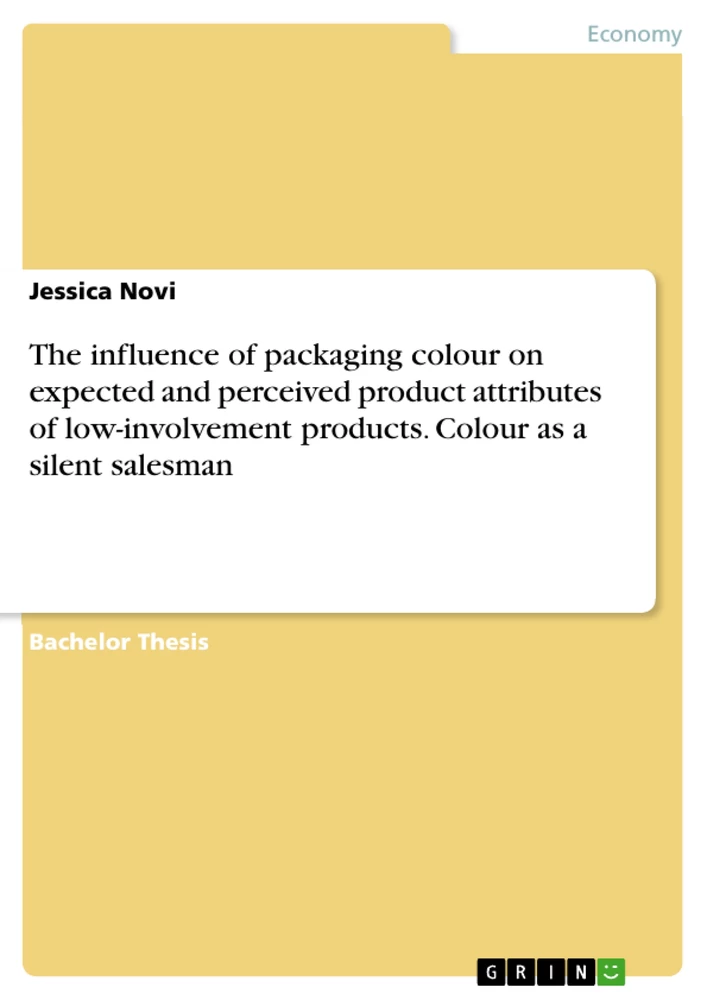
Table of Contents
1 Introduction
1.1 Problem statement
1.2 Research objectives
1.3 Research question
2 Literature Review
2.1 Colours
2.1.1 Colours and attention
2.1.2 Colours and emotions
2.1.3 Colour preferences
2.1.4 Colours and brands
2.1.5 Colours and product categories
2.2 Fast-moving low-involvement consumer products
2.3 Packaging
2.3.1 Packaging as an extrinsic cue and communicator
2.3.2 Packaging (re)design and product failure
2.3.3 Packaging and consumption
2.4 Psychological background
2.4.1 Means-end approach of consumer behaviour
2.4.2 Expectations and Perceptions
2.5 Revue: Current state of research
2.6 Hypotheses development
2.6.1 Product 1: Milk
2.6.2 Product 2: Shower gel
3 Study: Influence of packaging colour on expected and perceived product attributes of low-involvement products
3.1 Study design
3.1.1 Research methodology
3.1.2 Research implementation
3.1.1 Participants
3.1.2 Products
3.1.3 Packaging
3.2 Research results
3.2.1 Product 1: Milk
3.2.1.1 Liking of packaging
3.2.1.2 Fat content expected
3.2.1.3 Liking of taste
3.2.1.4 Fat content perceived
3.2.1.5 Relationship expected and perceived fat content
3.2.1.6 Importance factors
3.2.1.7 Suggested changes
3.2.1.8 Summary – product 1: milk
3.2.1 Product 2: Shower gel
3.2.1.1 Liking of packaging
3.2.1.2 Scent expected
3.2.1.3 Fruitiness perceived
3.2.1.4 Intensity perceived
3.2.1.5 Relationship perceived fruitiness and intensity
3.2.1.6 Scent perceived
3.2.1.7 Relationship expected and perceived scent
3.2.1.8 Importance factors
3.2.1.9 Suggested changes
3.2.1.10 Summary – product 2: shower gel
4 Discussion of results and their applicability and limitations in marketing practice
5 Conclusion
Research Objectives and Themes
The thesis explores the extent to which packaging colour influences consumer expectations and perceptions of low-involvement products, specifically milk and shower gel, at the point of sale. It aims to bridge the gap in current marketing research by demonstrating that colours serve as extrinsic cues that unconsciously guide purchase decisions and shape post-purchase evaluations.
- The impact of packaging colour on attribute expectations (e.g., fat content, scent).
- The relationship between initial expectations and actual sensory perception (assimilation-contrast theory).
- Consumer buying behaviour regarding low-involvement FMCG (Fast-Moving Consumer Goods).
- Differences in colour-influence susceptibility based on gender and age.
- Practical recommendations for marketers to improve product packaging design.
Excerpt from the Book
Expectations and Perceptions
Lastly, this chapter will deal with the possible influence of expectations on perceptions, a topic which will be of greater relevance for understanding the conducted study. First of all, every time an individual is in a situation of interacting with something the brain uses information that is stored in our memory as well as immediately available sensory cues for information processing which will form expectations (Piqueras-Fiszman & Spence, 2015). Perception on the other hand, is the way humans organize, interpret and experience those sensory stimuli. In theory, these perceptions include both bottom-up (sensory input as the basis) and top-down (how these inputs are interpreted with knowledge, experience, thoughts, etc.) processing (Levine & Shefner, 2000). What has to be emphasised here is the fact that even if the stimuli to begin with is the same for everyone, perceptions are not always because everyone has a distinct way of interpreting information.
Going a step further, it has been shown that if people build up expectations this can in fact have an influence on how they perceive certain stimuli (e.g. Puri & Wojciulik, 2008). For instance, Woods et al. (2011) as well as Piqueras-Fiszman and Spence (2015) and many others conducted studies proving that perception of the taste of food was influenced by previously formed expectations. And this phenomenon does most certainly not only hold for food but across many product categories.
But what happens if expectations do not match reality? This can be explained by the assimilation-contrast theory (Anderson, 1973) which says that if there is a disconfirmation between what is expected and what is actually experienced there are two possibilities of how we will react to this in order to minimize the feeling of discomfort. First of all, if the “error” is minor enough to fall into the so-called “latitudes of acceptance” of a consumer he/she will simply alter his/her perceptions towards the expected (even if the product itself might not justify this assessment). If, however, the “error” is too big there will be a “contrast effect” which means that the consumer will sense the disparity to be even larger.
Summary of Chapters
1 Introduction: Provides the foundation and motivation for the research, defining the scope and the core research question regarding the influence of packaging colour on low-involvement products.
2 Literature Review: Synthesizes existing theories on colour psychology, packaging as an extrinsic cue, and the psychological mechanisms governing consumer expectations and perceptions.
3 Study: Influence of packaging colour on expected and perceived product attributes of low-involvement products: Details the methodology, experimental setup, and the analysis of results concerning milk and shower gel, testing specific hypotheses about colour-induced perceptions.
4 Discussion of results and their applicability and limitations in marketing practice: Interprets the study's findings in the context of marketing strategy, highlighting the need for data-driven decisions over intuition.
5 Conclusion: Summarizes the key insights and reaffirms the importance of packaging colour as a significant, yet often overlooked, factor in the overall consumer buying experience.
Keywords
colour, packaging, low-involvement product, expectation, perception, attribute evaluation, consumer psychology, FMCG, sensory perception, marketing strategy, product design, brand recognition, assimilation-contrast theory, consumer behaviour, stimulus-driven attention
Frequently Asked Questions
What is the primary focus of this thesis?
The thesis investigates how the colour of packaging influences consumer expectations and the subsequent sensory perception of low-involvement products, such as milk and shower gel.
What are the central themes discussed in the literature review?
The review covers colour psychology, the role of packaging as a communicator, consumer buying patterns for FMCGs, and psychological theories like the means-end approach and assimilation-contrast theory.
What is the main research question?
The research asks: "In which ways and to which extent does packaging colour influence consumers when buying low-involvement products?"
Which methodology was employed for the study?
The author conducted a randomized mixed factorial experiment where participants evaluated products with different packaging colours, measuring both their expectations before sensory experience and their perception afterward.
What is covered in the main body of the work?
The main part focuses on the empirical study, analyzing the collected data regarding fat content expectations for milk and scent expectations for shower gel, along with discussions on the findings' applicability.
What are the key terms that define this work?
Keywords include colour, packaging, low-involvement products, consumer psychology, expectations, and perceptions.
Did the study find significant differences between genders?
Yes, the results suggested that women are generally influenced to a greater degree by packaging colour in both their expectations and their sensory perceptions compared to men.
How does the assimilation-contrast theory apply here?
It explains that if there is a gap between expected and experienced attributes, consumers will either align their perception to the expectation (if the gap is small) or experience a contrast effect (if the gap is too large).
Ende der Leseprobe aus 54 Seiten
- nach oben
- Arbeit zitieren
- Jessica Novi (Autor:in), 2021, The influence of packaging colour on expected and perceived product attributes of low-involvement products. Colour as a silent salesman, München, Page::Imprint:: GRINVerlagOHG, https://www.diplomarbeiten24.de/document/1190748

neugierig - aktuell - relevant
Entdecken Sie hilfreiche Tipps und Tricks rund ums Studium!

Entdecken Sie hilfreiche Tipps und Tricks rund ums Studium!
Ihre Hausarbeit / Abschlussarbeit:

- - Publikation als E-Book und Buch
- - Hohes Honorar auf die Verkäufe
- - Für Sie komplett kostenlos - mit ISBN
- - Es dauert nur 5 Minuten
- - Jede Arbeit findet Leser

- © GRIN Publishing GmbH.
- Alle Inhalte urheberrechtlich geschützt. Kopieren und verbreiten untersagt.
- info@grin.com
- AGB
- Open Publishing
Der GRIN Verlag hat sich seit 1998 auf die Veröffentlichung akademischer eBooks und Bücher spezialisiert. Der GRIN Verlag steht damit als erstes Unternehmen für User Generated Quality Content. Die Verlagsseiten GRIN.com, Hausarbeiten.de und Diplomarbeiten24 bieten für Hochschullehrer, Absolventen und Studenten die ideale Plattform, wissenschaftliche Texte wie Hausarbeiten, Referate, Bachelorarbeiten, Masterarbeiten, Diplomarbeiten, Dissertationen und wissenschaftliche Aufsätze einem breiten Publikum zu präsentieren.
Kostenfreie Veröffentlichung: Hausarbeit, Bachelorarbeit, Diplomarbeit, Dissertation, Masterarbeit, Interpretation oder Referat jetzt veröffentlichen!
Folgen Sie GRIN auf


- GRIN Verlag GmbH
-
- Nymphenburger Str. 86
- 80636
- Munich, Deutschland
- +49 89-550559-0
- +49 89-550559-10
- info@grin.com
-
