
präsentiert von

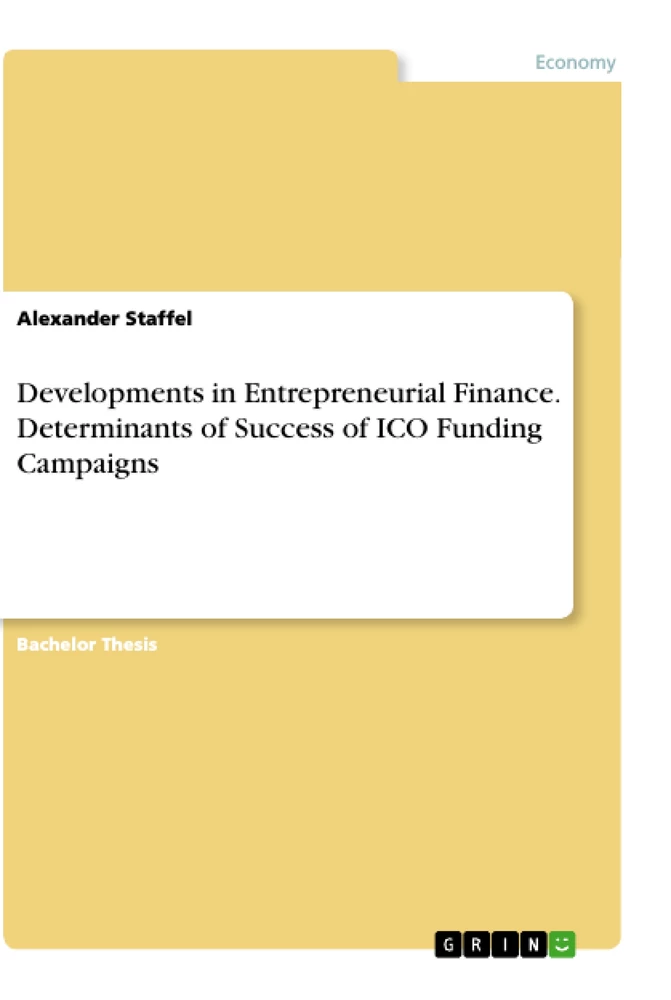
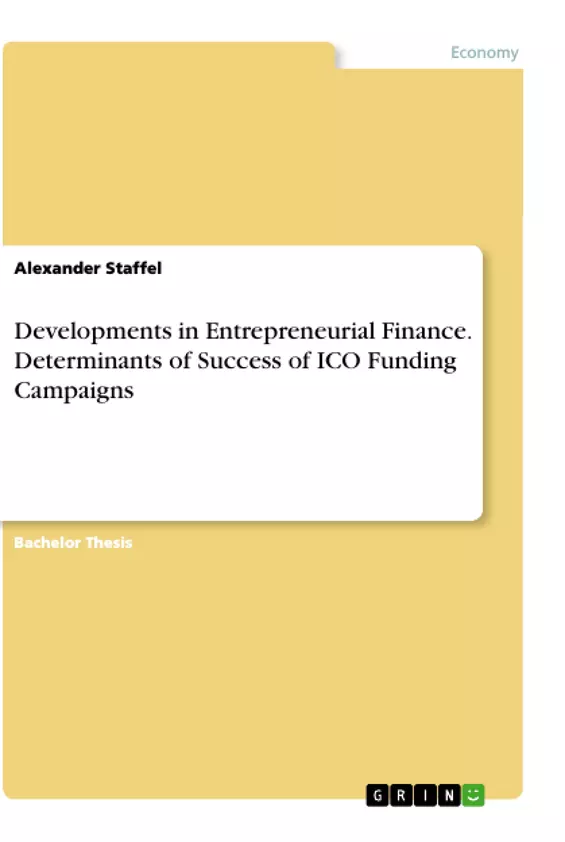
Table of Contents
1. Introduction
2. Blockchain, cryptocurrencies and Initial Coin Offerings (ICOs)
2.1 Blockchain
2.2 Cryptocurrencies
2.3 Initial Coin Offerings (ICOs)
3. Literature review
4. Methodology and research hypotheses
4.1 Methodology
4.2 Research hypotheses
5. Empirical analysis
5.1 Dataset and descriptive statistics
5.2 Determinants of success
6. Limitations and future research
7. Conclusions
Research Objectives and Key Topics
The primary objective of this thesis is to identify the critical determinants of success for Initial Coin Offering (ICO) funding campaigns. By applying a logit regression model to a dataset of 260 ICOs conducted between October 2017 and June 2019, the study investigates how various factors influence funding, listing, and long-term survival success, aiming to provide valuable insights for practitioners and researchers in the emerging field of entrepreneurial finance.
- Analysis of success determinants for Initial Coin Offerings (ICOs)
- Evaluation of post-ICO performance through listing and survival success metrics
- Application of signalling theory and human capital theory to explain success
- Impact of information disclosure (white paper, source code) and expert ratings
- Examination of social media presence and team composition as quality signals
Excerpt from the Book
1. Introduction
An Initial Coin Offering (ICO) or first token sale is the first sale of a new virtual coin or token based on the blockchain technology with the goal of financing a start-up business, blockchain related project or general business venture. Investors, which are usually called contributors in terms of ICOs, can be either categorised as retail (“crowd”) or institutional contributors, which exchange, depending on the campaign, either fiat money or cryptocurrencies and receive a new virtual token instead. ICOs share common features with Initial Public Offerings (IPOs), crowdfunding and Venture Capital (VC) although they differ in certain aspects from all those other financing sources (Dell’Erba, 2017). ICOs, as a new way of financing, were enabled by advances in information technology (IT), since this financing mechanism is completely automated and taken care by a blockchain (Chanson, Wortmann & Risius, 2018). Token sales are therefore not only of interest for the academic disciplines of finance, but also for computer science or information systems.
Moreover, ICOs are not only an arguably new topic for the scientific community but also for practitioners, as the first initial token sale was held in July 2013 by Mastercoin, which was later renamed to Omni. This first funding campaign was related to the creation of a new cryptocurrency (called MSC) as well as to a platform. During the public phase of the token sale, a total of approximately 2.3 million USD at the time was raised (Benedetti & Kostovetsky, 2018).
Summary of Chapters
1. Introduction: This chapter introduces the concept of Initial Coin Offerings (ICOs) as a new financing mechanism and outlines the research objective, which is to identify determinants of ICO success.
2. Blockchain, cryptocurrencies and Initial Coin Offerings (ICOs): This section provides a foundational understanding of the underlying technologies, including the blockchain, cryptocurrencies, and the structure of ICO campaigns.
3. Literature review: The chapter reviews existing empirical research concerning the success factors of ICOs, highlighting the sparse nature of current literature.
4. Methodology and research hypotheses: This section details the data collection process, explains the logit regression methodology, and formulates eight research hypotheses based on signalling and human capital theories.
5. Empirical analysis: The chapter presents the dataset, descriptive statistics, and the results of the regression models used to test the formulated hypotheses.
6. Limitations and future research: This section discusses the study's limitations, particularly regarding data quality and potential biases, and suggests avenues for future research.
7. Conclusions: The final chapter summarizes the research findings, noting that different factors influence funding success compared to post-ICO performance metrics like listing and survival.
Keywords
Initial Coin Offerings, ICO, Blockchain, Cryptocurrency, Funding Success, Listing Success, Survival Success, Signalling Theory, Human Capital, Expert Ratings, Logit Regression, Entrepreneurial Finance, Crowdfunding, White Paper, Source Code
Frequently Asked Questions
What is the core focus of this thesis?
The thesis focuses on identifying the specific factors that determine the success of Initial Coin Offering (ICO) funding campaigns, analyzing them through funding, listing, and survival metrics.
What are the primary themes explored in the work?
The work explores information disclosure, the role of human capital, market sentiment through social media, and specific technical characteristics like blockchain platforms as drivers for ICO success.
What is the main research question of this study?
The central research question is: Which determinants affect the success of ICO funding campaigns?
Which scientific method is utilized in this paper?
The author employs an empirical approach using a logit regression model applied to a manually collected dataset of 260 ICOs.
What is discussed in the main part of the thesis?
The main part covers the theoretical foundations of blockchain and ICOs, a review of existing literature, the detailed methodology and hypothesis formulation, and the empirical regression analysis of the dataset.
Which keywords best characterize this research?
Key terms include ICO, Blockchain, Funding Success, Signalling Theory, and Human Capital.
How does the author define 'survival success'?
Survival success is defined as the token being actively traded on an exchange at the beginning of July 2020, considering a minimum duration of one year after the ICO.
Does the availability of a white paper influence post-ICO success?
According to the findings, the mere existence of a white paper is positively correlated with reaching the initial funding target but does not significantly improve the probability of post-ICO performance.
Ende der Leseprobe aus 64 Seiten
- nach oben
- Arbeit zitieren
- Alexander Staffel (Autor:in), 2020, Developments in Entrepreneurial Finance. Determinants of Success of ICO Funding Campaigns, München, Page::Imprint:: GRINVerlagOHG, https://www.diplomarbeiten24.de/document/1191497

neugierig - aktuell - relevant
Entdecken Sie hilfreiche Tipps und Tricks rund ums Studium!

Entdecken Sie hilfreiche Tipps und Tricks rund ums Studium!
Ihre Hausarbeit / Abschlussarbeit:

- - Publikation als E-Book und Buch
- - Hohes Honorar auf die Verkäufe
- - Für Sie komplett kostenlos - mit ISBN
- - Es dauert nur 5 Minuten
- - Jede Arbeit findet Leser

- © GRIN Publishing GmbH.
- Alle Inhalte urheberrechtlich geschützt. Kopieren und verbreiten untersagt.
- info@grin.com
- AGB
- Open Publishing
Der GRIN Verlag hat sich seit 1998 auf die Veröffentlichung akademischer eBooks und Bücher spezialisiert. Der GRIN Verlag steht damit als erstes Unternehmen für User Generated Quality Content. Die Verlagsseiten GRIN.com, Hausarbeiten.de und Diplomarbeiten24 bieten für Hochschullehrer, Absolventen und Studenten die ideale Plattform, wissenschaftliche Texte wie Hausarbeiten, Referate, Bachelorarbeiten, Masterarbeiten, Diplomarbeiten, Dissertationen und wissenschaftliche Aufsätze einem breiten Publikum zu präsentieren.
Kostenfreie Veröffentlichung: Hausarbeit, Bachelorarbeit, Diplomarbeit, Dissertation, Masterarbeit, Interpretation oder Referat jetzt veröffentlichen!
Folgen Sie GRIN auf


- GRIN Verlag GmbH
-
- Nymphenburger Str. 86
- 80636
- Munich, Deutschland
- +49 89-550559-0
- +49 89-550559-10
- info@grin.com
-
