
präsentiert von

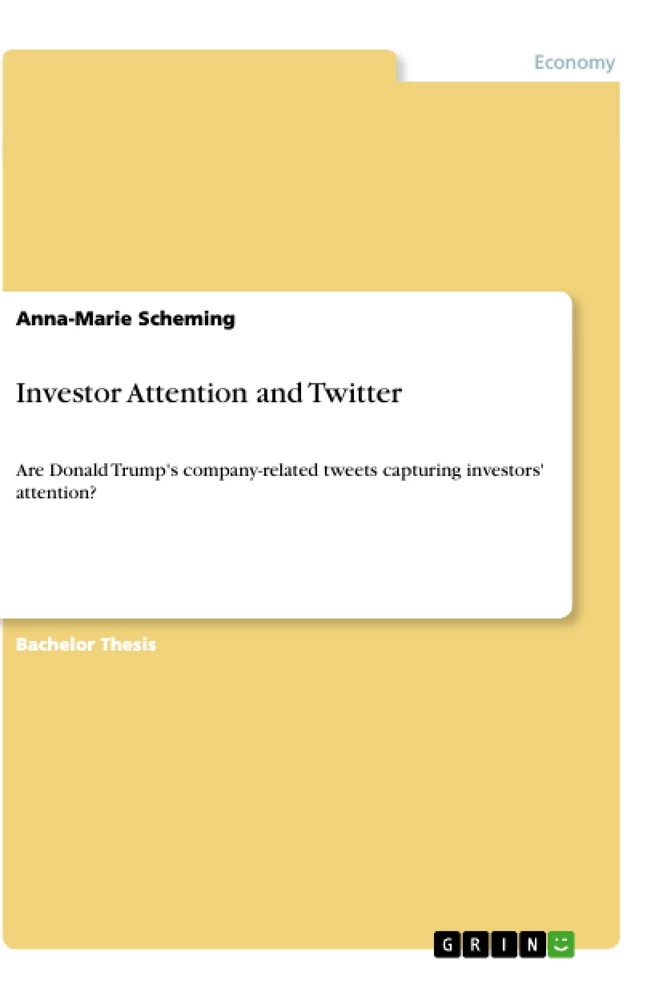
Table of Contents
1 Introduction
2 Theory and literature review
2.1 Financial attention
2.2 Direct measurements of attention
2.2.1 Search Volume Index
2.2.2 Yahoo Finance search
2.2.3 The Baidu- Index
3 Empirical study
3.1 Data and methodology
3.2 Results
4 Conclusion
Research Objective and Topics
This thesis investigates the impact of Donald Trump's company-specific Twitter posts on the attention of retail investors, aiming to determine whether these tweets trigger a measurable effect on financial attention using direct proxies.
- Analysis of retail investor attention mechanisms
- Evaluation of direct attention proxies (SVI, Yahoo Finance, Baidu Index)
- Empirical examination of Twitter-induced search volume spikes
- Comparison of positive vs. negative tweet influence on investor behavior
- Study of the relationship between company size, analyst coverage, and attention
Excerpt from the Book
2.2.1 Search Volume Index
Google publicizes the SVI of search terms via the Google Trends. More accurate Google Trends was implemented in 2006 and includes search volume data since 2004 for different languages and different regions. In addition, Google Trends data is normalized. Thus, for each data point, it is divided by the total number of searches in the corresponding geographic area and time period. This determines the levels of relative demand. Otherwise, locations with the highest search volume would always rank at the top. Afterwards, on a scale from 0 to 100, the results appear that are aligned in comparison to all search queries for all topics. The data of Google Trends reflects the search queries that users make on Google very detailed. The reason is that Google filters out certain search queries. This happens, for example, because Trends only analyzes data for popular search terms and terms with low search volume therefore appear as 0. It also removes repeating searches from the same person within a short period of time.
SVI can be extracted as a CSV file, which allows data to be obtained and processed in a user-friendly way. Figure 1 illustrates an example for the search term "Donald Trump". The figure shows the evolution of the search volume index for the search term "Donald Trump" over the last 90 days. On the y-axis are the values for SVI's and on the x-axis the time. There is a spike on November 7, 2020 and January 7, 2021. That increased number of searches for the term can be attributed to the end of the presidential election. On November 7, 2020, the US media declared that Biden has won. The spike on 07 January 2021 can be traced back to the blocking of Trump's Twitter account after the storming of the Capitol.
Summary of Chapters
1 Introduction: This chapter outlines the growing influence of social media on financial markets and establishes the research question regarding the impact of Donald Trump's tweets on retail investor attention.
2 Theory and literature review: This section covers the theoretical foundations of financial attention, the limited attention hypothesis, and examines various direct and indirect proxies for measuring investor interest.
3 Empirical study: This chapter details the data collection process from Twitter and Google Trends, describes the regression model used, and presents the findings regarding how tweets affect investor attention.
4 Conclusion: The final chapter summarizes the findings, confirms that Trump's tweets do impact retail investor attention, and discusses limitations as well as directions for future research.
Keywords
Financial attention, Retail investors, Twitter, Donald Trump, Search Volume Index, SVI, Yahoo Finance, Baidu Index, Empirical study, Regression analysis, Investor behavior, Stock market, Abnormal search volume, Information efficiency, Social media
Frequently Asked Questions
What is the core subject of this thesis?
The thesis examines how Twitter activity from Donald Trump impacts the attention of retail investors and whether this attention can be empirically measured using web search data.
What are the central thematic fields?
The work focuses on behavioral finance, specifically the link between social media communication, financial information processing, and direct proxies like the Google Search Volume Index.
What is the primary research question?
The central question is whether Donald Trump's company-related tweets have a triggering effect on retail investor attention and if this can be measured using direct proxies.
Which scientific method is utilized?
The author employs a quantitative empirical approach, utilizing regression analysis in Excel to correlate Twitter activity with daily changes in the Abnormal Search Volume Index (ASVI).
What topics are covered in the main body?
The main body consists of a theoretical framework defining financial attention and evaluating data proxies, followed by an empirical analysis of specific Twitter data against stock market metrics.
Which keywords characterize this work?
Key terms include financial attention, retail investors, SVI, social media, behavioral finance, and empirical stock market research.
How is the Baidu Index compared to Google Trends?
The Baidu Index serves as a similar direct proxy for attention in China, showing high correlation with Google Trends, though it is specifically tailored to the Chinese search environment.
What is the significance of the "limited attention hypothesis" in this context?
It explains that investors have limited capacity to process information, causing them to rely on specific cues—like high-profile tweets—to allocate their attention, which directly influences market activity.
Ende der Leseprobe aus 28 Seiten
- nach oben
- Arbeit zitieren
- Anna-Marie Scheming (Autor:in), 2021, Investor Attention and Twitter, München, Page::Imprint:: GRINVerlagOHG, https://www.diplomarbeiten24.de/document/1215873

neugierig - aktuell - relevant
Entdecken Sie hilfreiche Tipps und Tricks rund ums Studium!

Entdecken Sie hilfreiche Tipps und Tricks rund ums Studium!
Ihre Hausarbeit / Abschlussarbeit:

- - Publikation als E-Book und Buch
- - Hohes Honorar auf die Verkäufe
- - Für Sie komplett kostenlos - mit ISBN
- - Es dauert nur 5 Minuten
- - Jede Arbeit findet Leser

- © GRIN Publishing GmbH.
- Alle Inhalte urheberrechtlich geschützt. Kopieren und verbreiten untersagt.
- info@grin.com
- AGB
- Open Publishing
Der GRIN Verlag hat sich seit 1998 auf die Veröffentlichung akademischer eBooks und Bücher spezialisiert. Der GRIN Verlag steht damit als erstes Unternehmen für User Generated Quality Content. Die Verlagsseiten GRIN.com, Hausarbeiten.de und Diplomarbeiten24 bieten für Hochschullehrer, Absolventen und Studenten die ideale Plattform, wissenschaftliche Texte wie Hausarbeiten, Referate, Bachelorarbeiten, Masterarbeiten, Diplomarbeiten, Dissertationen und wissenschaftliche Aufsätze einem breiten Publikum zu präsentieren.
Kostenfreie Veröffentlichung: Hausarbeit, Bachelorarbeit, Diplomarbeit, Dissertation, Masterarbeit, Interpretation oder Referat jetzt veröffentlichen!
Folgen Sie GRIN auf


- GRIN Verlag GmbH
-
- Nymphenburger Str. 86
- 80636
- Munich, Deutschland
- +49 89-550559-0
- +49 89-550559-10
- info@grin.com
-
