
präsentiert von

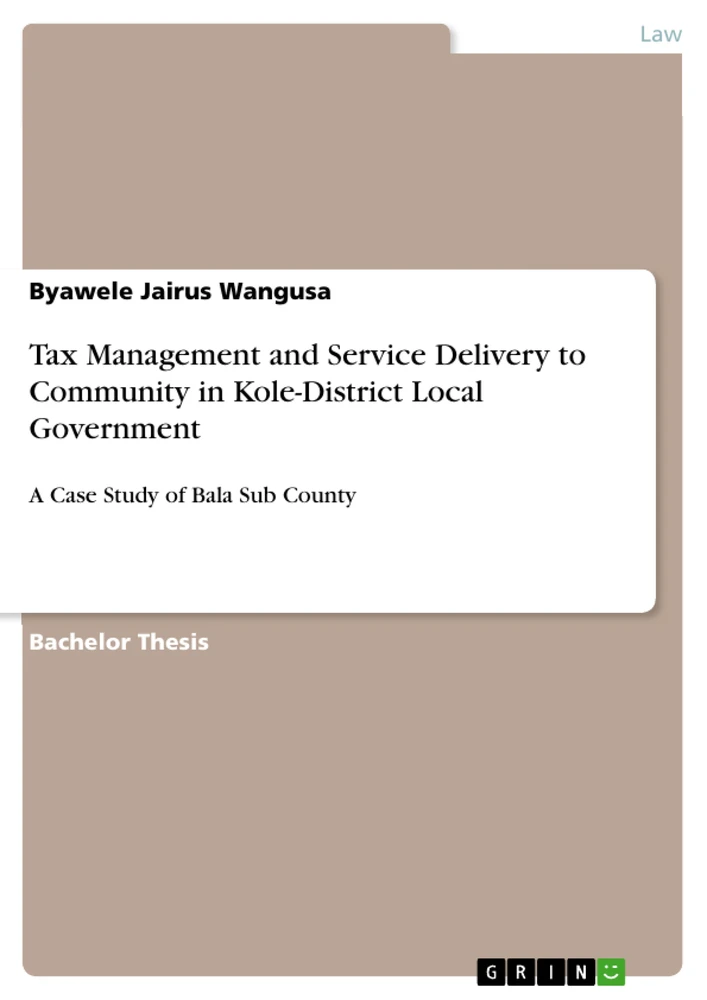
Table of Contents
1.0 Introduction
1.1Background of the study
1.2 Problem Statement of the Study
1.3 General Objective of the study
1.4 Specific Objectives of the study
1.5 Research Questions
1.6 Scope of the study
1.6.1 Time Scope
1.7 Conceptual frame work for the Study.
1.8 Significance of the study
2.0 Introduction
2.1 Service Delivery in Local Governments.
2.2 Decentralization
2.3 Local Revenue Collection
2.4 Tax administration
2.5 Revenue Collection and tax Management
2.6 Relationship between tax management and service delivery in local government
2.7 Summary of Literature Review
3.0 Introduction
3.1 Research Design
3.2 Study site and Setting
3.3 Study Population
3.4 Sample size and selection of participants
3.5.1 Purposive sampling technique
3.5.2 Simple random technique
3.6 Eligibility Criteria
3.6.1 Inclusion criteria.
3.6.2 Exclusion criteria.
3.7 Data Sources
3.8 Data Collection Instrument
3.9 Data Collection Methods
3.9.1 Observation Methods.
3.9.2 Interview method
3.9.3 Questionnaires
3.9.4 Documentary method
3.10 Data Processing, Analysis and Presentation
3.10.1 Data Analysis
3.10.2 Data Presentation
3.11 Measurement of variables
3.12 Quality Control (Validity and Reliability)
3.13 Data management.
3.14 Limitations to the study.
3.15 Ethical Consideration
4.0 Introduction
4.1 Response rate
4.2 Bio-data of Bala Sub-county respondents
4.2.1 Age category of respondents
4.2.2 Gender of the respondents
4.2.3 Level of education of the respondents
4.2.4 Respondents involvement in tax management
4.2.5 Does BSC provide services to the local community
4.3 Impacts of tax management in BSC
4.3.1 Correlation results for tax management and service delivery
4.3.2 Regression results for tax management and service delivery
4.4 Implementing tax management and tax ssources in BSC
4.4.1 Correlation results for implementing tax management plan and service delivery
4.4.2 Regression results for implementation of the tax management plan and service delivery
5.0 Introduction
5.1 Summary of the study.
5.1.1 Impacts of tax management on service delivery in BSC
5.1.2 Implementing tax management and tax sources in BSC
5.2 Discussion of the study
5.2.1 Impacts of tax management on service delivery in BSC
5.2.2 Implementing tax management and tax sources in BSC
5.3 Conclusions of the study
5.3.1 Impacts of tax management on service delivery in BSC
5.4 Recommendations of the study
5.4.1 Impacts of tax management on service delivery in BSC
5.4.2 Implementing tax management and sources in BSC
5.5 Limitations of the study
5.6 Areas for further study
Objectives and Research Focus
This study aims to examine the effects of tax management on service delivery to the local community in Bala Sub County, Kole District Local Government, specifically investigating the relationship between current revenue collection practices and the provision of public services.
- Analysis of common tax management activities in local government.
- Evaluation of the impact of tax management on public service delivery outcomes.
- Assessment of the relationship between tax compliance and service efficiency.
- Identification of gaps in current revenue enhancement and implementation strategies.
Excerpt from the Book
2.1 Service Delivery in Local Governments.
Uganda’s decentralization policy provided for transfer of powers and functions from central governments and departments to local governments. This mandate is embedded in the 1995 constitution of republic of Uganda. The provision of basic services such as water and sanitation, health care, primary education, feeder roads and agriculture extension services is left to local governments(MDLG, 2017).
However, the recent government’s policy of effectively deliver services and ensure value for money in the public expenditure. Some government policies which has been alarming impacts include the creation of new Districts and abolition of graduated tax. The creation of new Districts has put more expenditure pressure on local governments, reducing and in some cases taking away completely resources that could have been used in increasing and improving service delivery(Bray, 2008). This therefore, calls for placing “a high priority on delivery of personalized efficient customer service” Mourney, (1991)> Attitudes exhibited by the service providers, employees, and managers must be aimed at developing good working relations and ensuring that the customers are handled well while being served (Musgrave,1991), define public sector as “ those industries and services in a country that are owned and run by the state, such as “ education and railways (in many countries) in comparison with the private sector. Thus delivery entails public sector delivery mechanism to the local residents of local government(Bray, 2008).
Summary of Chapters
1.0 Introduction: This chapter outlines the background, research objectives, and the significance of the study regarding tax management and service delivery.
2.0 Literature Review: An exploration of existing theoretical frameworks and empirical studies concerning decentralization, revenue collection, and their impact on local governance.
3.0 Research Methodology: Details the research design, population, sampling techniques, and data collection methods employed for the study.
4.0 Presentation, Anaylsis and Intepretation of Results: This chapter provides the quantitative and qualitative findings of the study along with statistical correlations and regression analyses.
5.0 Summary, Discussion, Conclusion and Recommendations: The final chapter synthesizes the findings, draws conclusions based on research objectives, and offers practical recommendations for improvement.
Keywords
Tax Management, Service Delivery, Local Government, Decentralization, Revenue Collection, Kole District, Bala Sub County, Public Services, Fiscal Decentralization, Tax Administration, Community Development, Infrastructure, Revenue Enhancement, Tax Compliance, Public Expenditure.
Frequently Asked Questions
What is the primary focus of this research?
The study focuses on the intersection of tax management practices and the delivery of public services to the community within Bala Sub County, Kole District Local Government.
What are the core research themes?
The core themes include decentralization policies, local revenue collection methods, administrative tax strategies, and their direct influence on the quality and accessibility of local services like healthcare, water, and roads.
What is the main objective of the study?
The main objective is to investigate how tax management activities directly influence the effectiveness and efficiency of public service delivery at the sub-county level.
What research methodology was used?
The researcher utilized a cross-sectional and correlation survey design, employing mixed methods (both quantitative and qualitative) to gather and analyze data from local officials and community members.
What does the main body of the work cover?
The main body covers a comprehensive literature review, the methodological framework, a detailed presentation of statistical results (including correlation and regression analysis), and an in-depth discussion of findings linked to specific objectives.
Which keywords define this research?
Key terms include Tax Management, Service Delivery, Decentralization, Local Revenue Collection, and Public Governance in the context of the Ugandan local government system.
How is local revenue collection currently impacting service delivery in Bala Sub County?
The findings indicate that while there is a positive relationship, tax management challenges—such as low revenue mobilization, lack of trained staff, and taxpayer awareness gaps—currently hinder optimal service delivery.
What specific solutions does the author propose?
The author recommends continuous training for revenue assessment staff, improved logistical support for tax teams, and aggressive community sensitization to improve compliance and identify untapped revenue sources.
Ende der Leseprobe aus 55 Seiten
- nach oben
- Arbeit zitieren
- Byawele Jairus Wangusa (Autor:in), 2022, Tax Management and Service Delivery to Community in Kole-District Local Government, München, Page::Imprint:: GRINVerlagOHG, https://www.diplomarbeiten24.de/document/1217367

neugierig - aktuell - relevant
Entdecken Sie hilfreiche Tipps und Tricks rund ums Studium!

Entdecken Sie hilfreiche Tipps und Tricks rund ums Studium!
Ihre Hausarbeit / Abschlussarbeit:

- - Publikation als E-Book und Buch
- - Hohes Honorar auf die Verkäufe
- - Für Sie komplett kostenlos - mit ISBN
- - Es dauert nur 5 Minuten
- - Jede Arbeit findet Leser

- © GRIN Publishing GmbH.
- Alle Inhalte urheberrechtlich geschützt. Kopieren und verbreiten untersagt.
- info@grin.com
- AGB
- Open Publishing
Der GRIN Verlag hat sich seit 1998 auf die Veröffentlichung akademischer eBooks und Bücher spezialisiert. Der GRIN Verlag steht damit als erstes Unternehmen für User Generated Quality Content. Die Verlagsseiten GRIN.com, Hausarbeiten.de und Diplomarbeiten24 bieten für Hochschullehrer, Absolventen und Studenten die ideale Plattform, wissenschaftliche Texte wie Hausarbeiten, Referate, Bachelorarbeiten, Masterarbeiten, Diplomarbeiten, Dissertationen und wissenschaftliche Aufsätze einem breiten Publikum zu präsentieren.
Kostenfreie Veröffentlichung: Hausarbeit, Bachelorarbeit, Diplomarbeit, Dissertation, Masterarbeit, Interpretation oder Referat jetzt veröffentlichen!
Folgen Sie GRIN auf


- GRIN Verlag GmbH
-
- Nymphenburger Str. 86
- 80636
- Munich, Deutschland
- +49 89-550559-0
- +49 89-550559-10
- info@grin.com
-
