
präsentiert von

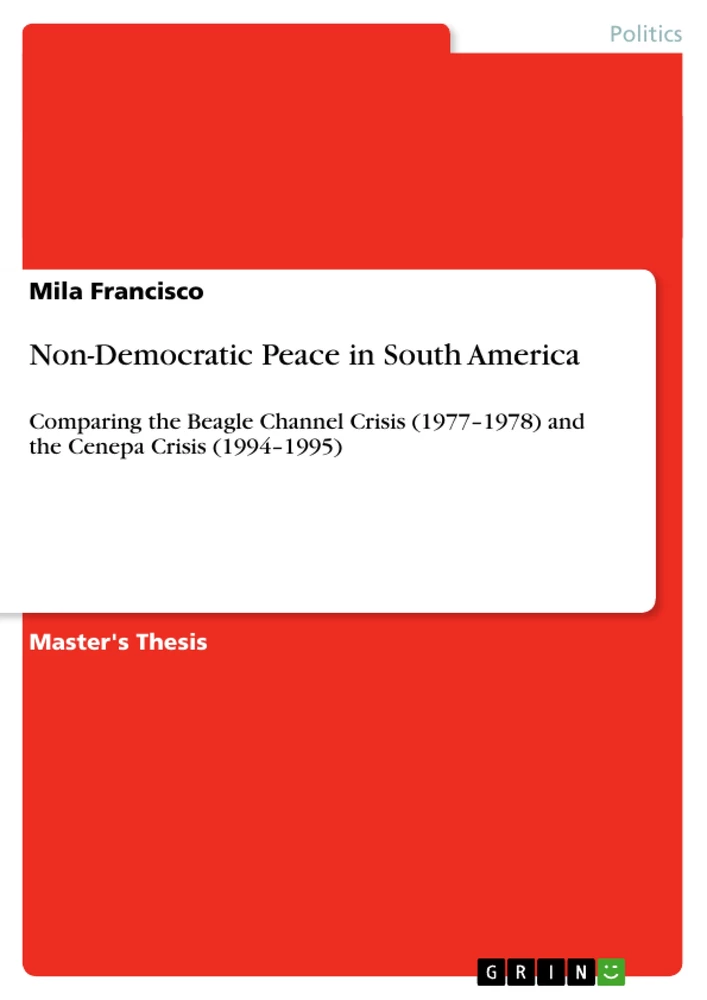
Table of Contents
Introduction
Part I. Theoretical Framework
Deterrence: Success and Failure
Third Party Intervention and War Prevention
Working Hypotheses
Part II. The Beagle Channel Crisis (Argentina vs. Chile 1977–1978)
Origins
Actors: The Military in Power
Claims
Onset
Escalation
De-escalation
Why Did the Crisis Not Escalate to War?
Part III. The Cenepa Crisis (Ecuador vs. Peru 1994–1995)
Origins
Actors: Democracy vs. Democracy?
Claims
Onset
Escalation
De-escalation
Why did the Crisis Escalate to War?
Part IV. Did Regime Type Influence the Crises’ Outcomes?
Regime Type and War
Regime Type, Deterrence and Third Party Intervention
Conclusions
Objectives and Research Themes
This study aims to explain why the Beagle Channel Crisis (1977–1978) was contained despite the militarized nature of both regimes, while the Cenepa Crisis (1994–1995) escalated to an intensive war between two democracies. The central research question investigates whether deterrence strategy alone is sufficient to prevent war or if the interaction between deterrence and third-party intervention is required to manage escalatory processes effectively.
- The effectiveness of deterrence strategies in different political contexts.
- The role of third-party mediation in preventing conflict escalation.
- The impact of regime type (military dictatorships vs. democracies) on crisis outcomes.
- The influence of domestic political constraints and audience costs on crisis management.
- A structured comparison of territorial disputes in South America.
Excerpt from the Book
Why Did the Crisis Not Escalate to War?
The crisis over the Beagle Channel was, in Patrick Morgan’s words, a “lengthy prolonged crisis,” which is one that stretches over a year or more. A longer crisis offers more possibilities for gathering information and looking for alternatives. However, there is less freedom to make decisions due to domestic and bureaucratic political constraints: more people may assist in shaping the decisions. “Each side has time to react incrementally and the domestic and international room to maneuver shrinks steadily but imperceptibly while the leaders on both sides continue to think that the opponent retains considerable flexibility and various options short of war.” Many factors of the Beagle Channel crisis could have led to an armed escalation: it was a territorial dispute between a military dyad, both actors conferred a great value on the issue at stake, negotiations failed repeatedly, and the strategies used were hostile. Although these “promoting wars” factors concurred, war was avoided at the last minute.
In light of the hypotheses presented at the beginning of this study, it is possible to conclude that Chile reacted quickly through credible threats at the very beginning of the crisis (H1). Indeed, to deter Argentina successfully, Chile did not have to demonstrate a capability to win or to retaliate, but instead to make a credible case that a military adventure against it would be very costly (denial). As seen in the case study, during the escalation process, Chile maintained forces and offered warnings of a forceful response to deter an eventual attack. At the same time, efforts were made to gain support from the international community (Chile recurred to the OAS, the UN Security Council and, finally, the Pope). In this sense, third party involvement (public appeals and mediation) at an early stage of the conflict reinforced the likelihood that Chile’s deterrence policy would help contain the conflict (H2.1). Hence, deterrence and third party intervention together increased the cost of going to war for Argentina, and made the Chilean commitment more credible.
Summary of Chapters
Introduction: Summarizes the historical prevalence of territorial disputes in Latin America and defines the study's focus on the Beagle Channel and Cenepa crises.
Part I. Theoretical Framework: Discusses the evolution of deterrence theory, the limitations of military capability alone, and the necessity of incorporating third-party mediation.
Part II. The Beagle Channel Crisis (Argentina vs. Chile 1977–1978): Details the military regimes' interactions and explains how credible threats and subsequent papal mediation successfully avoided war.
Part III. The Cenepa Crisis (Ecuador vs. Peru 1994–1995): Analyzes the escalation between two democracies, arguing that failed deterrence and a lack of timely third-party intervention contributed to the outbreak of war.
Part IV. Did Regime Type Influence the Crises’ Outcomes?: Investigates the democratic peace theory versus the role of domestic populist leadership and military autonomy in crisis decision-making.
Conclusions: Reasserts that while deterrence and mediation are essential, domestic conditions and the timing of third-party involvement are crucial variables that determine whether a crisis escalates to war.
Keywords
Deterrence, Third Party Intervention, Mediation, Crisis Escalation, Beagle Channel Crisis, Cenepa Crisis, Territorial Disputes, South America, Democracy, Military Dictatorship, War Prevention, Expected-Utility Theory, Regime Type, International Relations, Conflict Resolution.
Frequently Asked Questions
What is the fundamental focus of this research?
The research focuses on why two specific South American territorial crises led to different outcomes: the Beagle Channel crisis was resolved peacefully, while the Cenepa crisis resulted in war.
What are the central themes of the work?
The core themes include the effectiveness of deterrence strategies, the impact of third-party mediation, and the influence of domestic politics on international conflict resolution.
What is the primary objective of this study?
The goal is to determine if deterrence alone is sufficient to prevent war or if it must be supplemented by third-party involvement to contain escalatory processes.
Which scientific methods are employed?
The author uses a structured focused comparison, applying similar analytical questions to both case studies to assess historical, political, and military developments.
What is covered in the main body of the work?
The main body contains a theoretical framework, detailed historical case studies of the Beagle Channel and Cenepa crises, and an evaluation of how regime type influences conflict outcomes.
Which keywords characterize this research?
Key concepts include deterrence, mediation, crisis escalation, territorial disputes, and the impact of domestic political conditions on national leaders.
How did Chile successfully deter Argentina during the Beagle Channel dispute?
Chile utilized a strategy of denial, making it clear through credible threats and the pursuit of third-party support that an invasion of the contested islands would be prohibitively costly for Argentina.
Why did the Cenepa crisis escalate despite being between two democratic regimes?
The author argues that populist leadership in both Ecuador and Peru, coupled with high autonomy for their respective militaries, caused leaders to fear domestic political backlash if they chose to negotiate early, leading to overconfidence and the failure of deterrence.
Ende der Leseprobe aus 107 Seiten
- nach oben
- Arbeit zitieren
- Mila Francisco (Autor:in), 2007, Non-Democratic Peace in South America, München, Page::Imprint:: GRINVerlagOHG, https://www.diplomarbeiten24.de/document/122504

neugierig - aktuell - relevant
Entdecken Sie hilfreiche Tipps und Tricks rund ums Studium!

Entdecken Sie hilfreiche Tipps und Tricks rund ums Studium!
Ihre Hausarbeit / Abschlussarbeit:

- - Publikation als E-Book und Buch
- - Hohes Honorar auf die Verkäufe
- - Für Sie komplett kostenlos - mit ISBN
- - Es dauert nur 5 Minuten
- - Jede Arbeit findet Leser

- © GRIN Publishing GmbH.
- Alle Inhalte urheberrechtlich geschützt. Kopieren und verbreiten untersagt.
- info@grin.com
- AGB
- Open Publishing
Der GRIN Verlag hat sich seit 1998 auf die Veröffentlichung akademischer eBooks und Bücher spezialisiert. Der GRIN Verlag steht damit als erstes Unternehmen für User Generated Quality Content. Die Verlagsseiten GRIN.com, Hausarbeiten.de und Diplomarbeiten24 bieten für Hochschullehrer, Absolventen und Studenten die ideale Plattform, wissenschaftliche Texte wie Hausarbeiten, Referate, Bachelorarbeiten, Masterarbeiten, Diplomarbeiten, Dissertationen und wissenschaftliche Aufsätze einem breiten Publikum zu präsentieren.
Kostenfreie Veröffentlichung: Hausarbeit, Bachelorarbeit, Diplomarbeit, Dissertation, Masterarbeit, Interpretation oder Referat jetzt veröffentlichen!
Folgen Sie GRIN auf


- GRIN Verlag GmbH
-
- Nymphenburger Str. 86
- 80636
- Munich, Deutschland
- +49 89-550559-0
- +49 89-550559-10
- info@grin.com
-
