
präsentiert von

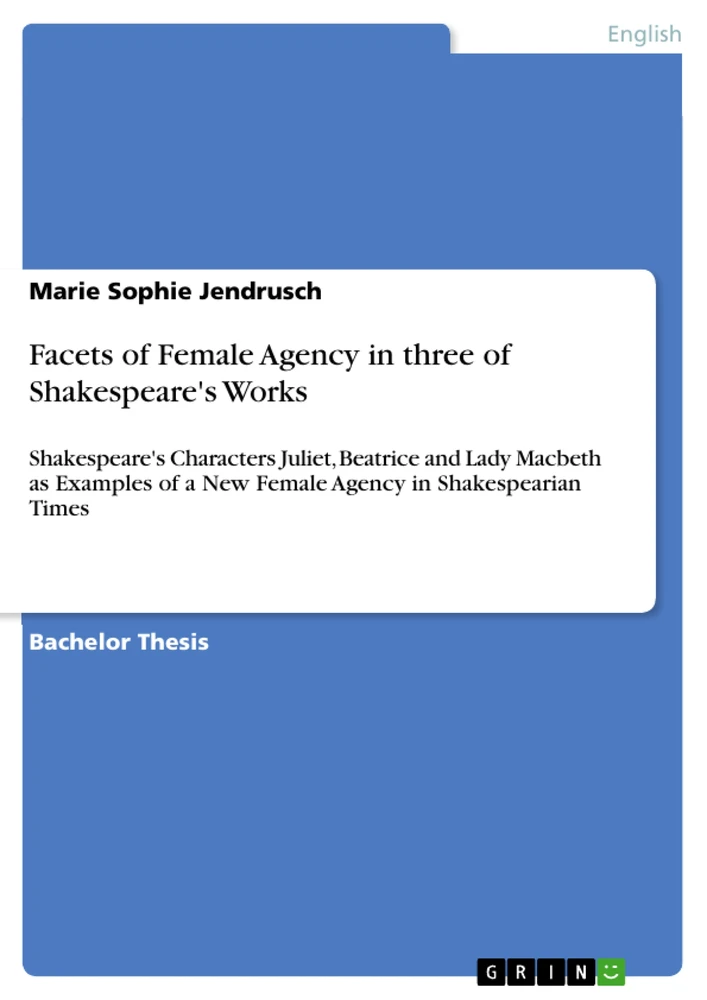
Table of Contents
1. Introduction
2. Active and Passive Gender Roles in Shakespearian Times
3. Romeo and Juliet – Loving Juliet
3.1 Act One – Agency in Mind
3.2 Act Two – Prompting the Plot
3.3 Act Three – Keeping Up Agency Despite All Burdens
3.4 Act Four – Acting Out the Plan
3.5 Act Five – Suicidal Agency
4. Much Ado About Nothing – Witty Beatrice
4.1 Act One – Agency in Eloquence
4.2 Act Two – Agency in Refusing to Act
4.3 Act Three – A Changing Course of Action
4.4 Act Four – Demanding Agency
4.5 Act Five – Silenced Agency
5. Macbeth – Strategic Lady Macbeth
5.1 Act One – Manipulative Agency
5.2 Act Two – Acting Out the Regicide
5.3 Act Three – Fading Agency
5.4 Act Five – The Loss of Agency
6. Comparing the Three Women
7. Conclusion
8. Bibliography
Research Objectives and Key Themes
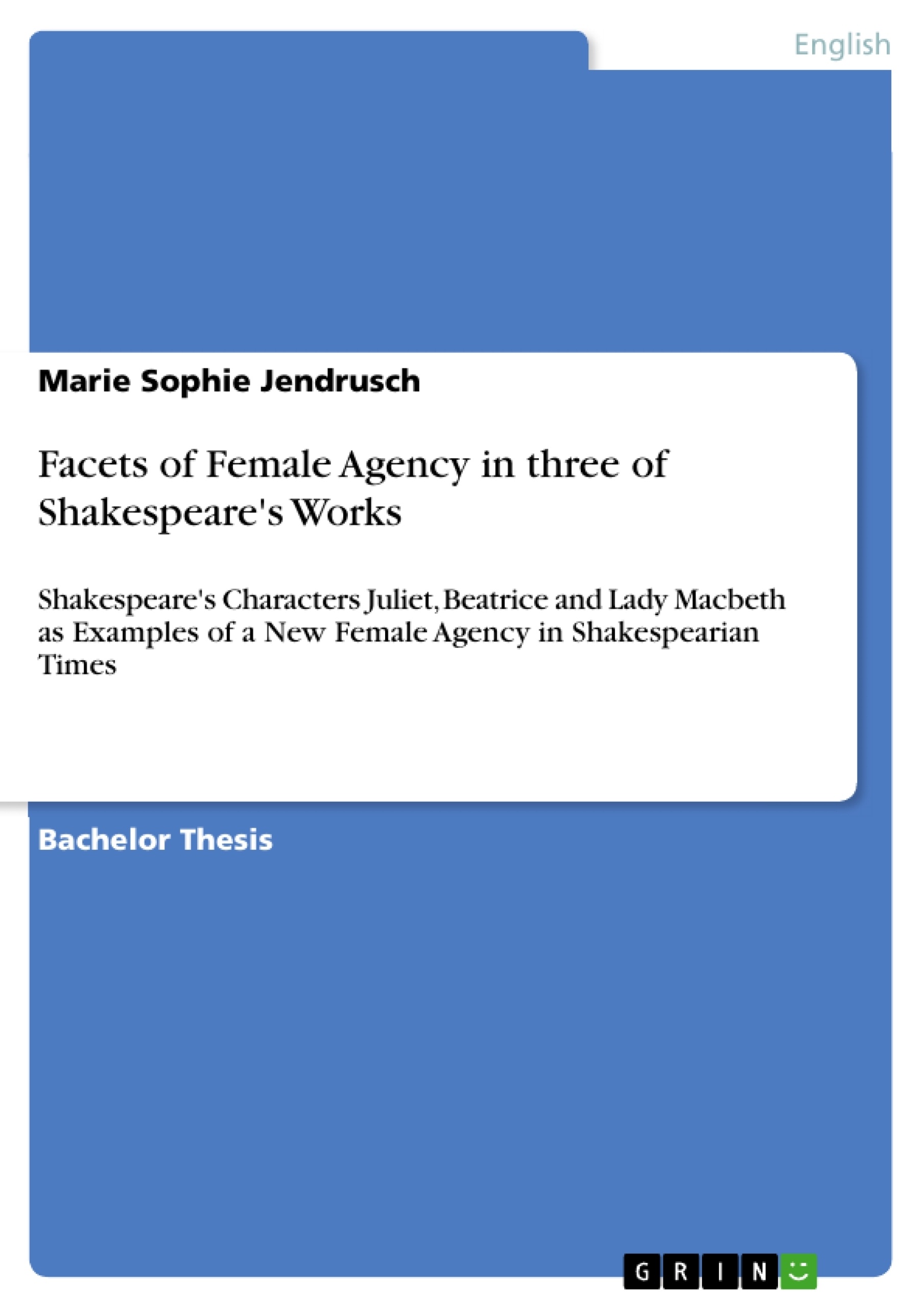
This thesis examines the concept of female agency in selected plays by William Shakespeare, specifically focusing on the characters of Juliet, Beatrice, and Lady Macbeth. It investigates how these women navigate the restrictive gender expectations of early modern England, challenging traditional stereotypes of passivity and submissiveness to exercise their own will, intelligence, and strategic influence within their respective narrative contexts.
- Analysis of typical gender roles in early modern England and the societal expectations regarding female behavior.
- Examination of character development and the expression of agency throughout the acts of the selected plays.
- Comparison of the characters' strategies to subvert patriarchal structures and assert their own desires.
- Evaluation of the limits of female agency in Shakespearian times, considering the ultimate destinies of the protagonists.
Excerpt from the Book
1. Introduction
"Submit yourselves unto your own husbands, as unto the Lord, for the husband is the wives [sic] head" (1559)
This is an extract from "[t]he Protestant marriage service in The book of common prayer of 1559" (Eales 1998, 24) and it shows how women are supposed to behave in Shakespearian times. By quoting The book of common prayer, Jacqueline Eales reveals obedience and passivity as the normal behaviour of a woman in early modern England. Nevertheless, Shakespeare gives his female characters lines like "I will not marry yet; and when I do, I swear | It shall be Romeo" (Weis (ed.) 2012, 279)1, "Lord, I could not endure a husband" (McEachern (ed.) 2016, 216)2 or "Hie thee hither, | That I may pour my spirits in thine ear" (Clark, Mason (ed.) 2015, 155)3. It is clear from this that Shakespeare ascribes an agency to the women in his plays that does not conform to the image of women of the period of time he lived in. "[T]he dramatist tells his audience that women can take on many different roles in society, not just the stereotypical roles that most people of Shakespeare's day expected of them." (Crawford 1997, 116). But how far can a Renaissance playwright go in granting agency to women? Are Shakespeare's female characters capable of pursuing their own happiness or standing up to a man? Are they able to commit a heinous crime, maybe murder? Shakespeare experiments with gender roles and ascribes to his female characters a cleverness and stamina, a wit and a cold-bloodedness that was contrary to what was expected of women in the normal daily life of that time.
Summary of Chapters
1. Introduction: Presents the central thesis regarding female agency in Shakespeare's works, contextualizing it within the socio-historical gender norms of early modern England.
2. Active and Passive Gender Roles in Shakespearian Times: Outlines the moral and social constraints placed upon women, highlighting the ideals of "chastity, silence, and obedience."
3. Romeo and Juliet – Loving Juliet: Examines Juliet's progression from a dutiful daughter to an autonomous agent who defies her family to claim her love.
4. Much Ado About Nothing – Witty Beatrice: Analyzes Beatrice's use of wit and eloquence as a tool to assert her intellectual superiority and resist traditional marriage expectations.
5. Macbeth – Strategic Lady Macbeth: Explores Lady Macbeth's exercise of power and strategic manipulation, illustrating her role as a driving force behind her husband's actions.
6. Comparing the Three Women: Synthesizes the findings to contrast the distinct manifestations of agency across the three female characters.
7. Conclusion: Summarizes the thesis findings, confirming that while Shakespeare grants his female characters unprecedented agency, he ultimately portrays the limitations imposed by the era.
8. Bibliography: Lists the academic sources used to support the analysis.
Keywords
Shakespeare, Female Agency, Early Modern England, Gender Roles, Juliet, Beatrice, Lady Macbeth, Subversion, Patriarchy, Chastity, Intelligence, Eloquence, Autonomy, Domesticity, Tragedy.
Frequently Asked Questions
What is the core focus of this bachelor thesis?
This thesis explores the theme of female agency in Shakespeare's plays, analyzing how Juliet in 'Romeo and Juliet', Beatrice in 'Much Ado About Nothing', and Lady Macbeth in 'Macbeth' defy contemporary gender expectations.
Which female characters are the primary subjects of study?
The study focuses on three distinct characters: Juliet, a young lover; Beatrice, a witty and assertive woman; and Lady Macbeth, a strategic and ambitious figure.
What is the primary research objective?
The goal is to determine how Shakespeare portrays female characters as having an active, non-traditional agency, and to evaluate the limits of this agency within early modern society.
What methodology is employed to analyze the characters?
The author uses a qualitative literary analysis, examining the characters' words, actions, and development within the chronological progression of their respective plays.
What topics are covered in the main section of the thesis?
The main text covers the socio-historical gender norms of the 16th and 17th centuries, followed by individual chapters detailing the specific struggles and triumphs of each character.
How would you describe the key characteristics of these female figures?
They are characterized by their cleverness, wit, strength of mind, and their refusal to remain strictly obedient or passive under patriarchal control.
How does Lady Macbeth challenge the domestic sphere in 'Macbeth'?
She challenges it by maneuvering her husband to commit regicide rather than focusing on household management, thereby taking on traditionally male-coded traits of power and ambition.
Does the thesis conclude that these women were successful in retaining their agency?
It concludes that while all three women demonstrate remarkable agency, they eventually face constraints—such as suicide, marriage, or insanity—imposed by the societal limits of the era.
Ende der Leseprobe aus 40 Seiten
- nach oben
- Arbeit zitieren
- Master of Education Marie Sophie Jendrusch (Autor:in), 2017, Facets of Female Agency in three of Shakespeare's Works, München, Page::Imprint:: GRINVerlagOHG, https://www.diplomarbeiten24.de/document/1236049

neugierig - aktuell - relevant
Entdecken Sie hilfreiche Tipps und Tricks rund ums Studium!

Entdecken Sie hilfreiche Tipps und Tricks rund ums Studium!
Ihre Hausarbeit / Abschlussarbeit:

- - Publikation als E-Book und Buch
- - Hohes Honorar auf die Verkäufe
- - Für Sie komplett kostenlos - mit ISBN
- - Es dauert nur 5 Minuten
- - Jede Arbeit findet Leser

- © GRIN Publishing GmbH.
- Alle Inhalte urheberrechtlich geschützt. Kopieren und verbreiten untersagt.
- info@grin.com
- AGB
- Open Publishing
Der GRIN Verlag hat sich seit 1998 auf die Veröffentlichung akademischer eBooks und Bücher spezialisiert. Der GRIN Verlag steht damit als erstes Unternehmen für User Generated Quality Content. Die Verlagsseiten GRIN.com, Hausarbeiten.de und Diplomarbeiten24 bieten für Hochschullehrer, Absolventen und Studenten die ideale Plattform, wissenschaftliche Texte wie Hausarbeiten, Referate, Bachelorarbeiten, Masterarbeiten, Diplomarbeiten, Dissertationen und wissenschaftliche Aufsätze einem breiten Publikum zu präsentieren.
Kostenfreie Veröffentlichung: Hausarbeit, Bachelorarbeit, Diplomarbeit, Dissertation, Masterarbeit, Interpretation oder Referat jetzt veröffentlichen!
Folgen Sie GRIN auf


- GRIN Verlag GmbH
-
- Nymphenburger Str. 86
- 80636
- Munich, Deutschland
- +49 89-550559-0
- +49 89-550559-10
- info@grin.com
-
