
präsentiert von

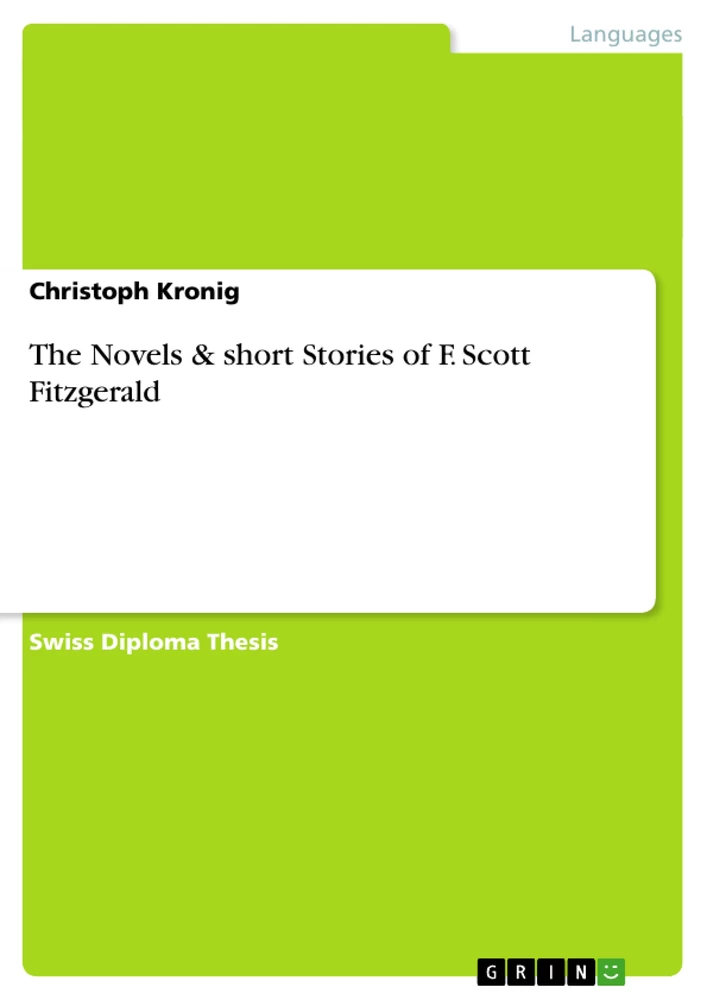
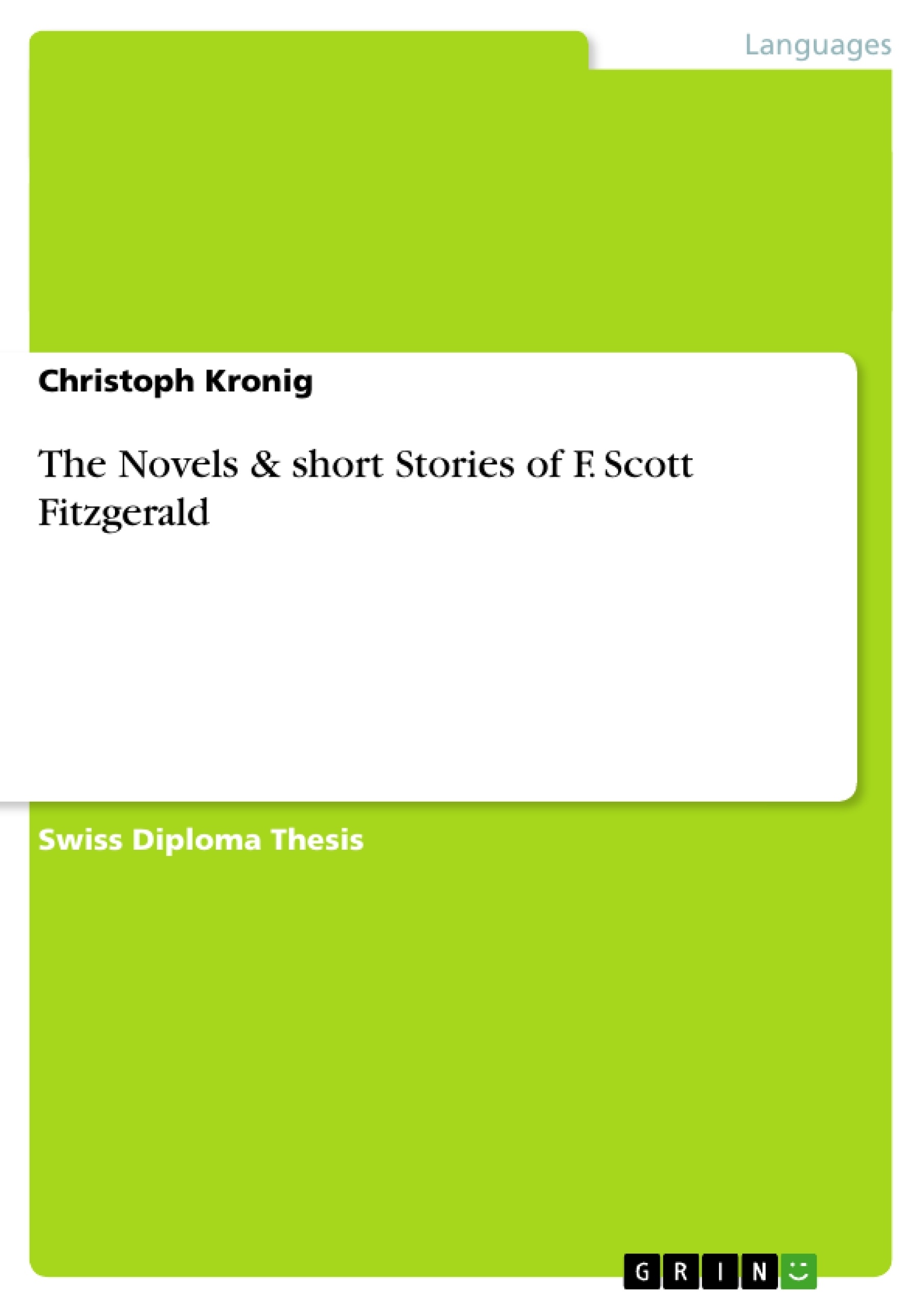
Table of Contents
1. “‘Go on talking,’ said the big man“
2. “Let’s not get to know anybody, but just stay together”
3. “So many smart men go to pieces nowadays”
4. “Hollywood: This is no art… - this is an industry”
5. Conclusions
Objectives & Core Themes
This work explores the recurring motifs of disillusionment, personal failure, and self-destruction within F. Scott Fitzgerald's novels and selected short stories, analyzing how these themes evolve alongside the author's changing prose style and narrative techniques.
- The role of illusions and the pursuit of false ideals in Fitzgerald's protagonists.
- The evolution of narrative techniques from the fragmented structures of early works to more controlled points of view.
- The impact of alcoholism and personal instability on the thematic depth of the author's later career.
- A comparative analysis of Fitzgerald's prose style across his novels and short fiction.
- The transition from the "romantic egotist" archetype to the more complex, workaholic figures in his later writing.
Excerpt from the Book
“‘Go on talking,’ said the big man. ‘I’ve been waiting to hear one of you fellows’”
In May 1916, F. Scott Fitzgerald sent the manuscript of his first novel to Charles Scribner’s Sons. The first title Fitzgerald gave to this novel was The Romantic Egotist. Scribner rejected the manuscript, claiming that it was poorly organised and lacked a conclusion. But they encouraged him to revise and resubmit the manuscript of what was later to become This Side of Paradise, a tremendously successful novel.
In 1918, Fitzgerald sent a hurriedly revised version of the novel, which he was still calling The Romantic Egotist, back to Scribner’s. He had not taken the trouble to work over it carefully, because he was convinced that he was going to die in the war. The manuscript was again rejected. Nevertheless, Fitzgerald decided to completely rewrite the story of The Romantic Egotist, after being discharged from the army in 1919. He shortened the original manuscript considerably and reorganised the whole novel, which had now acquired the working title The Education of a Personage.
In July 1919, he wrote to Maxwell Perkins, a Scribner’s editor who believed in Fitzgerald’s literary talent, that the new draft was “in no sense a revision of the ill-fated Romantic Egotist” (L 155), although he admitted that it contained much material from the rejected manuscript (L 156). What made the new draft so much better in the eyes of his publisher, who finally accepted the novel and published it as This Side of Paradise in March 1920, was the sum of Fitzgerald’s many, this time careful, revisions.
Chapter Summaries
1. “‘Go on talking,’ said the big man“: This chapter covers the developmental history of Fitzgerald's first novel, This Side of Paradise, tracing its evolution from initial rejection to its eventual success as a defining work of his career.
2. “Let’s not get to know anybody, but just stay together”: This section focuses on The Great Gatsby, examining the novel's complex structure, the controlled narrative perspective of Nick Carraway, and the tragic disillusionment of the protagonist.
3. “So many smart men go to pieces nowadays”: This chapter analyzes the theme of self-destruction through alcohol and failed relationships, specifically linking the author's personal life to the narrative arcs in Tender Is the Night and “An Alcoholic Case”.
4. “Hollywood: This is no art… - this is an industry”: This part explores the later period of Fitzgerald's life, focusing on his conflicted relationship with the Hollywood film industry and the creation of the Pat Hobby stories and The Last Tycoon.
5. Conclusions: This concluding chapter synthesizes Fitzgerald's literary career, emphasizing his dual legacy as an excellent novelist and writer of short stories, while summarizing the recurring cycle of hope and failure in his protagonists.
Keywords
F. Scott Fitzgerald, Disillusionment, Self-destruction, This Side of Paradise, The Great Gatsby, Tender Is the Night, The Last Tycoon, Narrative Technique, Alcoholism, American Dream, Prose Style, Hollywood, Pat Hobby, Idealism, Protagonist.
Frequently Asked Questions
What is the primary focus of this work?
The work provides a comprehensive thematic analysis of F. Scott Fitzgerald's literary output, tracking how his novels and short stories reflect his personal evolution and views on the American experience.
Which thematic fields are central to the study?
The study centers on themes of disillusionment, the failure of the American dream, the destructive nature of social hierarchies, and the persistent internal struggle of the individual against external expectations.
What is the core research question?
The research examines how Fitzgerald’s stylistic development mirrors the psychological trajectory of his characters, particularly their movement from youthful idealism to inevitable, often alcohol-fueled, self-destruction.
Which scientific methodology is applied?
The author employs a literary-analytical method, conducting a close reading of Fitzgerald's major novels alongside his short stories to identify recurring motifs and structural patterns.
What does the main body of the work cover?
The main body is structured chronologically, starting with the genesis of his first novel, moving through the stylistic breakthroughs of his middle career, and ending with his late-career work in Hollywood.
Which keywords define this academic work?
Key terms include literary disillusionment, narrative structure, Fitzgerald's prose style, biographical influence on fiction, and the evolution of the "tragic hero" across his body of work.
How does the author characterize the role of the narrator in The Great Gatsby?
The author identifies Nick Carraway as an impartial, half-involved first-person narrator, whose distance allows for the gradual, mystery-driven revelation of Gatsby's true character.
What does the work conclude regarding Fitzgerald’s revision process?
The work notes that Fitzgerald was a painstaking reviser, often struggling with his own manuscripts and correspondence, which sometimes resulted in complex or unfinished literary projects.
How is the "Pat Hobby" character portrayed?
Pat Hobby is depicted as a tragicomic, cynical, and ultimately self-destructive figure who represents the moral corruption of the Hollywood industry and the professional decline of a once-successful writer.
Ende der Leseprobe aus 80 Seiten
- nach oben
- Arbeit zitieren
- lic. phil. I Christoph Kronig (Autor:in), 2004, The Novels & short Stories of F. Scott Fitzgerald, München, Page::Imprint:: GRINVerlagOHG, https://www.diplomarbeiten24.de/document/124162

neugierig - aktuell - relevant
Entdecken Sie hilfreiche Tipps und Tricks rund ums Studium!

Entdecken Sie hilfreiche Tipps und Tricks rund ums Studium!
Ihre Hausarbeit / Abschlussarbeit:

- - Publikation als E-Book und Buch
- - Hohes Honorar auf die Verkäufe
- - Für Sie komplett kostenlos - mit ISBN
- - Es dauert nur 5 Minuten
- - Jede Arbeit findet Leser

- © GRIN Publishing GmbH.
- Alle Inhalte urheberrechtlich geschützt. Kopieren und verbreiten untersagt.
- info@grin.com
- AGB
- Open Publishing
Der GRIN Verlag hat sich seit 1998 auf die Veröffentlichung akademischer eBooks und Bücher spezialisiert. Der GRIN Verlag steht damit als erstes Unternehmen für User Generated Quality Content. Die Verlagsseiten GRIN.com, Hausarbeiten.de und Diplomarbeiten24 bieten für Hochschullehrer, Absolventen und Studenten die ideale Plattform, wissenschaftliche Texte wie Hausarbeiten, Referate, Bachelorarbeiten, Masterarbeiten, Diplomarbeiten, Dissertationen und wissenschaftliche Aufsätze einem breiten Publikum zu präsentieren.
Kostenfreie Veröffentlichung: Hausarbeit, Bachelorarbeit, Diplomarbeit, Dissertation, Masterarbeit, Interpretation oder Referat jetzt veröffentlichen!
Folgen Sie GRIN auf


- GRIN Verlag GmbH
-
- Nymphenburger Str. 86
- 80636
- Munich, Deutschland
- +49 89-550559-0
- +49 89-550559-10
- info@grin.com
-
