
präsentiert von

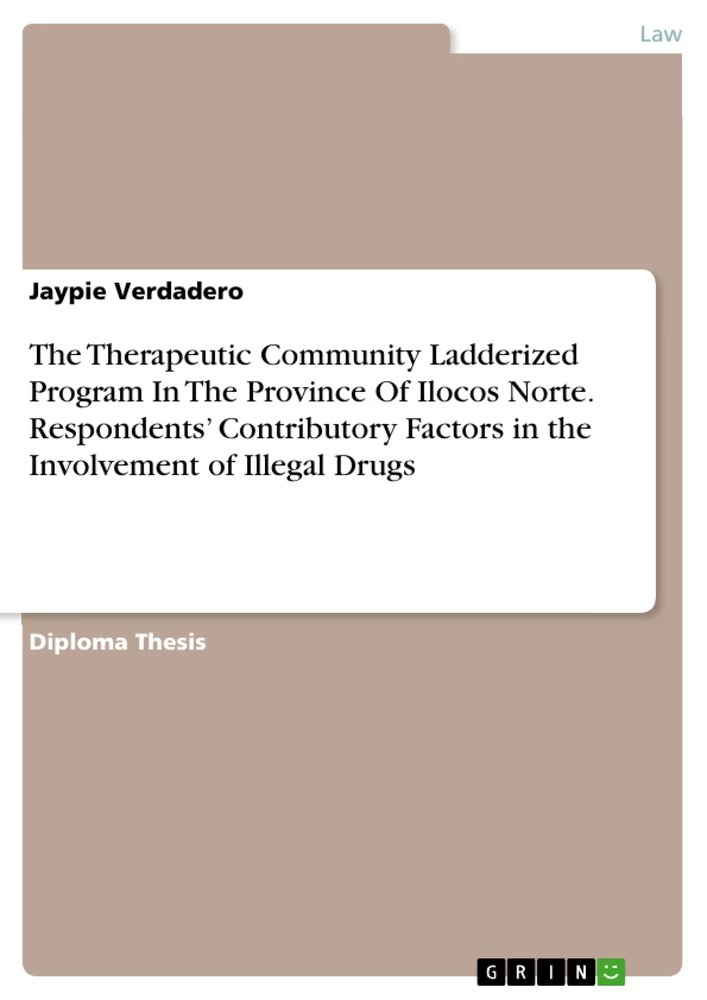
Table of Contents
CHAPTER I
THE PROBLEM
CHAPTER II
PRESENTATION, ANALYSIS AND INTERPRETATION OF DATA
CHAPTER III
SUMMARY, FINDINGS, CONCLUSIONS AND RECOMMENDATIONS
Research Goal and Themes
The primary goal of this study is to assess the implementation of the Therapeutic Community Ladderized Program (TCLP) for drug clients handled by the Ilocos Norte and Laoag City Probation and Parole Offices, while identifying the contributing factors behind their drug involvement and any programmatic challenges they encounter.
- Demographic profiling of probationers and petitioners.
- Evaluation of influential factors leading to illegal drug involvement.
- Assessment of the extent of implementation of TCLP modules.
- Identification of difficulties encountered by clients during the program.
- Development of an action plan to enhance the effectiveness of the rehabilitation program.
Excerpt from the Book
Therapeutic Community Ladderized Program
The Therapeutic Community (TC) is an environment that helps people get help while helping others. It is a treatment environment: the interactions of its members are designed to be therapeutic within the context of the norms that require for each to play the dual role of client-therapist. At a given moment, one may be in a client role when receiving help or support from others because of a problem behavior or when experiencing distress. At another time, the same person assumes a therapist role when assisting or supporting another person in trouble.
The operation of the community itself is the task of the residents, working under staff supervision. Work assignments, called “job functions” are arranged in a hierarchy, according to seniority, individual progress and productivity. These include conducting all house services, such as cooking, cleaning, kitchen service, minor repair, serving as apprentices and running all departments, conducting meetings and peer encounter groups.
The TC operates in a similar fashion to a functional family with a hierarchical structure of older and younger members. Each member has a defined role and responsibilities for sustaining the proper functioning of the TC. There are sets of rules and community norms that members upon entry commit to live by and uphold.
Summary of Chapters
CHAPTER I: This chapter introduces the study, covering the historical background of probation law in the Philippines, the definition and objectives of the Therapeutic Community Ladderized Program (TCLP), and the statement of the research problem.
CHAPTER II: This chapter covers the presentation, analysis, and interpretation of the collected data, specifically addressing the respondents' profiles, contributory factors to drug use, implementation levels of the program, and challenges encountered.
CHAPTER III: This chapter provides a summary of the research findings, offers logical conclusions drawn from the data, and presents recommendations for improving the implementation of the TCLP.
Keywords
Therapeutic Community Ladderized Program, Probationers, Parole and Probation Administration, Rehabilitation, Drug Abuse, Contributory Factors, Relational Management, Cognitive Management, Action Plan, Community Corrections, Treatment Modality, Behavioral Change, Offender Reformation, Criminal Justice, Ilocos Norte
Frequently Asked Questions
What is the core focus of this research?
The research primarily evaluates the implementation of the Therapeutic Community Ladderized Program (TCLP) specifically for drug clients within the Parole and Probation Offices in Ilocos Norte and Laoag City.
What are the identified pillars influencing drug involvement?
The study examines five key domains: Family factors, School influences, Community environment, Psychological factors, and Sociological pressures.
What is the central research objective?
The objective is to determine the contributory factors to illegal drug involvement and assess the effectiveness of the TCLP implementation to better guide the rehabilitation of drug-dependent probationers.
Which research methodology was utilized?
The study employed a descriptive research method using questionnaire checklists and informal interviews to gather data from 101 respondents.
What does the main body of the work cover?
The main body presents a detailed analysis of the demographic profiles of respondents, the statistical evaluation of program implementation effectiveness, and a thorough breakdown of problems encountered by probationers across various modules of the TCLP.
Which keywords define this document?
Key terms include Therapeutic Community Ladderized Program, Probationers, drug rehabilitation, criminal justice, and offender reform.
How does the TCLP differ from standard incarceration?
Unlike traditional imprisonment, the TCLP uses a peer-led, family-like community structure to foster individual responsibility and behavioral modification in a non-custodial setting.
What is the significance of the "Ladderized" approach?
The "ladderized" approach implements the rehabilitation process in progressive phases (I to IV), providing successful milestones that help clients reintegrate into society as productive, drug-free individuals.
Are there issues with personnel capacity in the studied offices?
Yes, the study notes that the local offices are significantly undermanned, with high caseloads (ratios around 1:83 to 1:100), which presents challenges to the intensive implementation of the TC model.
What is the primary output of the study?
The study proposes a structured action plan designed to address the specific problems encountered by probationers and to enhance the quality and delivery of the rehabilitation program by the local offices.
Ende der Leseprobe aus 110 Seiten
- nach oben
- Arbeit zitieren
- Jaypie Verdadero (Autor:in), 2020, The Therapeutic Community Ladderized Program In The Province Of Ilocos Norte. Respondents’ Contributory Factors in the Involvement of Illegal Drugs, München, Page::Imprint:: GRINVerlagOHG, https://www.diplomarbeiten24.de/document/1245068

neugierig - aktuell - relevant
Entdecken Sie hilfreiche Tipps und Tricks rund ums Studium!

Entdecken Sie hilfreiche Tipps und Tricks rund ums Studium!
Ihre Hausarbeit / Abschlussarbeit:

- - Publikation als E-Book und Buch
- - Hohes Honorar auf die Verkäufe
- - Für Sie komplett kostenlos - mit ISBN
- - Es dauert nur 5 Minuten
- - Jede Arbeit findet Leser

- © GRIN Publishing GmbH.
- Alle Inhalte urheberrechtlich geschützt. Kopieren und verbreiten untersagt.
- info@grin.com
- AGB
- Open Publishing
Der GRIN Verlag hat sich seit 1998 auf die Veröffentlichung akademischer eBooks und Bücher spezialisiert. Der GRIN Verlag steht damit als erstes Unternehmen für User Generated Quality Content. Die Verlagsseiten GRIN.com, Hausarbeiten.de und Diplomarbeiten24 bieten für Hochschullehrer, Absolventen und Studenten die ideale Plattform, wissenschaftliche Texte wie Hausarbeiten, Referate, Bachelorarbeiten, Masterarbeiten, Diplomarbeiten, Dissertationen und wissenschaftliche Aufsätze einem breiten Publikum zu präsentieren.
Kostenfreie Veröffentlichung: Hausarbeit, Bachelorarbeit, Diplomarbeit, Dissertation, Masterarbeit, Interpretation oder Referat jetzt veröffentlichen!
Folgen Sie GRIN auf


- GRIN Verlag GmbH
-
- Nymphenburger Str. 86
- 80636
- Munich, Deutschland
- +49 89-550559-0
- +49 89-550559-10
- info@grin.com
-
