
präsentiert von

Contents
1. Introduction
1.1. Background of the study
1.2. Statement of the Problem
1.3. Research questions
1.4. Objective of the study
1.4.1. General objective
1.4.2. Specific objectives of the study
1.5. Scope of the study
1.6. Significance of the study
1.7. Limitation of the study
1.8. Operational definition of terms
1.9. Organization of the Paper
2. Literature review
2.1. Conceptual review
2.1.1. What is Organization?
2.1.2. Intelligence organizations
2.1.3. What is culture?
2.1.4. The concept of organizational culture
2.1.5. Organizational Culture and organizational Commitment
2.1.6. Organizational Culture and Job satisfaction
2.1.7. Organizational Culture and Innovation
2.1.8. Organizational Culture and employee turnover
2.1.9. Organizational Performance
2.2. Theoretical review and models of organizational culture
2.2.1. Components of organizational factor
2.2.2. Types of Organizational Culture
2.2.3. Hofstede’s organizational culture dimensions
2.2.4. Denison’s Organizational Culture Model
2.3. Empirical review
2.3.1. Organizational culture (O.C) and organizational performance (O.P)
2.3.2. Organizational culture (O.C) in intelligence organizations (I.O)
2.3.3. Related studies in Ethiopia
2.4. Methodological review
2.5. Conceptual frame work of the study
3. Research methodology
3.1 Description of the study area/the organization
3.1.1. Vision
3.1.2. Mission
3.1.3. Strategic Values
3.1.4. Organizational structure
3.2. Research design and approach
3.3. Target population
3.4. Sampling
3.4.1. Sampling size
3.4.2. The sampling technique/procedure
3.5. Types and sources of data
3.6. Data collection tools/instruments
3.7. Data analysis and presentations
3.8. Inclusion and exclusion criteria
3.8.1 Inclusion criteria
3.8.2. Exclusion criteria
3.9. Validity and reliability
3.10. Ethical considerations
3.11. Budget/cost breakdown of the study
4. Findings and discussions
4.1. General Demographic Background of the Study
4.2. Dominant Organizational Culture of the Agency
4.2.1 Dominant Characteristics of the Agency
4.2.2 Organizational Leadership
4.2.3 Management of Employee
4.2.4. Organizational glue
4.2.5. Strategic emphasis of the organization
4.2.6. Organizational criteria of success
4.3. Descriptive analysis of organizational culture traits in INSA
4.4. Organizational culture and factors of organizational performance
4.4.1. The organizational culture and employee satisfaction
4.4.2. Organizational culture and innovation
4.4.3. Organizational culture and motivation
4.4.4. Organizational culture and organizational commitment
4.4.5. Organizational culture and Employee turnover
4.5. Organizational culture and organizational performance
4.5.1. Organizational goal
4.5.2. Employee performance
4.5.3. Organizational reputation and customer satisfaction
4.5.4. Financial performance
4.5.5. Quality of products
4.6. Summary and discussions on major findings
4.7. Alignment of Findings of this Research with Previous Studies
5. Conclusion and recommendation
5.1. Conclusion
5.2. Recommendations
5.3. Suggestions for Future Studies
Objectives and Research Themes
The primary objective of this study is to assess the organizational culture and its impact on the organizational performance of the Information Network Security Administration (INSA) in Ethiopia, aiming to identify the dominant cultural type and prevalence of cultural traits within this specific intelligence sector environment.
- Identification of the dominant organizational culture type within INSA.
- Assessment of the prevalence of various organizational cultural traits (involvement, consistency, adaptability, mission).
- Evaluation of the influence of organizational culture on key performance factors like employee commitment, satisfaction, turnover, and innovation.
- Comparative analysis of how current organizational culture relates to the agency's performance outcomes, including financial and reputational success.
Book Excerpt
1.1. Background of the study
Culture as a concept is used to denote different meanings in different disciplines, and due to its complexity, it is not easy to define. There have been many attempts in different disciplines, such as anthropology, sociology, and business to define the organizational culture (O.C). For example, from the anthropologists’ perspective it represents the customs and rituals developed by societies (Schein, 2011). Culture can be manifested and developed in different societal settings. Organizations of different purpose and type develop specific culture of their own in which members behave and operate within (Robbins & Judge, 2013). According to Cameron and Quinn (1999), O.P is defined as an enduring set of the core values, assumptions, interpretations and approaches that characterize organizations and their members. It denotes a wide range of social phenomena, including an organization’s customary dress, language, behavior, beliefs, values, assumptions, symbols of status and authority, myths, ceremonies and rituals, and modes of deference and subversion; all of which help to define an organization’s character and norms (Scott Mannion Davies and Marshall 2003)
Organizational performance (O.P) according to Cho and Dansereau (2010) as cited by Bashear et al (2016) refers to the performance of a company as compared to its goals and objectives. In addition, Tomaland Jones (2015) on the other hand defined organizational performance as the actual results or output of an organization as measured against that organization’s intended outputs. Alemegenet Hailu (2020) stated that “Performance is a set of behaviors that are relevant to the objectives of the organization or organizational unit where people work”. Alemegenet elaborated the concept of performance as a result of the quality and quantity of work achieved by the staff member in performing his or her duties in accordance with the responsibilities assigned.
Summary of Chapters
1. Introduction: This chapter introduces the research topic, context, and research questions regarding organizational culture in intelligence organizations.
2. Literature review: This chapter provides a conceptual and theoretical overview of organizational culture models and reviews previous empirical studies in the field.
3. Research methodology: This chapter details the mixed-methods approach, sampling techniques, and data collection tools utilized by the researcher at INSA.
4. Findings and discussions: This chapter presents the empirical results, analyzing the dominant culture traits and their impact on organizational performance factors.
5. Conclusion and recommendation: This final chapter synthesizes the main research findings and suggests practical recommendations for the agency and future researchers.
Keywords
Organizational culture, organizational performance, adhocracy culture, INSA, intelligence organizations, involvement trait, employee turnover, job satisfaction, Denison model, OCAI, Ethiopian security sector, performance parameters, organizational commitment, leadership style, strategic emphasis.
Frequently Asked Questions
What is the core focus of this research?
The research primarily examines the relationship between organizational culture and organizational performance within the Information Network Security Administration (INSA) in Ethiopia.
Which theoretical frameworks are applied?
The study utilizes the Denison organizational culture model for cultural traits and the Organizational Culture Assessment Instrument (OCAI) by Cameron and Quinn to identify the dominant cultural type.
What is the primary objective of this work?
The core objective is to identify the dominant organizational culture at INSA and measure its influence on specific organizational performance factors.
What research methodology was employed?
The author utilized a mixed-methods approach, relying primarily on survey-based quantitative data collected via questionnaires from 306 respondents, complemented by qualitative interview insights.
What does the main body of the work cover?
It covers the conceptual review of organizational culture in intelligence sectors, the methodology for assessment, detailed data analysis of survey results, and a discussion on how different culture types affect employee performance and commitment.
Which keywords define the scope of the paper?
Key terms include organizational culture, adhocracy, INSA, organizational performance, and employee turnover, among others.
How does INSA's culture influence its turnover rate?
The findings indicate that perceived flaws in organizational culture are significantly correlated with higher employee turnover, which is described as a critical factor negatively impacting the agency's overall performance.
What is the dominant culture type found at INSA?
The study concludes that "adhocracy culture" is the dominant organizational culture type at INSA, characterized by dynamic, entrepreneurial, and innovative working environments.
How is the agency performing in terms of its goals?
While the agency is rated highly for its external reputation and customer satisfaction, it faces significant challenges and lower performance ratings regarding financial management and resource allocation.
Ende der Leseprobe aus 89 Seiten
- nach oben
- Arbeit zitieren
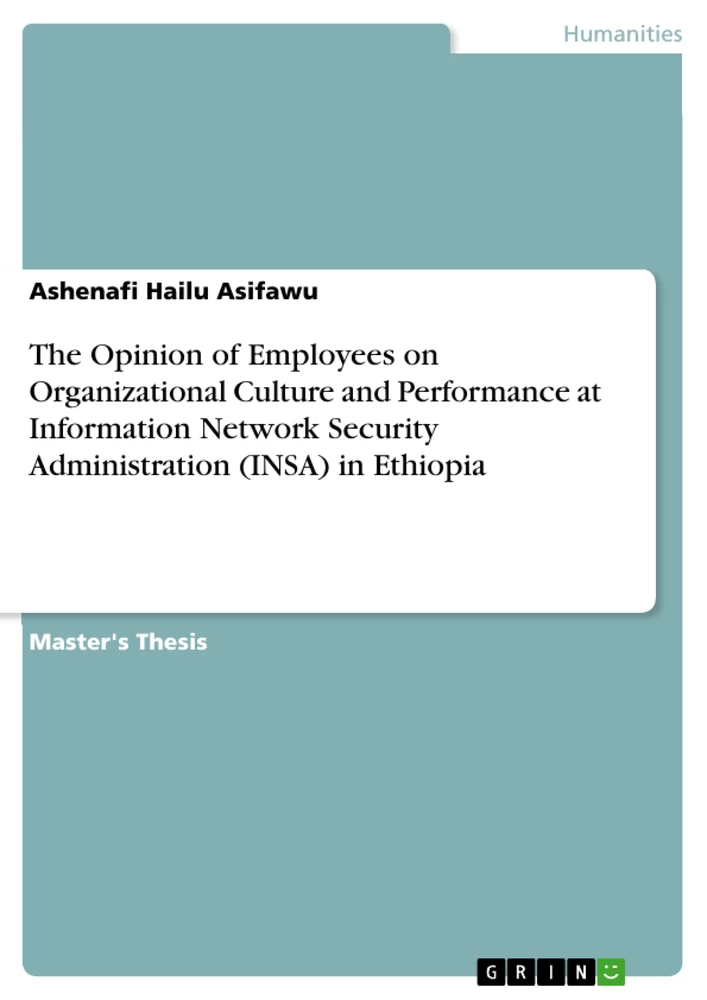
- Ashenafi Hailu Asifawu (Autor:in), 2020, The Opinion of Employees on Organizational Culture and Performance at Information Network Security Administration (INSA) in Ethiopia, München, Page::Imprint:: GRINVerlagOHG, https://www.diplomarbeiten24.de/document/1245771

neugierig - aktuell - relevant
Entdecken Sie hilfreiche Tipps und Tricks rund ums Studium!

Entdecken Sie hilfreiche Tipps und Tricks rund ums Studium!
Ihre Hausarbeit / Abschlussarbeit:

- - Publikation als E-Book und Buch
- - Hohes Honorar auf die Verkäufe
- - Für Sie komplett kostenlos - mit ISBN
- - Es dauert nur 5 Minuten
- - Jede Arbeit findet Leser

- © GRIN Publishing GmbH.
- Alle Inhalte urheberrechtlich geschützt. Kopieren und verbreiten untersagt.
- info@grin.com
- AGB
- Open Publishing
Der GRIN Verlag hat sich seit 1998 auf die Veröffentlichung akademischer eBooks und Bücher spezialisiert. Der GRIN Verlag steht damit als erstes Unternehmen für User Generated Quality Content. Die Verlagsseiten GRIN.com, Hausarbeiten.de und Diplomarbeiten24 bieten für Hochschullehrer, Absolventen und Studenten die ideale Plattform, wissenschaftliche Texte wie Hausarbeiten, Referate, Bachelorarbeiten, Masterarbeiten, Diplomarbeiten, Dissertationen und wissenschaftliche Aufsätze einem breiten Publikum zu präsentieren.
Kostenfreie Veröffentlichung: Hausarbeit, Bachelorarbeit, Diplomarbeit, Dissertation, Masterarbeit, Interpretation oder Referat jetzt veröffentlichen!
Folgen Sie GRIN auf


- GRIN Verlag GmbH
-
- Nymphenburger Str. 86
- 80636
- Munich, Deutschland
- +49 89-550559-0
- +49 89-550559-10
- info@grin.com
-
