
präsentiert von

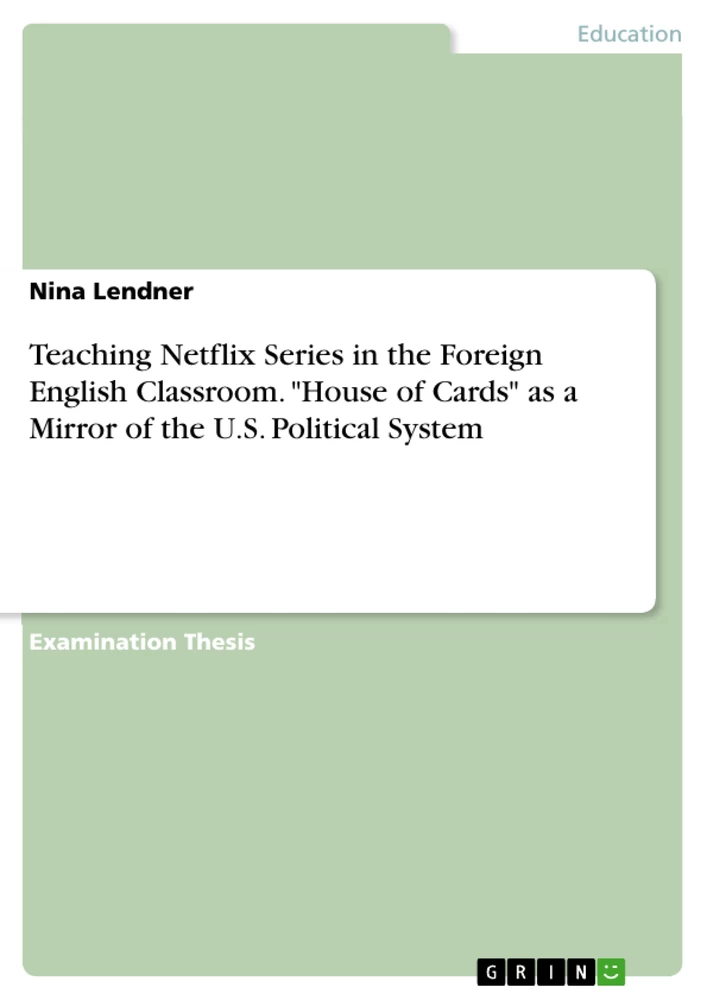
Table of Contents
1. Introduction
2. Film Education in Teaching English as a Foreign Language
2.1 The History of Film Based Language Learning in the TEFL Classroom
2.2 Film Based Language Learning with its Didactic Value in the TEFL Classroom
2.2.1 Development of Communicative Competences
2.2.2 Intercultural Learning
2.3 The Didactic Value of Audio-Visual Media in the TEFL Classroom
2.4 Practical Facets in Teaching Audio-Visual Media - Criteria for Film Selection
3. The Impact of Film Literacy in Teaching English as a Foreign Language
3.1 Lütge’s Four Dimensions of Approaches on Film Education
3.1.1 Motivational Affective Dimension
3.1.2 Language Learning and Competence Development Dimension
3.1.3 Aesthetic and Formal Dimension
3.1.4 Intercultural Dimension of Language Learning
3.1.5 Cognitive Approach by Wharton and Grant
3.2 The Consideration of Different Didactic Approaches on Film Based Language Learning
4. The Didactic Value of the Netflix Series House of Cards - Using House of Cards as a Case Study in the ELT Classroom
4.1 Students’ and Instruction Setting
4.2 Lesson One - What Do We Really Know About Politics in the U.S.? An Introduction
4.3 Lesson Two and Three - The Political System of the United States
4.4 Lesson Four - The Road to the White House
4.5 Lesson Five - America’s Gun Culture
4.6 Lesson Six - Film Analysis and Introduction of the Case Study - House of Cards as a Mirror of the U.S. political system
4.7 Lesson Seven to Eleven - Case Study
4.8 Lesson Twelve and Thirteen - Evaluations and Presentation of the Case Study
4.9 Lesson Fourteen - Excursus: Bush vs. Kerry - Different Views on the Iraq War
5. Conclusion
Objectives and Topics
This thesis examines the pedagogical application of the Netflix series "House of Cards" as a tool for teaching the U.S. political system in a 12th-grade EFL setting. It aims to demonstrate how students can enhance their film and media literacy by engaging with complex, authentic audiovisual content, thereby bridging theoretical analysis with practical political understanding.
- Theoretical foundations of film education and film literacy in TEFL.
- Didactic analysis of "House of Cards" in terms of its value as a case study.
- Lesson planning concepts for the American political system, gun culture, and presidential elections.
- The integration of Learner-Centered and Action-Oriented methods, such as "Learning by Teaching" (LdL).
Excerpt from the Book
1. Introduction
A film is not only the key medium of the 21st century it is also a form of art which possesses its own aesthetics, iconography and language (Krüger 8). Children and teenagers can experience the cultural values of Western societies, which play an important role in identity and social processes during their epitaxy. Popular films and TV series implement the idea of popular culture and operate as a guideline for young people when it comes to role models.
Popular culture is always defined in contrast to other conceptual categories, such as folk culture, mass culture as well as dominant culture. This form of culture can generally be said to denote culture that is well-linked by many people and, thus, happens to be popular. Another conception denotes popular culture as opposed to high culture and, thus, popular culture emerged following industrialization and urbanization and has a place in the capitalist market economy (Hebel and Moreth-Hebel 189ff). Further, cultural implemented audio-visual aids show the zeitgeist of a generation and shape views and attitudes towards the world’s existence. The way of teaching and learning in a foreign language classroom is constantly changing and the adaption of methods process dynamically due to the different needs of learners. In a modern and learner-centered environment the use of audio-visual aids in a foreign English classroom is almost indispensable according to the importance of films and series.
Summary of Chapters
1. Introduction: This chapter highlights the contemporary importance of film as a medium in the foreign language classroom and outlines the educational goals regarding film literacy.
2. Film Education in Teaching English as a Foreign Language: This section provides the historical and theoretical context of using film and audiovisual media for didactic purposes in the TEFL classroom.
3. The Impact of Film Literacy in Teaching English as a Foreign Language: This chapter categorizes approaches to film education, specifically examining Lütge’s four dimensions and Wharton and Grant’s cognitive approach.
4. The Didactic Value of the Netflix Series House of Cards - Using House of Cards as a Case Study in the ELT Classroom: This practical component details a comprehensive lesson concept for an A-level class, covering the American political system, gun culture, and a detailed analysis of the series.
5. Conclusion: The summary reflects on the successful integration of theory and practice for using "House of Cards," confirming its pedagogical potential for fostering critical media consumption and historical understanding.
Keywords
TEFL, Film Literacy, Audiovisual Media, House of Cards, U.S. Political System, Didactic Value, Intercultural Learning, Media Literacy, Learner-Centered Instruction, Learning by Teaching (LdL), Second Amendment, Gun Culture, Film Analysis, Case Study, Educational Standards.
Frequently Asked Questions
What is the primary focus of this thesis?
The thesis explores the integration of the Netflix series "House of Cards" into the English as a Foreign Language (EFL) classroom to teach students about the U.S. political system, media literacy, and cultural norms.
What are the core topics covered?
Key areas include the theoretical framework of film education, the communicative and intercultural benefits of audiovisual media, specific lessons on the U.S. political system, gun culture, and the implementation of student-led "Learning by Teaching" methods.
What is the primary pedagogical goal?
The primary aim is to foster film and media literacy, allowing students to analyze authentic political content critically rather than relying solely on traditional literary texts.
Which scientific methods are employed?
The work utilizes theoretical approaches to film education (Lütge, Thaler) and connects them to actionable lesson plans using modern teaching formats such as think-pair-share, group work, and debate-based role plays.
What does the main part address?
The main part provides a complete 14-lesson concept, including detailed objectives, methodology, and teaching materials for an A-level (gymnasiale Oberstufe) class.
Which keywords characterize this work?
Essential terms include TEFL, Film Literacy, "House of Cards," U.S. Political Culture, Didactic Value, Intercultural Learning, and Media Competence.
How does the work handle the complexity of the series?
The thesis suggests using "cutouts" and specific segments of the series, supported by explicit film analysis tools, to avoid overloading learners and to maintain focus on the intended curriculum.
How is the "Learning by Teaching" (LdL) method integrated?
Students are organized in groups to independently explore individual chapters of the series, create presentations, and develop learning materials, which deepens their personal engagement and responsibility for the learning outcome.
What role does the "Fourth Wall" play in the educational analysis?
The thesis examines breaking the "fourth wall" as a unique theatrical and cinematic device that connects viewers (students) directly to the protagonist, making them "partners in crime" and facilitating a critical analysis of political manipulation.
How is the Iraq War excursus justified?
It is included as a final lesson to allow students to apply their developed argumentative and linguistic skills in a pro-con debate, effectively practicing the oral requirements of their final examination (Abitur).
Ende der Leseprobe aus 96 Seiten
- nach oben
- Arbeit zitieren
- Nina Lendner (Autor:in), 2021, Teaching Netflix Series in the Foreign English Classroom. "House of Cards" as a Mirror of the U.S. Political System, München, Page::Imprint:: GRINVerlagOHG, https://www.diplomarbeiten24.de/document/1262965

neugierig - aktuell - relevant
Entdecken Sie hilfreiche Tipps und Tricks rund ums Studium!

Entdecken Sie hilfreiche Tipps und Tricks rund ums Studium!
Ihre Hausarbeit / Abschlussarbeit:

- - Publikation als E-Book und Buch
- - Hohes Honorar auf die Verkäufe
- - Für Sie komplett kostenlos - mit ISBN
- - Es dauert nur 5 Minuten
- - Jede Arbeit findet Leser

- © GRIN Publishing GmbH.
- Alle Inhalte urheberrechtlich geschützt. Kopieren und verbreiten untersagt.
- info@grin.com
- AGB
- Open Publishing
Der GRIN Verlag hat sich seit 1998 auf die Veröffentlichung akademischer eBooks und Bücher spezialisiert. Der GRIN Verlag steht damit als erstes Unternehmen für User Generated Quality Content. Die Verlagsseiten GRIN.com, Hausarbeiten.de und Diplomarbeiten24 bieten für Hochschullehrer, Absolventen und Studenten die ideale Plattform, wissenschaftliche Texte wie Hausarbeiten, Referate, Bachelorarbeiten, Masterarbeiten, Diplomarbeiten, Dissertationen und wissenschaftliche Aufsätze einem breiten Publikum zu präsentieren.
Kostenfreie Veröffentlichung: Hausarbeit, Bachelorarbeit, Diplomarbeit, Dissertation, Masterarbeit, Interpretation oder Referat jetzt veröffentlichen!
Folgen Sie GRIN auf


- GRIN Verlag GmbH
-
- Nymphenburger Str. 86
- 80636
- Munich, Deutschland
- +49 89-550559-0
- +49 89-550559-10
- info@grin.com
-
