
präsentiert von

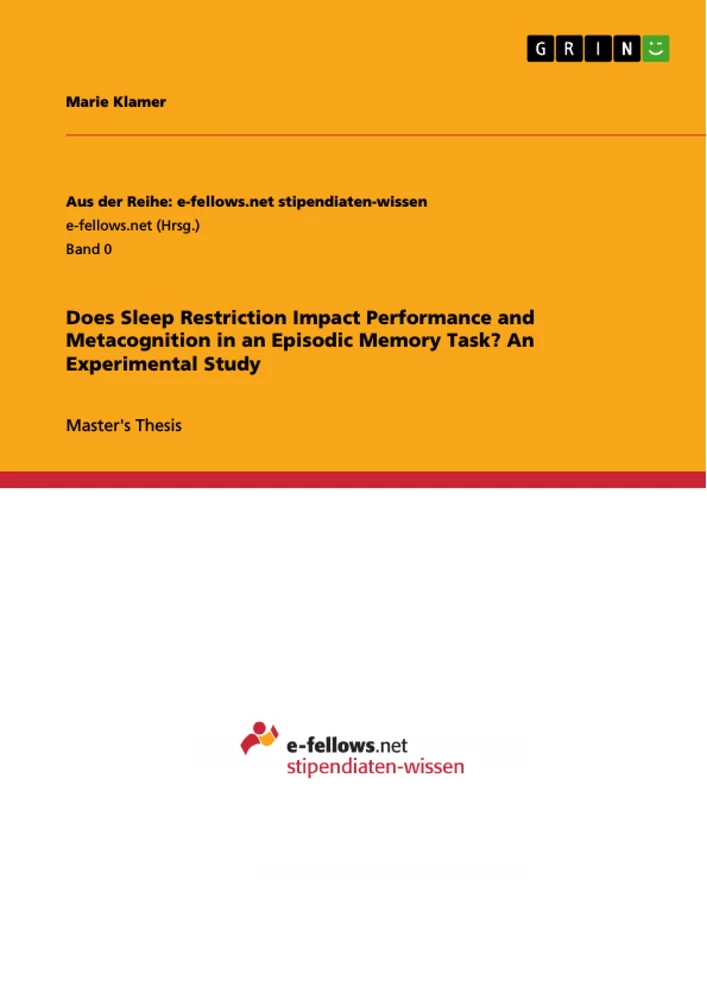
Table of Contents
Abstract
1. Sleep and the effects of sleep deprivation
2. Sleep and memory
3. Metacognition
4. Metacognition and sleep
5. The present research
6. Method
6.1 Participants
6.2 Materials and Procedure
6.2.1 General study procedure
6.2.2 Task materials and procedure
6.3 Analyses
6.4 Ethics
7. Results
7.1 Accuracy performance
7.2 Confidence bias
7.3 Metacognitive sensitivity
8. Discussion
8.1 Implications for practice and theory
8.2 Limitations and future directions
9. Conclusion
10. References
Research Objectives and Themes
This study investigates the impact of sleep restriction on episodic memory performance and two specific aspects of metacognition—confidence bias and metacognitive sensitivity—in healthy adults, aiming to clarify the relationship between sleep loss and cognitive monitoring abilities.
- The influence of restricted sleep on mnemonic performance.
- Evaluation of metacognitive confidence levels following sleep deprivation.
- Assessment of metacognitive sensitivity using signal detection theory.
- Examination of interindividual differences and potential susceptibility to sleep loss.
- Practical implications for fields where fatigue-induced decision errors carry high risks.
Excerpt from the Research
Metacognition
Dunlosky and Metcalfe (2008) define metacognition as the ability to monitor, reflect and comment on one’s cognitive processes. For example, a person may monitor and evaluate their memory performance within a memory task. Metacognition is involved in many abilities such as reasoning, planning, decision-making, social learning, and social interactions. Metacognitive performance experiences are most commonly assessed with judgments of confidence, meaning a subjective feeling of being correct about something (Pouget et al., 2016). Confidence judgments are relevant to consider because inaccurate confidence judgments can lead to unfavorable decisions with harmful consequences for individuals or society, such as in the healthcare and finance field (Broihanne et al., 2014; Croskerry & Norman, 2008).
Summary of Chapters
Sleep and the effects of sleep deprivation: Summarizes evolutionary theories of sleep and the documented cognitive impairments caused by both total sleep deprivation and sleep restriction.
Sleep and memory: Explores the distinction between procedural and declarative memory and describes the essential role sleep plays in memory consolidation.
Metacognition: Defines metacognition as a self-monitoring mechanism and discusses its measurement, critical role in decision-making, and association with psychiatric conditions.
Metacognition and sleep: Reviews existing literature regarding the currently limited evidence on how sleep loss affects the ability to accurately monitor personal performance.
The present research: Introduces the study's scope, including its randomized within-subjects design, and outlines the three specific hypotheses regarding sleep's effect on memory and metacognitive metrics.
Method: Details the sample of 148 participants, the crossover design of the experiment, and the analytical approaches using mixed models to test the hypotheses.
Results: Reports significant findings, showing that sleep restriction impairs accuracy and metacognitive sensitivity while unexpectedly increasing task confidence.
Discussion: Interprets the findings within the context of existing theory, acknowledges differences from earlier studies, and addresses potential implications for safety-critical professions.
Conclusion: Summarizes the key takeaway that sleep restriction creates a discrepancy between lower actual performance and higher confidence, necessitating caution in safety-sensitive decision-making.
Key Terms
Sleep restriction, Metacognition, Episodic memory, Cognitive performance, Confidence bias, Metacognitive sensitivity, Signal detection theory, Within-subjects design, Sleep deprivation, Memory consolidation, Decision-making, Clinical psychology, Neurocognition, Randomized controlled trial, Healthy adults
Frequently Asked Questions
What is the primary motivation for this study?
The study aims to address a gap in existing literature regarding how sleep restriction affects metacognitive processes—the ability to accurately monitor one's own memory performance—which is critical for preventing decision errors.
Which cognitive domain is specifically tested?
The research focuses on episodic memory, specifically the encoding and retrieval of grayscale indoor and outdoor scene images.
What is the core research goal?
To determine if restricting sleep to 4 hours per night for two nights negatively impacts accuracy, confidence levels, and metacognitive sensitivity compared to 9 hours of sleep.
What methodology was employed?
The researchers used an experimental, randomized within-subjects crossover design with a sample size of 148 healthy adults, followed by mixed model statistical analyses.
What is the significance of "metacognitive sensitivity"?
It represents an individual's ability to discriminate between their correct and incorrect performance, essentially how "tuned in" they are to their actual accuracy.
What keywords categorize this work?
Keywords include sleep restriction, episodic memory, metacognition, confidence bias, and signal detection theory.
How does the finding on participant confidence contradict common expectations?
Contrary to the hypothesis that confidence would decrease with performance, the study found that participants were actually more confident in their accuracy after being sleep-restricted.
Why are these results alarming for occupational fields?
The combination of decreased actual performance and increased overconfidence suggests that individuals may not be aware of their cognitive deficits, potentially leading to critical errors in safety-sensitive professions like medicine or transport.
What controlled variables were used?
To ensure robust results, the study controlled for age, gender, and reward factors, while excluding participants with sleep disorders, high caffeine consumption, or specific medication use.
Ende der Leseprobe aus 24 Seiten
- nach oben
- Arbeit zitieren
- Marie Klamer (Autor:in), 2022, Does Sleep Restriction Impact Performance and Metacognition in an Episodic Memory Task? An Experimental Study, München, Page::Imprint:: GRINVerlagOHG, https://www.diplomarbeiten24.de/document/1263725

neugierig - aktuell - relevant
Entdecken Sie hilfreiche Tipps und Tricks rund ums Studium!

Entdecken Sie hilfreiche Tipps und Tricks rund ums Studium!
Ihre Hausarbeit / Abschlussarbeit:

- - Publikation als E-Book und Buch
- - Hohes Honorar auf die Verkäufe
- - Für Sie komplett kostenlos - mit ISBN
- - Es dauert nur 5 Minuten
- - Jede Arbeit findet Leser

- © GRIN Publishing GmbH.
- Alle Inhalte urheberrechtlich geschützt. Kopieren und verbreiten untersagt.
- info@grin.com
- AGB
- Open Publishing
Der GRIN Verlag hat sich seit 1998 auf die Veröffentlichung akademischer eBooks und Bücher spezialisiert. Der GRIN Verlag steht damit als erstes Unternehmen für User Generated Quality Content. Die Verlagsseiten GRIN.com, Hausarbeiten.de und Diplomarbeiten24 bieten für Hochschullehrer, Absolventen und Studenten die ideale Plattform, wissenschaftliche Texte wie Hausarbeiten, Referate, Bachelorarbeiten, Masterarbeiten, Diplomarbeiten, Dissertationen und wissenschaftliche Aufsätze einem breiten Publikum zu präsentieren.
Kostenfreie Veröffentlichung: Hausarbeit, Bachelorarbeit, Diplomarbeit, Dissertation, Masterarbeit, Interpretation oder Referat jetzt veröffentlichen!
Folgen Sie GRIN auf


- GRIN Verlag GmbH
-
- Nymphenburger Str. 86
- 80636
- Munich, Deutschland
- +49 89-550559-0
- +49 89-550559-10
- info@grin.com
-
