
präsentiert von

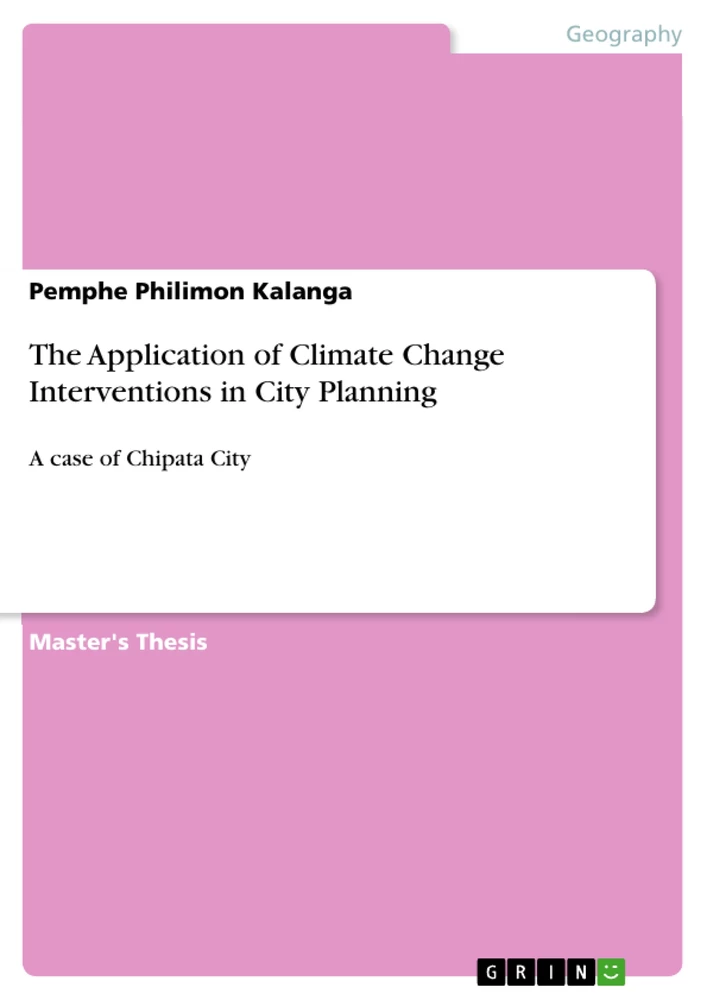
Table of Contents
CHAPTER ONE
INTRODUCTION
1.1 BACKGROUND OF THE STUDY
1.2 STATEMENT OF THE PROBLEM
1.3 AIM OF THE STUDY
1.4 SIGNIFICANCE OF THE STUDY
1.6 CONCEPTUAL FRAMEWORK
1.7 THEORETICAL FRAMEWORK
1.8 CHAPTER SUMMARY
CHAPTER TWO
LITERATURE REVIEW
2.1 INTRODUCTION
2.2 CLIMATE CHANGE CAUSES AND EFFECTS
2.3 CLIMATE CHANGE AND CITY PLANNING
2.4 CLIMATE CHANGE ADAPTATION AND CITY PLANNING
2.5 CLIMATE CHANGE MITIGATION AND CITY PLANNING
2.6 CLIMATE CHALLENGES FACED BY CITY RESIDENTS IN RELATION TO CITY PLANNING
2.8 CHAPTER SUMMARY
CHAPTER THREE
MATERIALS AND METHODS
3.1 INTRODUCTION
3.2 STUDY AREA LOCATION AND DESCRIPTION
3. 3 RESEARCH DESIGN
3.4. STUDY POPULATION
3.5 SAMPLING PROCEDURE
3.6 SAMPLE SIZE
3.7 DATA COLLECTION
3.8 DATA COLLECTION INSTRUMENTS
3.9 DATA PROCESSING AND ANALYSIS
3.10 ETHICAL CONSIDERATION
3.11 CHAPTER SUMMARY
CHAPTER FOUR
PRESENTATION OF RESULTS
4.1 INTRODUCTION
4.2 PRESENTATION OF RESULTS
4.3 CHAPTER SUMMARY
CHAPTER FIVE
DISCUSSION OF FINDINGS
5.1 INTRODUCTION
5.2 CLIMATE CHANGE ADAPTATION INTERVENTIONS USED BY CITY PLANNERS IN THE CITY OF CHIPATA
5.3 THE INCLUSION OF POLICIES AND LEGISLATIONS RELATED TO ADAPTATION INTERVENTIONS IN CITY PLANNING
5.4 CHALLENGES FACED BY CITY RESIDENTS IN RELATION TO CLIMATE CHANGE EFFECTS IN CITY PLANNING
5.5 CHAPTER SUMMARY
CHAPTER SIX
CONCLUSION AND RECOMMENDATIONS
6.1 INTRODUCTION
6.2 CLIMATE CHANGE ADAPTATION INTERVENTIONS USED BY CITY PLANNERS IN THE CITY OF CHIPATA
6.3 THE INCLUSION OF POLICIES AND LEGISLATIONS RELATED TO ADAPTATION INTERVENTIONS IN CITY PLANNING
6.4 CHALLENGES FACED BY CITY RESIDENTS IN RELATION TO CLIMATE CHANGE EFFECTS IN CITY PLANNING
6.5 CONCLUSION
6.5 RECOMMENDATIONS
6.6 AREAS OF FURTHER RESEARCH
Research Objectives & Core Topics
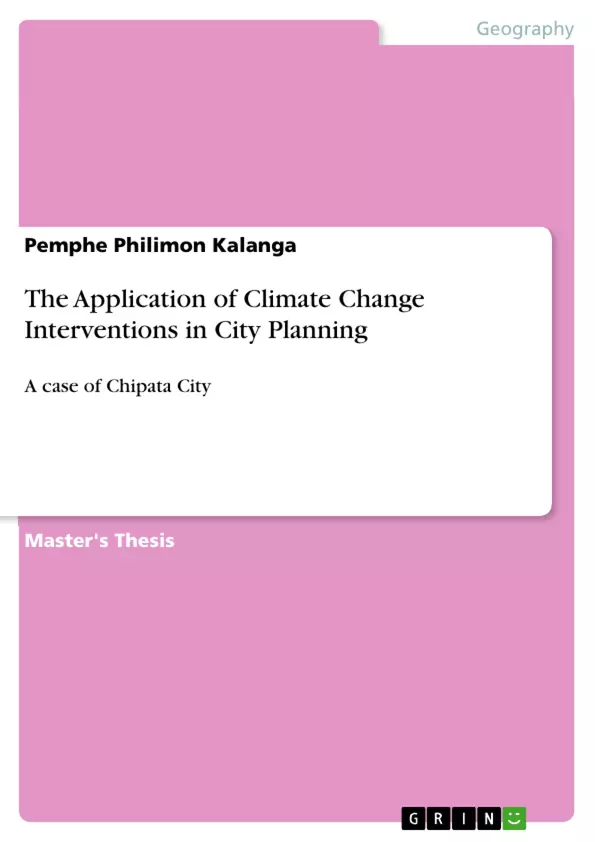
This study aims to assess the application of climate change adaptation interventions within the urban planning processes of Chipata City, Zambia, ultimately seeking to understand how city development can be better aligned with climate resilience to protect lives and infrastructure.
- Analysis of current climate change adaptation interventions utilized by city planners.
- Evaluation of existing policies and legislative frameworks governing climate adaptation in urban planning.
- Identification of significant challenges faced by city residents due to climate change impacts.
- Exploration of the institutional capacity and resource barriers to building climate-resilient cities.
- Investigation into the influence of physical geography and infrastructure standards on climate vulnerability.
Excerpt from the Book
1.1 Background of the study
Climate change is one of the major global challenges we face today. Gallup polls findings registered that a majority embraces the fact that corruption is the problem number one the world faces, and that is just ahead of climate change, poverty, or terrorism (Lesley, 2015). Perhaps things might not be the same as of current. Climate change might have taken the lead as problem number one the world is facing side-by-side with the COVID-19. Developing climate adaptation and mitigation measures is one such inevitable mechanism that everyone must embrace and take an active role in order to stand the changing times of our environment and our actions against climate change are really needed now more than ever to stop its negative impacts (Adriane, 2011). The Inter-Governmental Panel on Climate Change (IPCC, 2013) argues that the earth is expected to encounter a large proportion of natural disasters and exaggerated temperatures resulting from climate change. To be more specific, the following are the risks expected: flooding and strong winds will increase; coastal erosion; water shortages due to episodes of drought and reduced soil moisture; exacerbation of heat in urban areas coming from increased temperatures, worsening in air quality, and death tolls that are heat related and other unexpected issues that are fundamentally connected with climate change (Sova et al., 2014).
Summary of Chapters
CHAPTER ONE: INTRODUCTION: This chapter introduces climate change as a global crisis, framing Chipata City's development challenges within the context of necessary urban planning adaptations and the study's research objectives.
CHAPTER TWO: LITERATURE REVIEW: This chapter surveys scholarly perspectives on climate change causes, the intersection of city planning and climate resilience, and specific challenges residents face, establishing the theoretical grounding for the study.
CHAPTER THREE: MATERIALS AND METHODS: This chapter outlines the research design, detailing a mixed-method approach—combining quantitative surveys and qualitative discussions—used to gather data from planners, engineers, and residents in Chipata.
CHAPTER FOUR: PRESENTATION OF RESULTS: This chapter presents the data gathered from the field, illustrating the current state of climate policy integration and resident experiences with climate hazards in Chipata City through charts and statistics.
CHAPTER FIVE: DISCUSSION OF FINDINGS: This chapter analyzes the research results, discussing the institutional barriers to climate-informed urban planning and the disconnect between policy and practical on-the-ground interventions.
CHAPTER SIX: CONCLUSION AND RECOMMENDATIONS: This chapter synthesizes the research findings to provide actionable recommendations for policymakers and city authorities to improve climate resilience in Chipata City.
Keywords
Climate Change, city planning, Urban Development, Climate hazards, Climate risks, adaptation, mitigation, Application, resiliency, infrastructure, policy, Chipata, Zambia, urban resilience, drainage
Frequently Asked Questions
What is the primary goal of this research?
The primary aim is to assess how climate change adaptation interventions are being implemented in the city planning of Chipata, Zambia, to build a more resilient urban environment.
What are the core thematic areas of this study?
The study centers on three key areas: current adaptation strategies used by planners, the integration of climate policy in local legislation, and the vulnerability and challenges faced by residents due to climate hazards.
What methodology was employed to conduct this study?
The researcher utilized a mixed-method approach involving both quantitative surveys and qualitative Focus Group Discussions (FGDs) with technical stakeholders (planners and engineers) and city residents.
Which scientific methods were used for data analysis?
Quantitative data was analyzed using SPSS version 16, while qualitative data was examined through thematic content analysis.
What does the main body of the work address?
The main sections cover the literature on climate change in urban settings, the specific climate-related risks in Chipata (such as flooding and heat waves), and a critical look at how little has been done to incorporate climate resilience into local council policies.
What keywords best define the focus of this work?
The core keywords include Climate Change, City Planning, Urban Development, Climate Hazards, Climate Risks, Adaptation, and Mitigation.
How does the topographical nature of Chipata contribute to its climate risk?
Chipata is located between hills, which makes the city highly vulnerable to surface water runoff during heavy rainfall, often overwhelming drainage systems and damaging informal settlements built in flood-prone areas.
What are the identified barriers for City Planners in Chipata?
The findings indicate that significant barriers include a lack of institutional funding, limited access to scientific climate information, and a lack of specific policy guidelines to mandate climate-resilient urban development.
Why are informal settlements identified as particularly vulnerable?
Informal settlements in Chipata are often built on dangerous or ecologically fragile sites without official building permissions or proper infrastructure like storm drains, leaving residents highly exposed to floods and strong winds.
What is the role of the Joint Integrated Development Plan (JIDP)?
The JIDP is one of the few documents mentioned that addresses climate change development for the region, although the study notes that it currently lacks the necessary detail or specific, actionable climate planning integration to solve current problems.
Ende der Leseprobe aus 83 Seiten
- nach oben
- Arbeit zitieren
- Pemphe Philimon Kalanga (Autor:in), 2021, The Application of Climate Change Interventions in City Planning, München, Page::Imprint:: GRINVerlagOHG, https://www.diplomarbeiten24.de/document/1265474

neugierig - aktuell - relevant
Entdecken Sie hilfreiche Tipps und Tricks rund ums Studium!

Entdecken Sie hilfreiche Tipps und Tricks rund ums Studium!
Ihre Hausarbeit / Abschlussarbeit:

- - Publikation als E-Book und Buch
- - Hohes Honorar auf die Verkäufe
- - Für Sie komplett kostenlos - mit ISBN
- - Es dauert nur 5 Minuten
- - Jede Arbeit findet Leser

- © GRIN Publishing GmbH.
- Alle Inhalte urheberrechtlich geschützt. Kopieren und verbreiten untersagt.
- info@grin.com
- AGB
- Open Publishing
Der GRIN Verlag hat sich seit 1998 auf die Veröffentlichung akademischer eBooks und Bücher spezialisiert. Der GRIN Verlag steht damit als erstes Unternehmen für User Generated Quality Content. Die Verlagsseiten GRIN.com, Hausarbeiten.de und Diplomarbeiten24 bieten für Hochschullehrer, Absolventen und Studenten die ideale Plattform, wissenschaftliche Texte wie Hausarbeiten, Referate, Bachelorarbeiten, Masterarbeiten, Diplomarbeiten, Dissertationen und wissenschaftliche Aufsätze einem breiten Publikum zu präsentieren.
Kostenfreie Veröffentlichung: Hausarbeit, Bachelorarbeit, Diplomarbeit, Dissertation, Masterarbeit, Interpretation oder Referat jetzt veröffentlichen!
Folgen Sie GRIN auf


- GRIN Verlag GmbH
-
- Nymphenburger Str. 86
- 80636
- Munich, Deutschland
- +49 89-550559-0
- +49 89-550559-10
- info@grin.com
-
