
präsentiert von

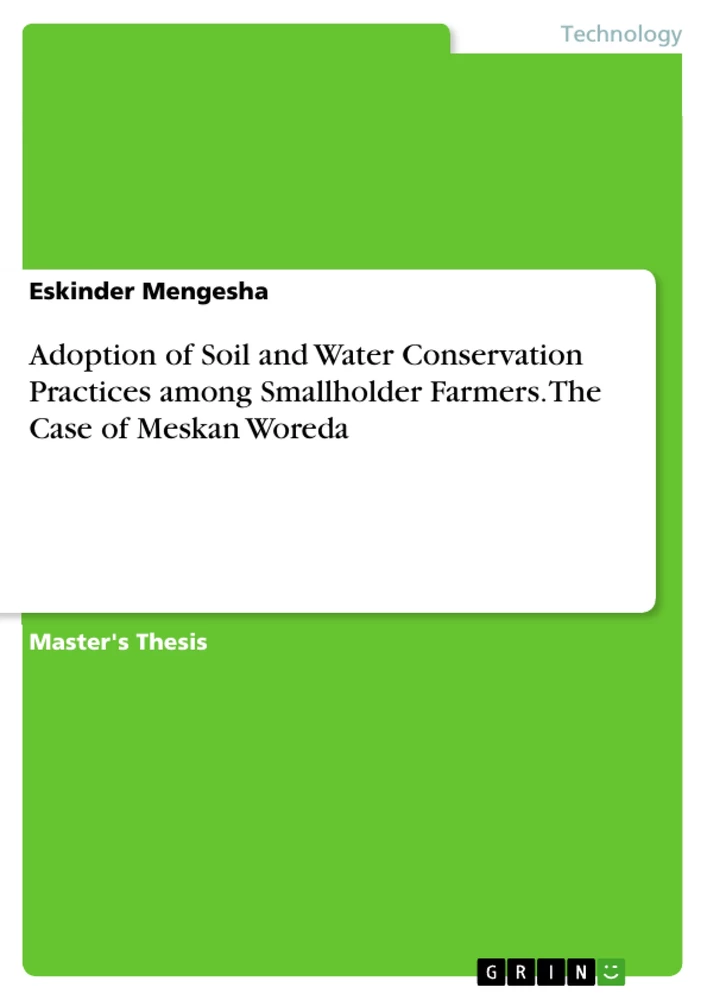
Table of Contents
1. INTRODUCTION
1.1 Background
1.2 Statement of the Problem
1.3 Objective of the Study
1.4 Research Questions
1.5 Scope and Limitation of the study
1.6 Significance of the Study
1.7 Organization of the Thesis
2. REVIEW OF LITERATURE
2.1 Definition of Concepts
2.2 Theoretical Background of Soil Conservation
2.3 Soil Conservation Practices in Ethiopia
2.4 Soil Conservation Policies in Ethiopia
2.5 Empirical Study
2.6 Conceptual Framework
3. METHODOLOGY
3.1 Description of the Study Area
3.1.1 Location
3.1.2 Geographic clasification
3.1.3 Climate
3.2 Types of Data and Method of Data Collection
3.2.1 Primary data
3.2.2 Secondary data
3.3 Sampling Techniques
3.3.1 Sample size
3.3.2 Sampling procedures
3.4 Methods of Data Analysis
3.4.1 Descriptive statistics
3.4.2 Econometric model
3.5 Definition of Variables and Hypothesis
4. RESULTS AND DISCUSSION
4.1 Level of Adoption of Improved Soil and Water conservation Practices
4.2 Background Information of the Respondents
4.2.1 Sex of the household head (SEXHHS):
4.2.2 Educational status of the household head (EDUCHH)
4.2.3 Age of the household head (AGEHHS):
4.2.4 Family size (FAMSIZE):
4.2.5 Labour availability (ACTLAB)
4.3 Farming system and farm characteristics
4.3.1 Livestock ownership (TLU):
4.3.2 Farm income of the house hold (FARMINC)
4.3.3 Land size (LANDSIZE)
4.3.4 Slope of the land holding (SLOPLND):
4.3.5 Non-farm activity (NONFACT):
4.4 Perception of Farmers
4.4.1 Perception on the effect of Soil Erosion (PERERO)
4.4.2 Perception on the ownership of Land (PEROWN)
4.5 Social Variable
4.5.1 Social position (SOCPOS)
4.6 Institutional variables
4.6.1 Training (PARTRING):
4.6.2 Access to credit (ACCCRED):
4.6.3 Distance of Extension Offices (FTCs) from household residence (FTCDIST)
4.6.4 Frequency of Extension agents contact (FREQEXT)
4.7 Use of Soil Conservation Measures
4.7.1 Use of Indigenous Soil Conservation Structures
4.7.2 Improved Soil Conservation Practices
4.8 Summary of the Results of Descriptive Analysis
4.9 Econometric Analysis of Determinants of Adoption of SWC Practices
5. SUMMARY, CONCLUSIONS AND RECOMMENDATIONS
5.1 Summary and Conclusions
5.2 Recommendations
6. REFERENCES
7. APPENDICES
7.1 Appendix A Appendix Tables
7.2 Appendix B Questions for focus group discussion
7.3 Appendix C Interview schedule
Research Objectives and Topics
This study aims to examine the extent of soil and water conservation (SWC) practices adoption among smallholder farmers in Meskan Woreda, Ethiopia, and to identify the primary socioeconomic, institutional, and demographic factors that influence farmers' decision to engage in these conservation activities.
- Assessment of current SWC practice levels among local smallholder farmers.
- Identification of key determinants driving participation in conservation activities.
- Cataloging frequently used indigenous and improved soil conservation techniques.
- Analysis of the relationship between household socioeconomic characteristics and technology adoption.
- Development of policy recommendations to enhance long-term adoption rates.
Excerpt from the Book
1.1 Background
Soil is the most fundamental and basic resource since humans cannot survive without it because it is the basis of all terrestrial life. Soil is a vital resource that provides food, feed, fuel, and fiber. It underpins food security and environmental quality, both essential to human existence. Essentiality of soil to human well-being is often not realized until the production of food drops or is jeopardized when the soil is severely eroded or degraded to the level that it loses its inherent texture and resilience. Soil is a non-renewable resource over the human time scale. It is dynamic and prone to rapid degradation with land misuse. Water and wind erosion are two main agents that degrade soils. Control and management of soil erosion are important because when the fertile topsoil is eroded away the remaining soil is less fertile and it becomes less productive consequently. Accelerated erosion is as old as agriculture.
The productivity of agricultural economy, which is the back bone of the country economy, is being seriously eroded by unsustainable land management practices both in areas of food crops and in grazing lands (Derejaw et.al, 2013). Agriculture is the mainstay of Ethiopia’s economy and it accounts for over 46% of GDP, provide 85 % to total employment, 90% to the foreign exchange earnings and provide 70% of raw materials requirement of countries industry (ATA, 2014). Owing to this fact, economic development of the country is extremely dependent on the performance of agricultural sector. Although other factors like shortage of rainfall and poor land management are the principal contributing factor to the low and declining agricultural productivity in Ethiopia, which is explained by the loss of soil fertility (FAO, 2000; Bayramin et.al, 2002). The resultant effect of land degradation can be detected by the decline of crop yields, decline of water and forest resources and by gully formation across the grazing and ploughing fields.
Summary of Chapters
1. INTRODUCTION: Provides an overview of global soil importance, highlights the critical state of agricultural productivity in Ethiopia due to land degradation, and defines the specific research objectives for Meskan Woreda.
2. REVIEW OF LITERATURE: Examines conceptual definitions, theoretical backgrounds of land conservation, existing policy frameworks in Ethiopia, and synthesizes previous empirical studies on adoption factors.
3. METHODOLOGY: Details the research design, including the study area description, multi-stage sampling techniques used to select 150 households, and the data analysis methods (descriptive statistics and binary logit model).
4. RESULTS AND DISCUSSION: Presents comprehensive descriptive statistics and econometric model results regarding the adoption level and significant factors influencing farmers' decisions.
5. SUMMARY, CONCLUSIONS AND RECOMMENDATIONS: Synthesizes the core research findings and provides policy-oriented recommendations to improve the adoption of soil conservation strategies.
Keywords
Soil and water conservation, Adoption, Binary Logit, Meskan, Ethiopia, land degradation, sustainable land management, extension services, smallholder farmers, farm productivity, socioeconomic factors, institutional determinants.
Frequently Asked Questions
What is the core focus of this research?
The research is primarily concerned with assessing the degree to which smallholder farmers in Meskan Woreda have adopted soil and water conservation (SWC) practices and determining the variables that influence these decisions.
Which thematic fields are central to the study?
The study revolves around agricultural economics, rural development, land management, and environmental conservation, specifically analyzing socioeconomic and institutional barriers to technology adoption.
What is the primary objective of the thesis?
The primary goal is to identify specific determinants—such as education, farm income, and extension support—that affect whether or not a farmer chooses to implement improved soil conservation structures.
Which scientific methodology does the author apply?
The author uses a multi-stage sampling technique for primary data collection and employs a binary logit regression model to analyze the influencing factors on binary adoption decisions (adopters vs. non-adopters).
What topics are analyzed in the main body (Chapter 4)?
The main body breaks down the respondents' demographic profiles, socioeconomic status, and farming characteristics, juxtaposing them with their adoption status and analyzing the specific impact of various independent variables.
What features define this thesis?
The work is characterized by its empirical focus on a specific geographic area (Meskan Woreda), the use of descriptive statistics to contrast adopters and non-adopters, and the application of a logistic regression model to quantify influence variables.
How does farm income impact the adoption of conservation technology?
The study found a positive correlation, suggesting that higher income allows households to better afford the costs associated with implementing specialized conservation technologies and soil improvements.
What role do extension agents play in adoption?
The frequency of contact with extension agents was a statistically significant positive factor, as it facilitates the transfer of necessary information and technical knowledge to farmers, effectively reducing uncertainty regarding new technologies.
How does land tenure perception affect conservation efforts?
Farmers who perceive that their land ownership is secure for their lifetime are significantly more likely to invest in long-term conservation structures, as they are assured of the future benefits of those investments.
Ende der Leseprobe aus 75 Seiten
- nach oben
- Arbeit zitieren
- Eskinder Mengesha (Autor:in), 2018, Adoption of Soil and Water Conservation Practices among Smallholder Farmers. The Case of Meskan Woreda, München, Page::Imprint:: GRINVerlagOHG, https://www.diplomarbeiten24.de/document/1266518

neugierig - aktuell - relevant
Entdecken Sie hilfreiche Tipps und Tricks rund ums Studium!

Entdecken Sie hilfreiche Tipps und Tricks rund ums Studium!
Ihre Hausarbeit / Abschlussarbeit:

- - Publikation als E-Book und Buch
- - Hohes Honorar auf die Verkäufe
- - Für Sie komplett kostenlos - mit ISBN
- - Es dauert nur 5 Minuten
- - Jede Arbeit findet Leser

- © GRIN Publishing GmbH.
- Alle Inhalte urheberrechtlich geschützt. Kopieren und verbreiten untersagt.
- info@grin.com
- AGB
- Open Publishing
Der GRIN Verlag hat sich seit 1998 auf die Veröffentlichung akademischer eBooks und Bücher spezialisiert. Der GRIN Verlag steht damit als erstes Unternehmen für User Generated Quality Content. Die Verlagsseiten GRIN.com, Hausarbeiten.de und Diplomarbeiten24 bieten für Hochschullehrer, Absolventen und Studenten die ideale Plattform, wissenschaftliche Texte wie Hausarbeiten, Referate, Bachelorarbeiten, Masterarbeiten, Diplomarbeiten, Dissertationen und wissenschaftliche Aufsätze einem breiten Publikum zu präsentieren.
Kostenfreie Veröffentlichung: Hausarbeit, Bachelorarbeit, Diplomarbeit, Dissertation, Masterarbeit, Interpretation oder Referat jetzt veröffentlichen!
Folgen Sie GRIN auf


- GRIN Verlag GmbH
-
- Nymphenburger Str. 86
- 80636
- Munich, Deutschland
- +49 89-550559-0
- +49 89-550559-10
- info@grin.com
-
