
präsentiert von

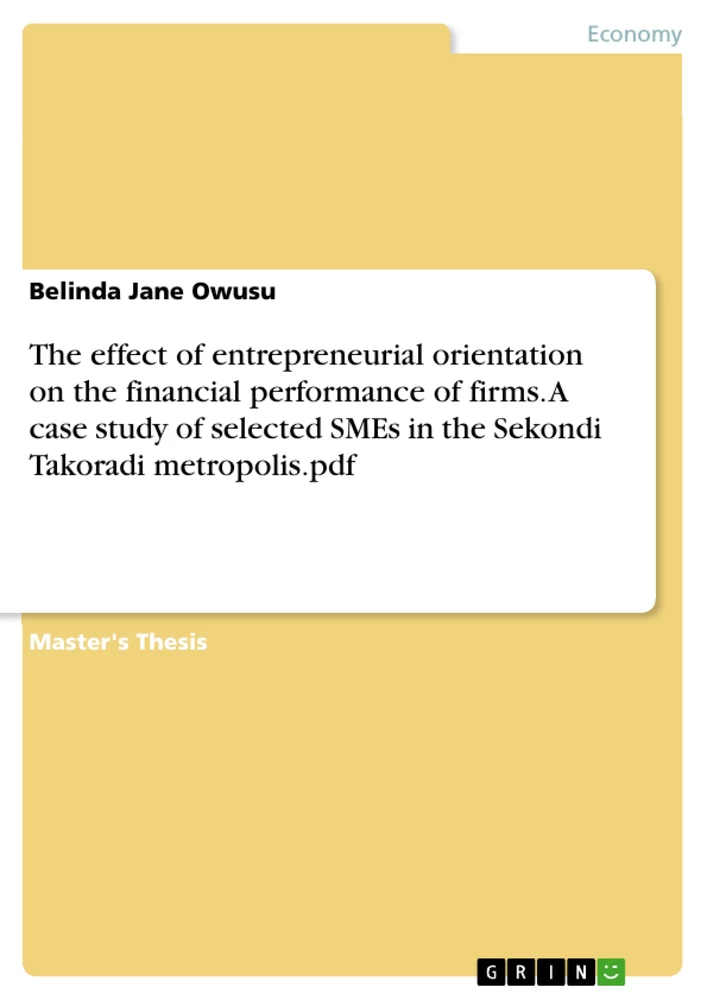
Table of Contents
1. INTRODUCTION
1.1 Background to the Study
1.2 Problem Statement
1.3 Objectives of the Study
1.3.1 General objective
1.3.2 Specific objectives
1.4 Research Question
1.5 Justification of the Study
1.6 Scope of the Study
1.7 Summary of Methodology
1.8 Limitations of the Study
1.9 Organization of the Thesis
2. LITERATURE REVIEW
2.0 Introduction
2.1 Conceptual Review
2.1.1 Entrepreneurial Orientation
2.1.2 Dimensions of Entrepreneurial Orientation
2.1.2.1 Innovativeness
2.1.2.2 Pro-activeness
2.1.2.3 Proclivity for Taking Risks
2.1.2.4 Autonomy
2.1.2.5 Competitive Aggressiveness
2.1.3 Small and Medium Size Enterprise
2.1.4 Challenges Confronting SMEs
2.1.5 Financial Performance of SMEs
2.1.6 Factors Influencing the Performance of SMEs
2.1.6.1 Internal Environmental Factors
2.1.6.2 Managerial Competency and Skills
2.1.6.3 Access to Finance
2.1.6.4 Technological Capabilities
2.1.7 External Environment Factors
2.1.7.1 Competition
2.1.7.2 Globalization
2.1.7.3 Regulatory Factors
2.1.8 Factors Affecting Macroeconomics
2.1.9 The Impact of Entrepreneurial Orientation on Small Business Financial Performance
2.2 Theoretical Review
2.2.1 Schumpeter’s Innovation Theory
2.2.2 Trait Model of Entrepreneurial Orientation
2.2.3 The Resource-Based View Theory.
2.3 Empirical Review
2.4 Conceptual Framework
3. METHODOLOGY
3.0 Introduction
3.1 Research Design
3.2 Target Population
3.3 Sampling Procedure and Sampling Size
3.4 Data Collection
3.4.1 Types and Sources of Data
3.4.3 Data Collection Instrument
3.4.1.1 Questionnaire
3.5 Data Analysis
3.9 Ethical Consideration
4. ANALYSIS, PRESENTATION, AND DISCUSSION OF DATA
4.0 Introduction
4.1 Respondents' Demographic Profile
4.2 Cronbach Alpha is a measure of data reliability
4.3 Entrepreneurial Orientation Practices Adopted by the SMEs in the Metropolis.
4.3.1 Pro-activeness
4.3.2 Proclivity for taking risks
4.3.3 Innovativeness
4.3.4 Competitive Aggressiveness
4.3.5 Autonomy
4.4 Factors Affecting Financial Performance of the SMEs in the Metropolis.
4.4.1 Access to Business Information Services
4.4.2 Finance Availability
4.4.3 Technological input in Payment
4.4.4 Managerial Expertise
4.5 The Effect of Entrepreneurial Orientation on Financial Performance of Firms.
4.5.1 Pro-activeness
4.5.2 Risk-taking Propensity
4.5.3 Innovativeness
4.5.4 Competitive Aggressiveness
4.6 Value of Beta
4.8 Discussion of Findings
4.8.1 Entrepreneurial Orientation Practices Adopted by the SMEs in the Metropolis.
4.8.2 Factors Affecting Financial Performance of the SMEs in the Metropolis.
4.8.3 The Financial Performance of Firms as a Function of Entrepreneurial Orientation
5. CONCLUSIONS AND RECOMMENDATIONS SUMMARY OF FINDINGS
5.1 Introduction
5.2 Findings in Brief
5.2.1 Entrepreneurial Orientation Practices Adopted by the SMEs in the Metropolis.
5.2.2 Factors Affecting Financial Performance of the SMEs in the Metropolis.
5.2.3 The Effect of Entrepreneurial Orientation on Financial Performance of Firms.
5.3 Conclusion
5.4 Recommendation
5.4.1 Entrepreneurial Orientation Practices Adopted by the SMEs in the Metropolis.
5.4.2 Factors Affecting Financial Performance of the SMEs in the Metropolis.
5.4.3 The Effect of Entrepreneurial Orientation on Financial Performance of Firms.
5.5 Recommendation for more research
Research Objectives and Focus Themes
The primary research objective of this study is to examine the influence of entrepreneurial orientation (EO)—specifically its dimensions of innovativeness, proactiveness, risk-taking propensity, autonomy, and competitive aggressiveness—on the financial performance of small and medium-sized enterprises (SMEs) within the Sekondi Takoradi metropolis in Ghana.
- Entrepreneurial Orientation (EO) dimensions and their operationalization in SMEs.
- Factors influencing business financial performance in developing economies.
- Statistical correlation between entrepreneurial behaviors and profit/market growth.
- Role of internal SME resources and managerial competencies in achieving financial success.
- Quantitative analysis of SME management practices and performance metrics.
Excerpt from the Book
2.1.2 Dimensions of Entrepreneurial Orientation
According to both popular and scholarly literature, governments support entrepreneurial activities since they are considered fundamental drivers of a country's economic well-being (Ghani et al., 2014; Beynon et al., 2016). Many benefits are claimed in the literature, and one of the most popular points of view is that an entrepreneur's propensity for risk-taking, proactiveness, and innovation are persuasive characteristics of entrepreneurial orientation (Covin and Lumpkin, 2011), while Wiklund and Shepherd (2003) assert that companies that adopt such an entrepreneurial orientation outperform companies that do not. Market orientation, as opposed to entrepreneurial orientation, is a basic principle for small companies (Ledwith and O'Dwyer, 2008) and has a substantial influence on the entrepreneurial orientation of a company (Nasution et al., 2011). Risk-taking inclination, proactiveness, and creativity are three elements of EO discovered by Miller (1983). Competitive energy was found as an extra component of EO by Augusto Felcio et al. (2012).
Summary of Chapters
CHAPTER ONE: Provides an introduction to the research, detailing the background of SMEs in Ghana, the problem statement regarding financial performance, and the specific objectives and research questions of the study.
CHAPTER TWO: Reviews the literature on entrepreneurial orientation and SMEs, covering conceptual theories, the dimensions of EO, and factors such as managerial competence and external environmental challenges that influence firm performance.
CHAPTER THREE: Outlines the research methodology, including the research design, target population of SMEs, sampling procedures, and the process of data collection and analysis.
CHAPTER FOUR: Displays the analysis and discussion of the survey data, including demographic profiles, reliability tests, and regression models testing the influence of EO dimensions on financial performance.
CHAPTER FIVE: Presents the conclusions drawn from the study and offers recommendations for SME managers and suggestions for future research in the field of entrepreneurial orientation.
Keywords
Entrepreneurial Orientation, SMEs, Financial Performance, Sekondi Takoradi, Innovativeness, Risk-taking Propensity, Proactiveness, Competitive Aggressiveness, Autonomy, Managerial Competency, Ghana, Economic Growth, Resource-Based View, Strategic Management, Business Sustainability.
Frequently Asked Questions
What is the primary focus of this thesis?
The thesis investigates how an organization's entrepreneurial orientation—characterized by proactive, risk-taking, and innovative behaviors—affects the financial performance and economic success of small and medium-sized enterprises (SMEs) in the Sekondi Takoradi area of Ghana.
What are the core pillars of the research?
The central pillars include the five dimensions of Entrepreneurial Orientation, factors influencing financial success in developing economies, and the use of quantitative survey data to establish direct links between management strategies and business performance metrics.
What is the ultimate research objective?
The study aims to determine which specific entrepreneurial practices yield the highest impact on SME financial performance, helping managers understand where to focus their operational resources.
Which scientific methodologies are implemented?
The researcher uses a descriptive and explanatory research design, gathering primary data through structured questionnaires and utilizing SPSS version 20 to perform regression and correlation analysis.
What topics are discussed specifically in the main body?
The main body focuses on the conceptual framework of EO, including innovativeness, risk-taking, and competitive aggressiveness, as well as testing these variables against financial metrics like turnover, profit growth, and return on investment.
How would one characterize the essential keywords?
Key terms include Entrepreneurial Orientation, Financial Performance, SMEs, Innovativeness, Proactiveness, Risk-taking, and Managerial Expertise.
What conclusion does the author reach regarding proactiveness?
Interestingly, the study finds the relationship between proactiveness and financial performance to be statistically insignificant in this specific context, suggesting that many local SMEs are not sufficiently proactive in their daily strategic decision-making.
Why is risk-taking propensity important in this research?
Risk-taking propensity emerged as a significant predictor of business success, proving that SME managers who are willing to invest in new, calculated ventures generally achieve better financial outcomes than those who avoid risk entirely.
Ende der Leseprobe aus 84 Seiten
- nach oben
- Arbeit zitieren
- Belinda Jane Owusu (Autor:in), 2017, The Effect of Entrepreneurial Orientation on Financial Performance of Firms, München, Page::Imprint:: GRINVerlagOHG, https://www.diplomarbeiten24.de/document/1270173


neugierig - aktuell - relevant
Entdecken Sie hilfreiche Tipps und Tricks rund ums Studium!

Entdecken Sie hilfreiche Tipps und Tricks rund ums Studium!
Ihre Hausarbeit / Abschlussarbeit:

- - Publikation als E-Book und Buch
- - Hohes Honorar auf die Verkäufe
- - Für Sie komplett kostenlos - mit ISBN
- - Es dauert nur 5 Minuten
- - Jede Arbeit findet Leser

- © GRIN Publishing GmbH.
- Alle Inhalte urheberrechtlich geschützt. Kopieren und verbreiten untersagt.
- info@grin.com
- AGB
- Open Publishing
Der GRIN Verlag hat sich seit 1998 auf die Veröffentlichung akademischer eBooks und Bücher spezialisiert. Der GRIN Verlag steht damit als erstes Unternehmen für User Generated Quality Content. Die Verlagsseiten GRIN.com, Hausarbeiten.de und Diplomarbeiten24 bieten für Hochschullehrer, Absolventen und Studenten die ideale Plattform, wissenschaftliche Texte wie Hausarbeiten, Referate, Bachelorarbeiten, Masterarbeiten, Diplomarbeiten, Dissertationen und wissenschaftliche Aufsätze einem breiten Publikum zu präsentieren.
Kostenfreie Veröffentlichung: Hausarbeit, Bachelorarbeit, Diplomarbeit, Dissertation, Masterarbeit, Interpretation oder Referat jetzt veröffentlichen!
Folgen Sie GRIN auf


- GRIN Verlag GmbH
-
- Nymphenburger Str. 86
- 80636
- Munich, Deutschland
- +49 89-550559-0
- +49 89-550559-10
- info@grin.com
-
